
Limerick Leader story here.
I have found nothing relevant in the British Newspaper Archive between 1 January 1900 and 31 December 1910, but I may have used the wrong search terms.
Limerick Leader story here.
I have found nothing relevant in the British Newspaper Archive between 1 January 1900 and 31 December 1910, but I may have used the wrong search terms.
In Foreign Parts.
h/t Tyler Cowen
Posted in Economic activities, Foreign parts, Modern matters, Sea, Shannon, The fishing trade, Waterways management
Tagged eels, fishing, Lough Mask, Lough Neagh, Maine, Shannon
Here is a piece about the Aaron Manby, the first iron steamer to make a sea voyage, and its links to Irish inland waterways transport.
The piece was first published in the rally magazine of the Inland Waterways Association of Ireland Lough Derg Branch in July 2017.
Posted in Charles Wye Williams, Economic activities, Engineering and construction, Extant waterways, Foreign parts, Historical matters, Industrial heritage, Ireland, Irish inland waterways vessels, Operations, Passenger traffic, People, Sea, Shannon, shannon estuary, Sources, Steamers, The cattle trade, Tourism, waterways, Waterways management
Tagged Aaron Manby, Charles Napier, Charles Wye Williams, Irish Sea, iron, John Grantham, John Oldham, Liverpool, Shannon, steam
Both the OSI and Logainm.ie show the spelling as Scarriff, but the version with one R seems to be common in the area and is used on the area’s website. I’m sticking to the longer version, so that I can at some future time work up a joke about Scaelbowiff.
Scarriff is a small town in County Clare, a little distance upriver from the end of Lough Derg’s western arm.
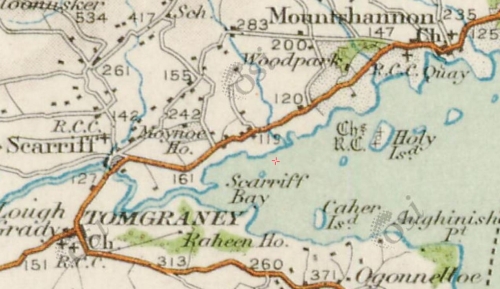
Lough Derg’s western arm (OSI ~1900)
In the 1840s the Shannon Commissioners made the river navigable to the town: before then Reddan’s Pier at Tuamgraney seems to have been the head of the river, at least for larger boats.
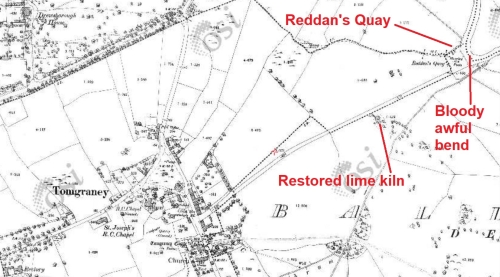
Reddan’s Quay at Tuamgraney (aka Tomgraney) (OSI ~1900)
Tuamgraney is a pleasant spot. A short distance up the road to the village is a restored limekiln.
However, Reddan’s Quay is on a bloody awful bend in the river. Large boats may have difficulty in making the turn without assistance, especially if they’re coming downstream with a flow. Anyone moored at Reddan’s Quay in such circumstances might need a new paint job afterwards.
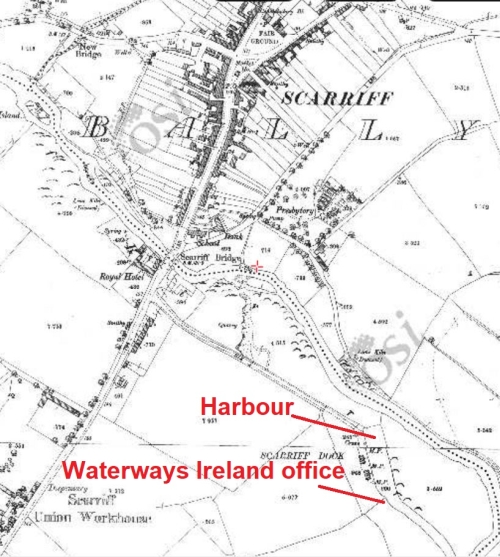
Scarriff Harbour (OSI ~1900)
Scarriff Harbour was expanded in recent times by the addition of concrete finger jetties, which provide more mooring spaces for modern cruisers. The jetties don’t touch the old quay: I gather that this was to preserve the ancient monument or something [perhaps, Gentle Reader, you can correct me on that]. The quay still sports a Shannon Commissioners crane (no longer working) . Two long berths were provided during the expansion: half of one long berth is occupied by a boat (one of three such) that was not occupied last weekend and the other is the pump-out berth.
At the inner end of the harbour are some floating pontoons suitable for open boats and for launching kayaks and canoes. However, despite the presence of a lock-up cage for the safe storage of kayaks and canoes, indicating that small-boat activity is welcome, low barriers (only 1.8m) at the entrance to the harbour require those arriving by car to unload the kayak or canoe outside the harbour and carry it in, then return to drive the car in and unload the vessel’s equipment and cargo.
There is no slipway.
The barriers might deter camper-vans, alas: another example of discrimination against RV-users.
The harbour has a toilet-and-shower block, a pump-out, two double-socket mains electricity pillars, lights and a supply of water, which latter is used by persons arriving by car with numbers of plastic containers.
However, the harbour has not a single bin of any kind. Thus, late-evening carousers are forced to jettison their empty bottles and cans and their cardboard containers around the harbour, smashing some on the concrete in the process. A civic-minded citizen might try to sweep up the broken glass but then has nowhere to put it. [Incidentally, the carousers had left by about midnight and there was none of the threatening atmosphere that is sometimes to be felt: apart from their regrettable habits in the matter of rubbish disposal, these seemed to be quite civilised carousers.]
But back to bins. A civic-minded dog-owner who cleans up after Fido must then carry the remains around. In hot weather, dog poo on a boat begins to smell after a while; any outbreaks of cholera can be attributed to what Waterways Ireland calls its “Leave no trace” policy, which might better be termed “Pay no local authority bin charges”. As a policy, “Leave no trace” is simply an encouragement to dog-owners not to clean up: it’s far, far less trouble to leave the stuff for someone else to walk in.
In 1997 Síle de Valera, a local TD, became Minister for Fairytales. Waterways Ireland was set up during her reign and cursed by being given several regional offices; the Western region (ie Shannon) office was built at the harbour in Scarriff, in Ms de Valera’s constituency, and some unfortunate staff were sentenced to transportation to East Clare.
However, with a high population of yoghurt-knitting yurt-dwellers, East Clare is quite an interesting place. The Friday smallholders’ market had lots of good breads and cakes, jams, preserves and mushroom salt, as well as a stock of African decorative items. The fruit and veg shop on the same side of the road had a good range, while across the way the Graney sells healthfoods, veg, good cheeses, chocolate and much other stuff. No doubt other shops in Scarriff are equally good in their own fields, but I didn’t get to visit them.
On a sunny weekend (and no doubt at other times too) Scarriff was an extremely pleasant place to be, yet there were very few boats there (apart from the three unoccupied boats). [In the next photo, taken early on Friday, the unoccupied boats are out of shot to the left.] One occupied boat left at lunchtime on Friday when we arrived; one more came later, so there were two occupied boats in the harbour that night.
Saturday was slightly busier: the boat that had arrived on Friday left, but two other private boats arrived and, between 2230 and 2245, two large Emerald Star hire boats arrived too, making five occupied boats in the harbour.
Some small boats, mostly of the zoomy variety, visited briefly on Saturday. I realise that drivers may find it exciting to travel fast on a narrow, winding river where they can’t see what’s coming, but paddlers of canoes and kayaks may find less amusement in dealing with the wash from the speedsters. They in turn might find it less amusing were they to collide with 45 tons of steel coming downriver. Perhaps purchasers of fast boats should be required to demonstrate the possession of IQs in at least double figures before being allowed to take the wheel.
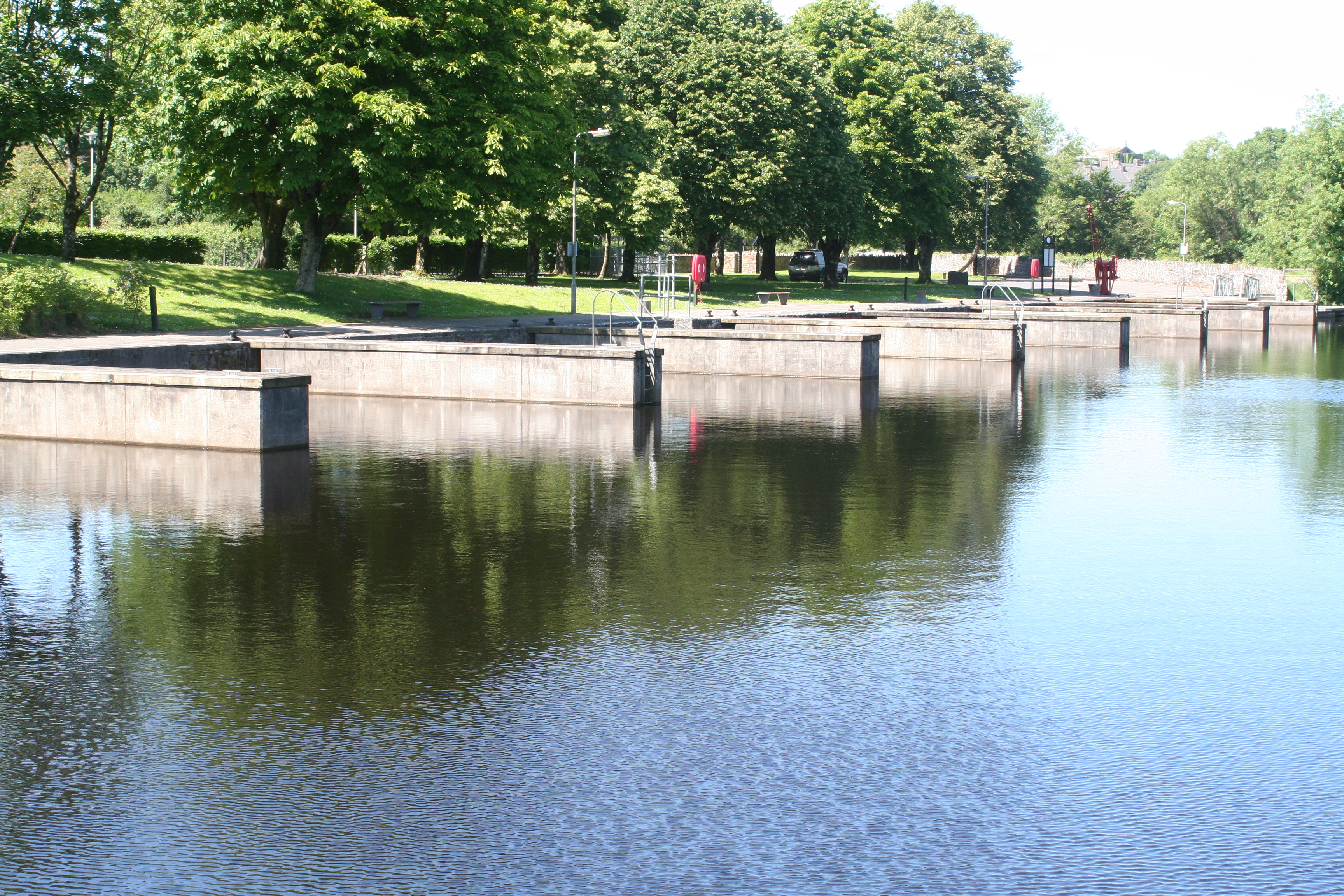
Scarriff June 2017
The small numbers of boats made it seem that a fine facility was being wasted (although it is dangerous to make generalisations on the basis of a single visit). It also seemed that local people made little use of the facility: I saw two anglers, a few dog- or baby-walkers and one or two others.
Here are some (cheap-to-implement, I hope) suggestions to bring more life to the harbour by encouraging both residents and visitors to use it.
On the same weekend, Dromineer seemed to be packed with boats and with non-boat people; Scarriff didn’t have many of either, and it seems a pity.
Posted in Ashore, Built heritage, Charles Wye Williams, Economic activities, Engineering and construction, Extant waterways, Historical matters, Industrial heritage, Ireland, Irish inland waterways vessels, Modern matters, Operations, Passenger traffic, People, Politics, Restoration and rebuilding, Safety, Scenery, Shannon, Steamers, The grain trade, Tourism, Water sports activities, waterways, Waterways management, Weather
Tagged Clare, Lough Derg, Reddan's Pier, Scariff, Scarriff, Shannon, Tomgraney, Tuamgraney, Waterways Ireland
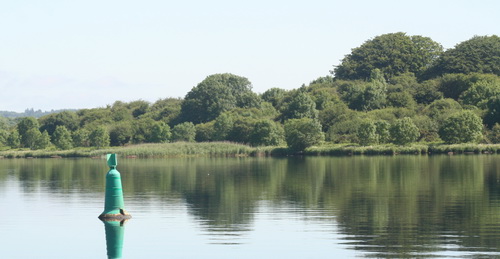
The Red Island green
Posted in Engineering and construction, Extant waterways, Ireland, Modern matters, Operations, Safety, Scenery, Shannon, waterways, Waterways management
Tagged buoy, green, Lough Derg, marker, Red Island, Scariff, Scarriff, Shannon
The Royal Canal’s origins have never been satisfactorily explained: a later legend even seeks to explain its origins in an obscure dispute between a retired shoemaker and other members of the Grand Canal Company. But in fact its origins were political. As the Grand Canal Company was taken over by the conservative La Touche clique, the opposition launched a new venture: its patron was the duke of Leinster; businessmen and opposition politicians rallied to it; and Gleadowes, rivals of the La Touches, were bankers to the company. In other words, there was to be a left-wing as well as a right-wing way to reach the Shannon. Almost symbolically on its more northerly route to the Shannon, it passed through the duke of Leinster’s land.
L M Cullen “Politics and Institutions, 1731–1835” in Economy, Trade and Irish Merchants at home and abroad, 1600–1988 Four Courts Press, Dublin 2012
Posted in Built heritage, Canals, Economic activities, Engineering and construction, Extant waterways, Historical matters, Industrial heritage, Ireland, People, Politics, Restoration and rebuilding, Shannon, Sources, waterways, Waterways management
Tagged Dublin, duke of leinster, Gleadowes, La Touche, Royal Canal, Shannon

 Irish waterways history