Tag Archives: steamer

Steam, the Shannon and the Great British Breakfast

That is the title of the Railway and Canal Historical Society‘s 2014 Clinker Memorial Lecture, to be held at the Birmingham and Midland Institute, Margaret Street, Birmingham B3 3BS, at 1415 on Saturday 18 October 2014.

The lecture will concentrate on the period before 1850 with such interesting topics as

  • Shannon steamers
  • the Grand and Royal Canals
  • the first Irish turf (peat) to reach the USA (possibly)
  • port developments in Dublin, Limerick and Kingstonw
  • the Dublin and Kingstown Ship Canal
  • the Midland Great Western Railway
  • what “cattle class” really means
  • bacon and eggs.

Admission is free and booking is not required. However, if you plan to attend, it would be helpful if you could e-mail […] to this effect.

The Clinker Memorial Lecture is named for Charles R Clinker, an eminent railway authoe and one-time historian of the Great Western Railway, who died in 1983.

If you would like the contact email address, leave a Comment below and I’ll get in touch with you direct.


Shannon history in Birmingham

According to the Railway & Canal Historical Society’s Events page, its annual Clinker Memorial Lecture, to be held in Birmingham in October 2014, will be about River Shannon steamers in the second quarter of the nineteenth century:

The 2014 Clinker Memorial Lecture will be held in Birmingham on the afternoon of Saturday 18th October 2014. The speaker will be Brian Goggin, BA (Mod), MA.

Brian graduated from Trinity College, Dublin in Economics and Politics, and spent some years as honorary Editor of the quarterly magazine of the Inland Waterways Association of Ireland. He and his wife Anne have been boating on Irish inland waterways since the late 1970s. He is currently working on a book on the Shannon steamers of the 1830s and 1840s, and the Clinker Lecture will draw on his research.

Before lunch (and independent of the Lecture) there will be a walking tour of central Birmingham, focusing on sites of waterway and railway interest.


Waterways [and other] archives

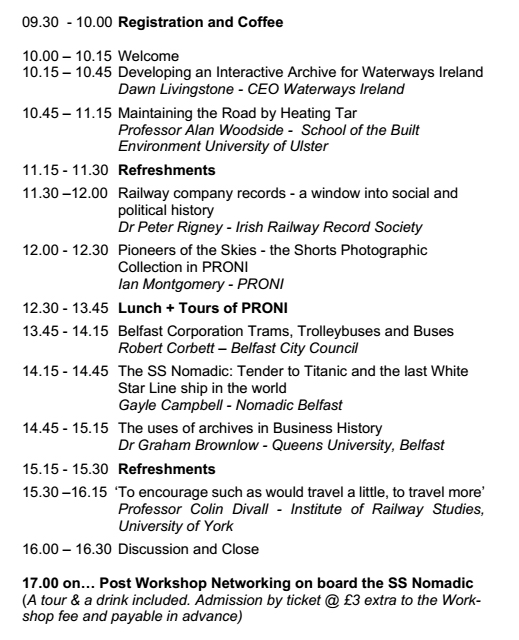
For anyone interested in transport history, there is an interesting-looking workshop scheduled for Belfast on 8 September 2014. It’s being held in the Public Record Office of Northern Ireland [PRONI] in the Titanic Quarter and there’s an optional extra tour and reception on the SS Nomadic afterwards.

The programme covers waterways, roads, railways and flight. For this site, the opening session is of great interest: Dawn Livingstone, CEO of Waterways Ireland, is to talk about an interactive archive for Waterways Ireland.

By air, sea and land

By air, sea and land

The workshop is being organised for PRONI by A²SN, the Archives and Artefacts Study Network, supported by the Historical Model Railway Society, the Business Archives Council and the Postal History Society.

The [two-page PDF] brochure is downloadable here PRONI transport archives workshop. The workshop fee is £20/€25 with an extra £3/€3.50 for the SS Nomadic visit. Sterling cheques are accepted; there is provision for paying in euro by online banking.

While on the subject of archives, I might mention again the Archives & Records Association, Ireland branch, whose [freely downloadable PDF] newsletters often cover topics of interest, and their Learn About Archives site here.

Important topics in Ireland 1845–1850

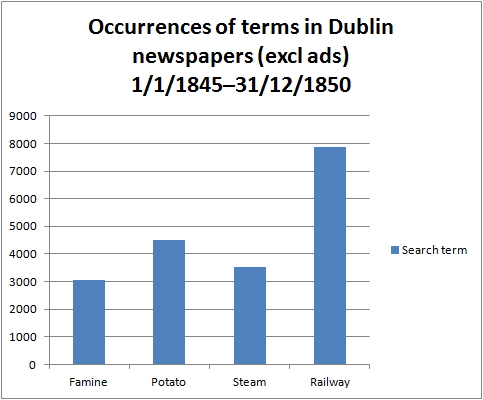
I thought it would be interesting to ask the British Newspaper Archive what people were reading about in newspapers published in Dublin between 1 January 1845 and 31 December 1850. The BNA has scans of two Dublin newspapers for that period, the Freeman’s Journal and the Dublin Evening Mail. I used the archive to search for four different words in those newspapers in that period; I then counted the numbers of results.

On the first round, I included ads and family notices.

Newspaper terms incl ads 1845–1850

Terms in Dublin newspapers (incl ads) 1845–1850

I guessed that the numbers for steam and railway might be exaggerated by their inclusion in ads so, on the second round, I excluded both ads and family notices. The result was as expected.

Newspaper terms excl ads 1845–1850

Terms in Dublin newspapers (excl ads) 1845–1850

I then asked Google’s Ngram machine to count the numbers of occurrences of four pairs of words between 1845 and 1850. I asked it to do a case-insentitive search, but it can’t do that for “compositions” (combinations of words), so it counted:

Ireland+potato
Ireland+steam
Ireland+famine
Ireland+railway.

Here is what it came up with, but whence I know not, other than that it searched the corpus English. The embedding process doesn’t seem to be working, so I’ve left the code here but also cut and pasted the output.

Google Ngram

Google Ngram

I suspect that, in recent times, the amount written about steam and railways of the period 1845–1850 in Ireland has been rather less than that about potatoes and the famine.


The Mahmoudié Canal

There is a possible link between the Mahmoudié Canal, which ran from Alexandria to the Nile, and Irish waterways. I have not managed to establish a definite link to this Irish canal-boat but it is not ruled out either, and a few other Irish connections came up along the way: Oscar Wilde’s father, for instance, who wrote about the Boyne and the Corrib, and sent his most famous son to school on the Erne, travelled on the Mahmoudié Canal.

And did you know that, in the early 1840s, you could buy bottled Guinness and Bass in Cairo? Or that, to transport 50 people (including 12 ladies and 3 female servants) and 3 bags and 62 chests of mail across 84 miles of desert, you would have needed, in 1841,

  • 130 camel men, donkey men and servants
  • an escort of 17 Arab horsemen
  • 145 camels
  • 60 donkeys
  • 12 saddle horses
  • 12 carriage horses
  • 7 carriage camels
  • 12 donkey chairs: “for invalids, or ladies, the donkey-chair forms as easy a conveyance as a palanquin or sedan”
  • 3 two-wheeled carriages
  • 1 four-wheeled carriage?

Or that, to reduce the number of rats and insects on a cangia (sailing boat) on the Nile, you should sink it for two or three days before boarding?

You can read about all of that and more in this PDF. However, it’s not for the faint-hearted: it’s 51 pages, with over 300 endnotes (which you don’t have to read) and lots of links for those who are really interested. There are illustrations in some of the linked materials.

The Mahmoudié mystery v04 iwh [PDF]

The (re)invention of heritage

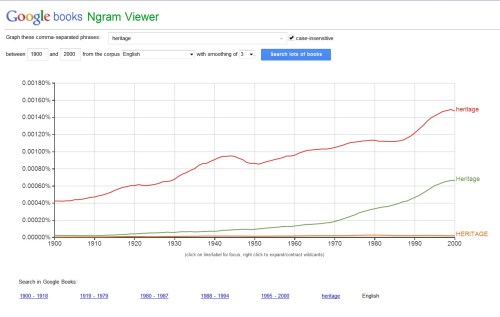
From Google’s Ngram viewer (more here):

ngram[Sorry, Google: couldn’t get the embedding to work properly. WordPress’s whitelist omits Google, though maps seem to work OK. Here’s the original.]

The growth in the use of “Heritage” with an initial capital is particularly interesting. I can think of three possible reasons:

  • that more organisations, eg The Heritage Council, use the word in their titles
  • that the word is increasingly used as an abstract noun at the start of sentences like “Heritage is important”
  • that the word is increasingly used as an attributive adjective at the start of sentences like “Heritage apples should be preserved”.

Traditional, personal uses (like “My heritage from my ancestors …”) are, I think, less likely to require initial capital letters. That in turn might suggest that Google’s Ngram viewer is reflecting a new(ish) set of meanings for the word and might lead us to ask what that new(ish) usage is (or was) intended to achieve.

It might also lead us to ask whether an even newer concept might now be more useful: one that would dissuade well-meaning folk from preserving and displaying context-free old tat and persuade them to find and record information instead.

The Gillogue railroad

Gillogue, in Co Clare, is the site of a former Burlington factory and of a Clare entrance to the University of Limerick. It is also the site of a lock on the Plassey–Errina Canal, a section of the old Limerick Navigation, and of quarries, gravel pits and lime kilns.

And, according to the 6″ Ordnance Survey map, of around 1840, Gillogue also had a railroad.

The Gillogue rail road

The Gillogue rail road (click to enlarge)

The railroad was almost certainly not for carrying passengers; it may have been a light railway, with small wagons pushed by men or pulled by horses, and designed to be taken up and moved elsewhere fairly easily. However, I have no hard information about who owned it, who built it or what it was for. I can make guesses, based on its closeness to the canal and to the quarries, but it would be nice to have evidence.

If, Gentle Reader, you know anything about it, do please leave a Comment below.

My OSI logo and permit number for website

M’Gauley’s mysterious mechanism

In 1851 Alex Thom, Printer and Publisher of Dublin, produced the third edition of Lectures on Natural Philosophy by the Rev James William M’Gauley, Canon &c, Professor of Natural Philosophy and one of the Heads of the Training Department to the National Board of Education in Ireland. [The Morning Post of 9 October 1840 suggests that the first edition seems to have been in 1840: Longman, Orme & Co in London, W Curry, jun & Co in Dublin and Fraser and Crawford in Edinburgh.]

You can read the third edition of the Lectures here, paying special attention to any electro-magnetic apparatus, given that the Rev James read papers on the subject to the meetings of the British Association for the Advancement of Science in Dublin in 1835 and in Liverpool in 1837.

But I can find nothing, there or elsewhere, about his contributions to steam propulsion on canals. Several British newspapers copied this story from the Dublin Pilot in 1837:

We understand that the Rev Mr M’Gauley, of Marlborough-street, in this city, has completed a series of experiments upon a subject which for some time has occupied his attention — the application of steam to canal boats, with perfect success.

Our readers are aware that the great obstacle to the application of steam to packet boats on canals is caused by the great injury which would arise to the banks from the wave created by the paddles. He has, it seems, adopted a paddle on an altogether new principle; one of great simplicity and of such a nature that the injury to the banks shall not be greater than what is produced by the ordinary boat.

He gets rid entirely of backwater, his paddles work without noise, and require for their application a steam engine of the simplest construction.

It is said that Mr M’Gauley contemplates a velocity which to seem possible would require his working model to be understood. We hope and indeed believe, that Mr M’Gauley will not have to contend with apathy and want of enterprise in the introduction of so important an application of steam in Ireland, one which would render our canals incalculably more profitable and more useful than at present, and to give us an opportunity of consuming to advantage the turf with which so large a portion of the country is covered.

And in its issue of 29 December 1838 [No 803] the Mechanics’ Magazine, Museum, Register, Journal, & Gazette carried this story from the Dublin Post:

Steam-boats on Canals. — The Rev J W M’Gauley, Professor of Natural Philosophy to the Board of Education, we understand, has at length succeeded in fabricating a machine for propelling boats on canals without raising a surge, which has been very detrimental to the banks, causing a considerable annual outlay to keep them in repair.

The power will be derived from a steam-engine; but instead of the usual paddle-wheels, there will be a machine immerged in the water underneath the centre of the boat, the working of which will not cause the least ripple on the surface of the water. There will be a public test of the invention on the Grand Canal about a fortnight hence, with a boat fitted up under the immediate inspection of the Rev gentleman.

But I have found nothing after that: no report of the success or otherwise of the machine. I would be grateful for information from anyone who knows anything about it.

By 1840 the Rev M’Gauley’s attention had returned to electro-magnetic apparatus with a practical application. In November and December of that year several British newspapers reproduced this report from the Dublin Monitor [I take this from the Leicester Chronicle, which was so excited that it reported the news twice, on 21 November and 12 December 1840]:

Important improvement. — The Rev Professor M’Gauley, whose scientific experiments in electro-magnetism excited so much interest in the philosophic world some time ago, has communicated to some of the principal Railway Companies in England a valuable invention, which will be attended with most important results in the preservation of life and property from almost all the casualties to which they are at present subjected in railway travelling.

His object is to render the stoppage of the train entirely independent of the engine conductors; so that, should they, as was lately the case, fall asleep, get drunk, or otherwise become incapacitated for the discharge of their responsible duties, the steam can be turned off, and the train stopped, totally independent of them. The simple announcement of the object of Mr M’Gauley’s invention is sufficient to render its vast importance obvious to every man who has bestowed one moment’s thought upon the subject. We have been favoured with an examination of the invention, and consider it at once simple, ingenious, and admirably adapted to effect the desired end; its cost is trifling.

This important improvement has been submitted to the directors of some of the first lines of railway in England, to the Dublin and Kingstown and Ulster Railway Companies who are giving it their best consideration, and, we presume, will test its utility by experiment.

Addendum April 2017:  could this be relevant?

More on M’Gauley (lots of variant spellings) in Wikipedia and here in a short notice at the bottom right of page 376 of The Engineer for 1 November 1867 [PDF courtesy of Grace’s Guide]. Who knew that folk left the priesthood and got married in the nineteenth century?

A further brief mention here [January 2019].

More Pathé

A train ferry, claimed to be in service on the Liffey

Fishing at Ringsend the hard way

Turf by canal

Launching the Irish Elm in Cork

A Boyne regatta

Making and using a Boyne currach in 1921 (you can learn the art yourself here)

A non-watery film: Irish Aviation Day 1936


Matters of minor importance

Some recent(ish) discussions amongst the People’s Representatives. I haven’t time to analyse them all. All links courtesy of the estimable KildareStreeet.com.

Brendan Smith [FF, Cavan-Monaghan] wants a sheugh in Clones; he got the usual answer. And he allowed Jimmy Deenihan [FG, Kerry North/West Limerick] to announce, on 19 December 2013, the death of the suggested extension of the Erne navigation to Lough Oughter [loud cheers]:

Brendan Smith: To ask the Minister for Arts, Heritage and the Gaeltacht if he has received the feasibility study on the proposed extension of the Erne navigation from Belturbet to Killeshandra and Killykeen; and if he will make a statement on the matter.

Jimmy Deenihan: I am informed by Waterways Ireland that it commissioned a Strategic Environment Assessment for the possible extension of the Erne Navigation from Belturbet to Killeshandra and Killykeen.

On reviewing the environmental information from this process, Waterways Ireland considers that the environmental designations of this lake complex make the feasibility of the proposed navigation extension highly unviable. For that reason, I am advised that Waterways Ireland does not propose to pursue this project any further at this time.

Well, that’s one minor victory for sanity. Here’s how a dredger got to Lough Oughter in 1857.

Maureen O’Sullivan is anxious to recreate the economy of the eighteenth and nineteenth centuries by using canals for carrying cargoes. Especially on the Shannon–Erne Waterway, where commercial carrying was so successful before. [What is it about the Irish left?] Thank goodness that the sainted Leo Varadkar gave not an inch: someone should make that man Taoiseach, President and Minister for Finance. And Supreme Ruler of The Universe and Space.

The web-footed inhabitants of the midlands, who have discovered that they live in a flat area with rivers, keep wittering on about Shannon flooding, failing to realise that it is a message from The Lord, telling them to either (a) move to higher ground, eg Dublin, or build arks. On 15 January 2014 Brian Hayes told Denis Naughten, inter alia, that info from the recent OPW/CFRAM monitoring of water levels on Lough Ree (which I think was when the levels were lowered) would be placed on the OPW website “in the coming days”; I haven’t been able to find it yet so I’ve emailed the OPW to ask about it. And on 21 January one James Bannon said that he intends to introduce a bill setting up a Shannon authority, which will have magical powers. Well, if it doesn’t have magical powers it won’t be able to stop the Shannon flooding, but perhaps it’s designed to allow the unemployed landowners of Ireland another forum in which to demand taxpayers’ money to prop up their uneconomic activities.

Finally, a senator called John Whelan wants a longer consultation period on the proposed amendments to the canals bye-laws. I suppose I’d better read them  myself.