Tag Archives: vessels

WI’s budget: the minister speaks

I wrote here about the implications of the RoI 2014 budget for Waterways Ireland. The minister, Jimmy Deenihan [FG, Kerry North/West Limerick], spoke about it in the Dáil on Wednesday 16 October 2013 [h/t KildareStreet.com]. At the end of his lengthy contribution he said:

I am committed to developing North-South co-operation within the broader arts, heritage and commemorative activities of the Department as well as through the funding of North-South bodies. A provision of €38.3 million will be made available to support the two North-South implementation bodies, An Foras Teanga, comprising Foras na Gaeilge and the Ulster-Scots Agency, and Waterways Ireland. The provision will enable Waterways Ireland to deliver on its core activities and targets, which include keeping the waterways open for navigation during the main boating season and promoting increased use of the waterways resource for recreational purposes. This expenditure should also assist in developing and promoting the waterways, attracting increased numbers of overseas visitors and stimulating business and regeneration in these areas. Capital funding of almost €4 million will be made available to Waterways Ireland to facilitate the ongoing maintenance and restoration of Ireland’s inland waterways, thereby increasing recreational access along the routes of waterways.

The Government has reaffirmed its commitment to continuing to make progress, to improving the economy, to exiting the bailout, and to helping to create jobs. The Department and the sectors it represents will make a significant contribution to this work over the course of 2014.

I pointed out last year that Waterways Ireland is part of northsouthery and that, at budget time, we don’t get a breakdown of the northsouthery budget between An Foras Teanga and Waterways Ireland. In 2011, WI got roughly 60%, but I don’t know what happened after that. Here’s what I thought was happening last year:

Current spending (WI)

2010 Estimates: €25 585 000
2011 Estimates: € 24 335 000
2012 Estimates: €22 929 600 (60% of €38 216 000)

Capital spending (WI)

2008 Estimates: €11 000 000
2009 Estimates: €10 300 000
2010 Estimates: €8 000 000
2011 Estimates: €6 000 000 (or €6 002 000)
2012 Estimates: €4 500 000 (or €4 502 000) (100%)

In his speech, above, the minister said that northsouthery is going to get €38.3 million and that Waterways Ireland is to get capital funding of €4 million. However, the €4 million is included in the €38.3 million. The expenditure report [PDF; see page 160] gives these details:

  • for 2013 northsouthery had €36 210 000 of current spending; for 2014 it will get €34 425 ooo
  • for 2013 northsouthery had €4 080 000 of capital spending (all, or almost all, of which was for Waterways Ireland}; for 2014 it will get €3 958 000
  • the overall budget for northsouthery is down 5%.

We can calculate that the capital budget is down about 3%; the much larger current budget is down 5%. If WI gets 60% of the total, its current expenditure contribution from RoI will be €20 655 000, down over €2 000 000 from the previous year and about €5 000 000 since 2010, and its total current expenditure (85% RoI, 15% NI) will be €24 300 000.

The other interesting part of the minister’s speech is what WI is expected to do:

  • promoting increased use of the waterways resource for recreational purposes
  • developing and promoting the waterways
  • attracting increased numbers of overseas visitors
  • stimulating business and regeneration in these areas
  • increasing recreational access along the routes of waterways.

That should keep them busy. But I omitted one activity:

  • keeping the waterways open for navigation during the main boating season.

Emphasis mine, but does this mean that winter boating (at least if it involves staff time, eg at locks) will become a thing of the past?


Maureen O’Sullivan and Effin Bridge

A knowledgeable written question [h/t KildareStreet.com] from Maureen O’Sullivan [Ind, Dublin Central] about the Effin Bridge over the Royal Canal at Newcomen Bridge:

To ask the Minister for Arts, Heritage and the Gaeltacht if he will identify the parties concerned with the operation of the lifting bridge which occupies the site of the original first lock on the Royal Canal Newcomen Bridge, Dublin 1; the factors that contribute to the status of the lifting bridge; if he will convene a meeting of interests concerned with the operation of the lifting bridge with a view to devising a management and operational system that is less hostile to the use of the waterway as currently it is an impediment and discouragement to navigation on the Royal Canal and an obstacle to navigation-communication between the Royal Canal and River Liffey and between Royal Canal and Grand Canal at their eastern reaches; and if he considers the lifting bridge could be re-engineered as a dropping bridge.

The minister, Jimmy Deenihan [FG, Kerry North/West Limerick], responded:

I can advise the Deputy that the parties concerned with the operation of the lifting bridge over the railway line close to Newcomen Bridge are Irish Rail and Waterways Ireland. The bridge carries the rail line from Connolly Station to the lower line link to the docks area. The bridge was procured and installed by Waterways Ireland’s predecessors. The bridge is operated by Irish Rail staff on a request basis at Waterways Ireland’s expense. The option of introducing a drop lock to replace the need of the lifting bridge has been considered but not deemed viable due to the cost estimate involved.

Note that the question was about a “dropping bridge” but the answer was about a “drop lock”.

The answer suggests that the number of lifts each year is a function of the number of requests made by Waterways Ireland; it would be interesting to know whether that it actually so. If it is, then WI’s budget [cut again] is probably the ultimate determinant; if Irish Rail has a say in the matter, its operational needs may influence the decisions.

I cannot think of any cost-effective solution. I am not convinced that the bridge in itself discourages navigation.


Water levels in Athlone

At time of writing, the depth of water at Athlone Weir is 1.7m. “Staff gauge zero is 35.360m above Poolbeg datum”, which means the water level is 37.06m OD (Poolbeg). According to Bob Cullen’s 2002 article for Inland Waterways News [PDF], “The minimum navigation level in Lough Ree is 36.88m OD”, so if the level drops another 0.18m, about 7 inches, there may be a WI Marine Notice.

It seems that the dropping of the level of Lough Ree is intended to provide a buffer against flooding in the area from Athlone downstream to Meelick. According to Brian Hayes “A meeting between the ESB, Waterways Ireland and the Office of Public Works to review the interim operating regime is due to take place shortly.” [I have asked Waterways Ireland for a report on the meeting.]

But, if we are to believe the Dublin Evening Mail, the Shannon Commissioners took a rather more robust attitude to flooding downstream of Athlone: steamers [and PR] came first.

Shannon passage times 1838

Estuary

Kilrush to Limerick 4 hours

Tarbert to Limerick 3 hours

Clare[castle] to Limerick 3.5 hours

Limerick Navigation

Limerick to Killaloe:

  • iron passenger boat 2.5 hours
  • timber passenger boat 3.5 hours
  • trade boat 6 hours.

Shannon

Killaloe to Portumna:

  • passenger steamer 6 hours
  • steamer towing lumber boats 8 hours.

Portumna to Shannon Harbour:

  • 6 hours.

Shannon Harbour to Athlone:

  • 8 hours.

Source: Railway Commissioners second report Appendix B No 6.

Chambers, pots

Folk knowledgeable about canal engineering and artefacts might be able to contribute to a current discussion, over at the Helpful Engineer’s website, of the Four Pots overflow and the side chambers at Lock 16 (Digby Bridge) on the Grand Canal.

Drowning

This Irish Times story updates this.

Transition?

I am grateful to Waterways Ireland for letting me have the Shannon traffic figures for July 2013. As I said last month:

The usual caveats apply: the underlying figures (kindly supplied by Waterways Ireland) do not record total waterways usage because, for instance, sailing, fishing or waterskiing on lakes or river stretches, which did not involve a passage through a lock or Portumna Bridge, would not be recorded. The passage records are our only consistent long-term indicator of usage of the Shannon but they would not show, for instance, a change in the balance of types of activities from those in larger cruising boats to those in smaller (sailing, fishing, waterskiing) boats. It is quite possible, therefore, that overall usage might be increasing while long-distance cruising was declining.

I also said:

[…] the figures show a small increase over 2012 in passages by private boats. I suspect that July’s warm weather will spur a further increase.

And so indeed it proved to be.

Shannon all JanJul

A slight increase

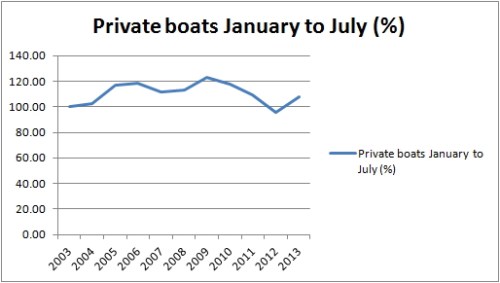
July’s traffic was up enough to increase the total for the year to date: the first increase (for the period January through July) since 2003.

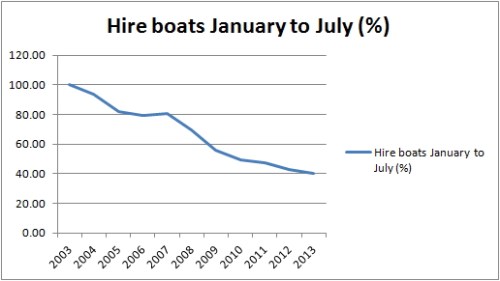
Here are the figures as percentages of the 2003 figure.

Shannon all JanJul %

Seven-month totals as percentages of the 2003 seven-month total

The total is still around 60% of 2003’s figure: a significant decline. But there was a marked increase in private traffic …

Shannon private JanJul %

Private traffic up

… while the decline in the hire-boat traffic continued.

Shannon hire JanJul %

Hire-boat traffic down

Over on Afloat, someone wrote that:

[…] a source close to Afloat.ie says that the falling numbers may be skewed by a growing emphasis on larger-capacity vessels on Ireland’s inland waterways, with eight- and 12-berth boats supplanting older four-berth vessels, and families and groups consolidating their recreational boating.

I don’t know what “skewed” is intended to mean. Well-capitalised hire firms may be adding larger boats to their fleets, but the number of passages is down by 60% and sources close to irishwaterwayshistory.com say that the combined hire fleet is down from about 500 to about 250 boats.

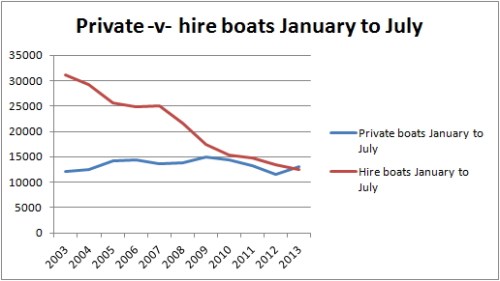
That doesn’t mean that the hire-boat industry is entirely dead, but it is much less important to the Irish waterways than it was. I don’t know of any published figures [if IBRA would like to supply them, I’ll happily publish them], but I suspect that employment within the industry has gone down and that its comparative economic importance to the Shannon and to the Irish tourist industry has declined too. And here is an interesting chart:

Shannon private v hire JanJul

The transition


For the first time that I know of, the seven-month figures show that measured private traffic outweighs hire-boat traffic. It may be that we need new approaches to attracting more overseas visitors to the Shannon. According to Waterways Ireland’s Lakelands & Inland Waterways Strategic Plan 2010–2015 (which I can no longer find on the WI website):

The mission of the Lakelands and Inland Waterways Strategic Plan is:
Throughout the Lakelands and Inland Waterways Region, to increase domestic and overseas visitors in number and revenue, while supporting existing sustainable tourism enterprises and encourage emerging tourism businesses through a series of practical business supports.

The plan was short on hard numbers for its targets, but at least as far as the Shannon hire business is concerned, it ain’t working.


Canal carrying 1846: Dublin to Waterford

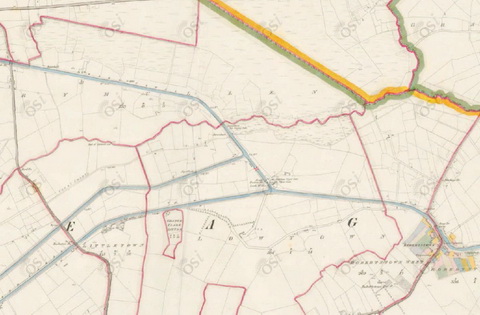
Lowtown is at the western end of the summit level of the Grand Canal; it thus has some claim to be the highest point on the canal. It is close to the village of Robertstown in County Kildare.

Lowtown is also the site of the junction between the main (Dublin to Shannon) line of the Grand Canal and its most important branch, the Barrow Line.

Lowtown (OSI ~1840)

Lowtown (OSI ~1840)

The main line from Dublin comes in from near the bottom right and exits near the top left. The two cuts leaving near the bottom left are the Old and New Barrow Lines, which join together just off the map. The Barrow Line runs to Athy, in south County Kildare, from which the Barrow [river] Navigation runs to the tidal lock at St Mullins, downstream of Graiguenamanagh.

The River Nore joins the Barrow a litle further downstream; the Nore is navigable on the tide upstream to Inistiogue. The combined rivers flow south through the port of New Ross and eventually join the estuary of the River Suir. Turning right at that point takes you up the Suir to Waterford, Carrick-on-Suir and Clonmel. Thus the Barrow Line, from Lowtown, forms an inland waterway link between Dublin and some towns along the Barrow, Nore and Suir.

Isaac Slater’s Directory[i] of 1846 lists those carrying goods on inland waterways. There is a long list for Dublin; entries for other towns list those providing local services. There are some conflicts between the lists (see below).

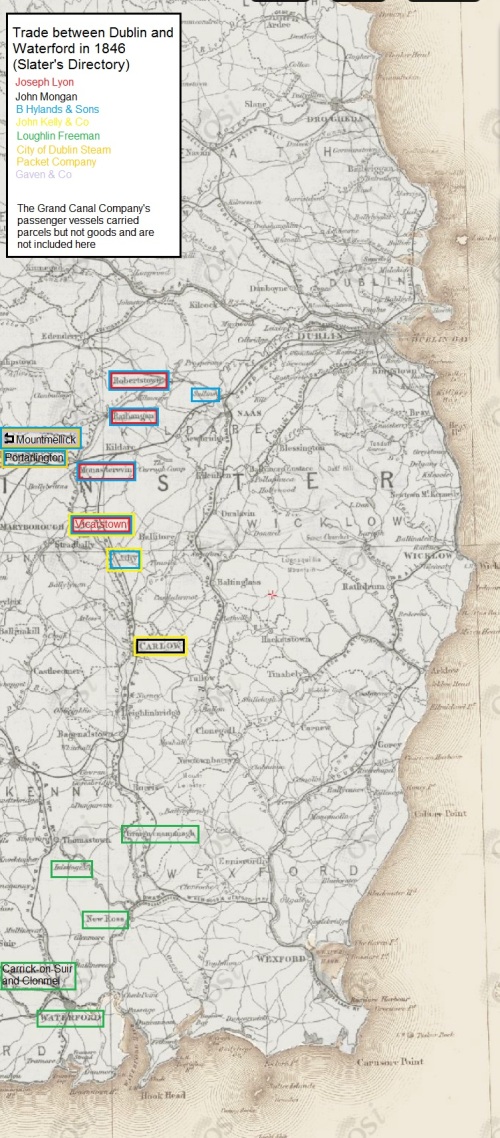
The map below shows those carrying on the Barrow Line of the Grand Canal and on the rivers Barrow, Nore and Suir. Each carrier is assigned a colour, which is used to frame the name of each place served by that carrier. Some towns (Mountmellick, Carrick-on-Suir, Clonmel) are off the map, further to the west. Note that the map is from the 25″ Ordnance Survey map of around 1900 rather than the 6″ of around 1840: I used it because it was clearer, but it shows features (eg railway lines) that were not present in 1846.

Click on the map to get a slightly larger version.

Dublin to Waterford: inland waterway traders 1846 (OSI)

Dublin to Waterford: inland waterway carriers 1846 (OSI)

Notes

All but one of the carriers are shown as having Dublin premises at Grand Canal Harbour, James Street. The exception is Gaven & Co, which is mentioned only in the Mountmellick entry.

I have not included the Grand Canal Company’s passenger-carrying boats, which carried parcels but not goods.

The City of Dublin Steam Packet Company entry for Dublin does not include Portarlington and Mountmellick amongst the towns served but the entry for Mountmellick says that the company’s boats leave for Dublin every Tuesday and Friday (its agent being John White) while that for Portarlington says they leave weekly. Boats from Mountmellick had to pass through Portarlington as well as Monastereven and other towns en route to Dublin.

Similarly, the entry for Mountmellick says that the Hylands boats leave there every other day while that for Portarlington says that they pass through weekly.

There is a page missing from the electronic copy of the directory that I consulted so the entry for Monastereven is incomplete.

The entry for Carlow says

To DUBLIN, and also to [New] ROSS, Boats depart, at uncertain periods, from the Wharfs of Lawrence and James Kelly, the Quay.

It does not say whether Lawrence and James Kelly owned any boats. They may have had boats but used them only for their own goods.

The entry for Mountmellick says “Bryan Hyland” rather than “B Hylands”.

The entry for Mountmellick includes the only mention I have found of Gaven & Co’s boats (James Waldron, agent).

The entry for Rathangan says

There are Boats for the conveyance of Goods, but no fixed period of departure.

Thomas Berry & Co, the most important carrier on the Grand Canal, did not venture south of Lowtown.

More

As far as I know, little has been written about the carrying companies, especially those of the nineteenth century. I would be glad to hear from anyone who can correct, supplement or comment on this information.


[i] I Slater’s National Commercial Directory of Ireland: including, in addition to the trades’ lists, alphabetical directories of Dublin, Belfast, Cork and Limerick. To which are added, classified directories of the important English towns of Manchester, Liverpool, Birmingham, Sheffield, Leeds and Bristol; and, in Scotland, those of Glasgow and Paisley. Embellished with a large new map of Ireland, faithfully depicting the lines of railways in operation or in progress, engraved on steel. I Slater, Manchester, 1846

My OSI logo and permit number for website

Shannon traffic to June 2013

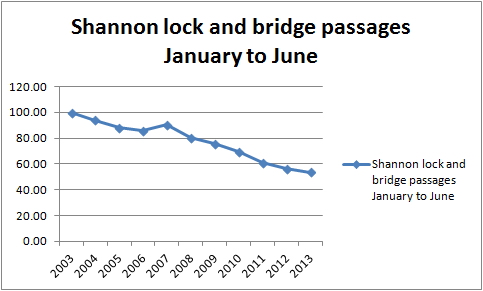
The figures for Shannon lock passages to the end of June 2013 are now available. The decline continues, though perhaps more slowly.

Shannon traffic Jan to June percent

Shannon lock and bridge passages January to June as percentages of the 2003 number

The usual caveats apply: the underlying figures (kindly supplied by Waterways Ireland) do not record total waterways usage because, for instance, sailing, fishing or waterskiing on lakes or river stretches, which did not involve a passage through a lock or Portumna Bridge, would not be recorded. The passage records are our only consistent long-term indicator of usage of the Shannon but they would not show, for instance, a change in the balance of types of activities from those in larger cruising boats to those in smaller (sailing, fishing, waterskiing) boats. It is quite possible, therefore, that overall usage might be increasing while long-distance cruising was declining.

Shannon traffic Jan to June private

Shannon lock and bridge passages by private boats January to June

As it happens, the figures show a small increase over 2012 in passages by private boats. I suspect that July’s warm weather will spur a further increase.

Folk living in Ireland, whether owners or prospective hirers, are likely to be able to react quickly to better (or worse) weather by doing more (or less) boating; folk living abroad may be less able to change their holiday plans. Accordingly, July’s weather might (I’m speculating here) mean an increase in passages by private boats and by boats hired by Irish residents; it might not lead to an increase in hiring from abroad.

Traffic in hired boats continued to decline in June.

Shannon traffic Jan to June hire

Shannon lock and bridge passages by hired boats January to June

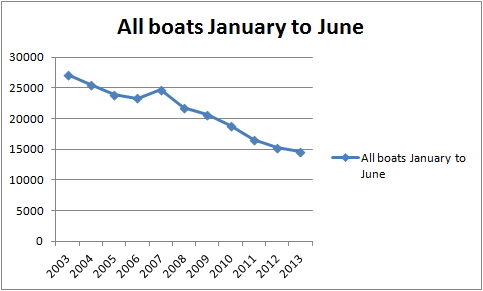
That decline outweighed the small increase in private traffic, leading to an overall decline in the first six months as compared with the same period in 2012, which itself continued the pattern set in 2007.

Shannon traffic Jan to June all

Shannon lock and bridge passages by all boats January to June

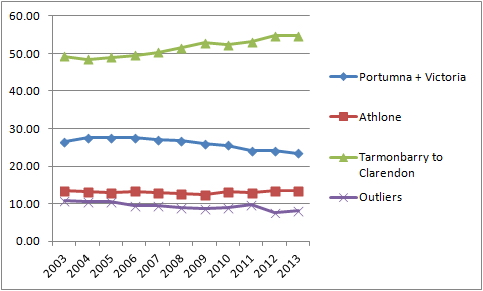
I wondered whether the figures might show any change in the geographical distribution of activity. WI’s reports don’t show separate figures for private and hired boats for the individual locks, but it seems to me that the hire business is becoming more concentrated on northern waters, from Lough Ree upwards. If that is so, then there might be an increase in the proportion of passages through the northern locks, from Tarmonbarry upwards, and a decrease in the proportion passing through Portumna Bridge and Meelick (Victoria) Lock.

I put the WI reporting stations in four groups:

  • Portumna + Meelick
  • Athlone
  • Tarmonbarry, Clondra, Roosky, Jamestown (Albert), Knockvicar (Clarendon)
  • the also-rans: the three locks leading to Lough Allen, Pollboy leading to Ballinasloe, the Limerick sea-lock (Sarsfield).

The figures suggest that the distribution is indeed changing, but gradually rather than dramatically. Athlone’s figures are pretty steady, the outliers are declining slightly and Portumna + Meelick are declining a bit more; the northern locks (Tarmonbarry to Knockvicar) are taking the gains. Comments or alternative interpretations welcome.

Change by region

Lock passages by group

The figures for 2013 are for the six months January to June; those for other years are for twelve months.

The locks could of course be grouped in other ways, and I may try some of them in future months.

Dialogue

Some time ago I noted that Waterways Ireland was now down wid da kidz in da hood, doing groovy things like social meeja with a Youtube thingie. It features (inter alia) a flight in a helicopter gunship along a restored Clones Sheugh. At least, that’s what I presume was going on, although I couldn’t work out how to fire the rockets at the suspiciously large number of narrowboats found along the way. The scenic highlight of the journey was Clones.

There’s also a Facebook page, from which I learned that there is now a skippered boat available for hire on the Barrow. And there is a Twitter whatsit, which does two interesting things.

First, it has summaries of marine notices, which will be useful to those cruising on the waterways without internet access.

Second, it shows signs of WI’s engaging in public dialogue with users, even when their comments might be critical. This is very welcome; it will be interesting to see the extent to which such public dialogue is permitted to develop.