Category Archives: Ashore

Marty Whelan, St Saran, Colonel l’Estrange and the Tessauren Ferry

Marty Whelan, a youthful disk-jockey chap with an insignificant amount of facial hair, presents a morning programme on the wireless. One day last week, discussing traffic problems with a chap from AA Roadwatch, he considered the origin of the name of L’Estrange Bridge, whose location neither he nor his collocutor knew.
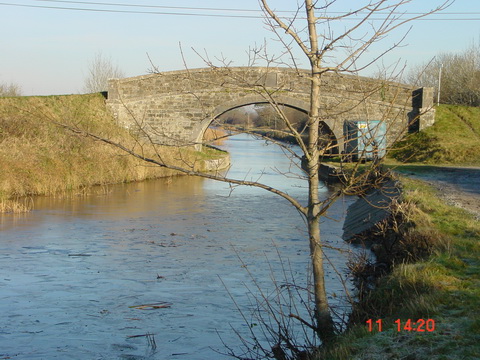
L'Estrange Bridge (2003)

L’Estrange Bridge (2003)

It had been mentioned on this site as the location of a fatal motoring accident in December 2011 and it is, of course, a useful stopping place for those who, driving to Athlone, like to stop to consume the coffee (and any comestibles) they may have purchased in the award-winning Spar shop in Cloghan.

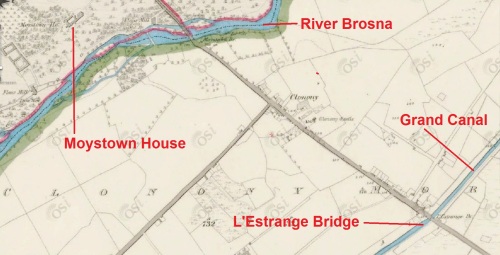
I emailed Mr Whelan, with a link to the location on the OSI map.
Tessauren 1

L’Estrange Bridge and Moystown House

I speculated that, as the nearby Moystown House was owned by the l’Estrange family (as was Huntston or Hunstanton, across the road), the Grand Canal Company might have had to buy land from them and, with the aim of keeping the cost down, have agreed to name the bridge after the landowner (a tactic that the National Roads Authority might adopt).

I should make it clear that I have not researched the land purchases of the Grand Canal Company in the area, so this should not be taken as definitive. I note, from Fred Hamond’s Bridges of Offaly County: an industrial heritage review (for Offaly County Council, November 2005), that the date on the bridge is 1800, although the canal was not opened until 1804; as Fred says:

Most [bridges] were built before their respective stretches of canal opened […].

The Parliamentary Gazetteer of 1846 says:

The principal artificial features are the mutually adjacent demesnes of Moystown and Hunstanton, the residences of the Messrs L’Estrange, situated on the Brosna. “Though Moystown,” remarks Mr Fraser, “has not extensively diversified park scenery to boast of, and is environed by deep brown bog, there is, in the style of the house, in the arrangement of the plantations, and in the beautiful evergreen oaks and other ornamental trees which adorn the lawn, a character which carries us back to the gentlemen’s seats of the olden times. This demesne is watered by the Brosna, which pays its ample tribute to the Shannon at thetermination of the grounds, and where also the Grand Canal crosses the river in its progress to Ballinasloe.”

Lewis’s Topographical Dictionary of 1837 says that Colonel l’Estrange was living at Moystown at the time, William l’Estrange was living at Kilcummin, a little distance north of Huntston, and Major Carlton (a relative, I think) at Huntston.

A quick search suggests that the l’Estranges did occupy land there in 1800, but I cannot claim to have carried out a thorough investigation.

What was of more interest to me was that the Parliamentary Gazetteer extract was from an item headed Tessauran, Tiseran or Kilcally:
Tessauren 2

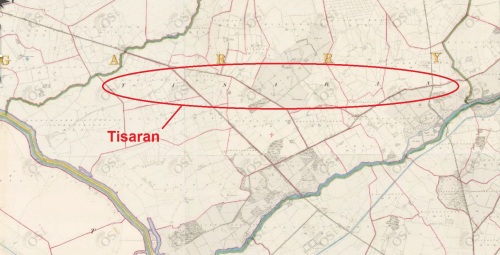
The parish of Tisaran

TESSAURAN, TISERAN, or KILCALLY, a parish in the barony of Garrycastle, 2¼ miles north-west by west of Cloghan, King’s co., Leinster. Length, south-westward, 3¾ miles; extreme breadth, 2½; area, 7,316 acres, 2 roods, 12 perches, — of which 106 acres, 3 roods, 38 perches are in the river Shannon. Pop., in 1831, 2,032; in 1841, 2,029. Houses 346. The north-western boundary is traced by the Blackwater; the south-western boundary, by the Shannon; and the south-eastern boundary, by the Brosna. All the northern district, part of the eastern, and most of that along the Blackwater, are bog; much of that along the Shannon is lowland meadow; and most of the remainder is dry limestone land, pleasant in appearance, and possessing a considerable aggregate of embellishment.

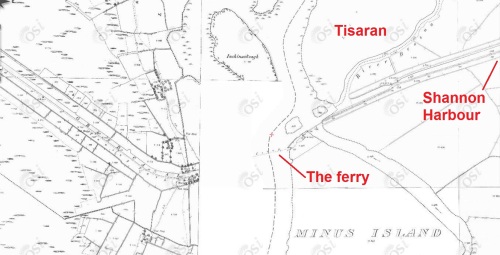
Some time ago, I asked here about Tessauren Ferry, but had no response. I found the term in F E Prothero and W A Clark eds Cruising Club Manual: A New Oarsman’s Guide to the Rivers and Canals of Great Britain and Ireland George Philip & Son, London 1896. His entry for the Grand Canal included this at 79¼ miles from Dublin:

Entrance into the Shannon at Tessauren Ferry.

I have not seen the term used anywhere else. The ferry is of course that provided by the Shannon Commissioners to enable horse-drawn boats to cross the Shannon to the Ballinasloe Line of the Grand Canal. It would be nice to find other instances of the use of Prothero’s term.

Tessauran, Tisaran, Tiseran, Tessauren (and perhaps there are other variants) is the name of the parish north-east of the junction between the Brosna and the Shannon. It is odd that the ferry’s eastern departure point was actually outside the parish, because the Brosna was the boundary and the ferry started from the south side of the canal and the Brosna.
Tessauren 3

Tisaran parish and the ferry

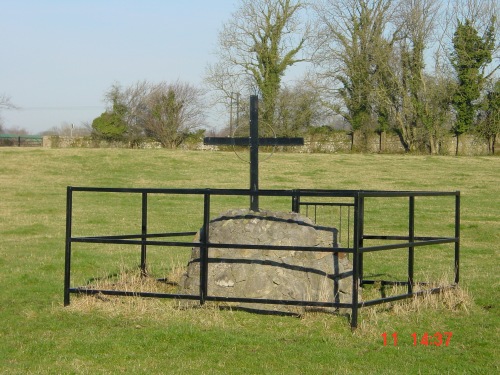
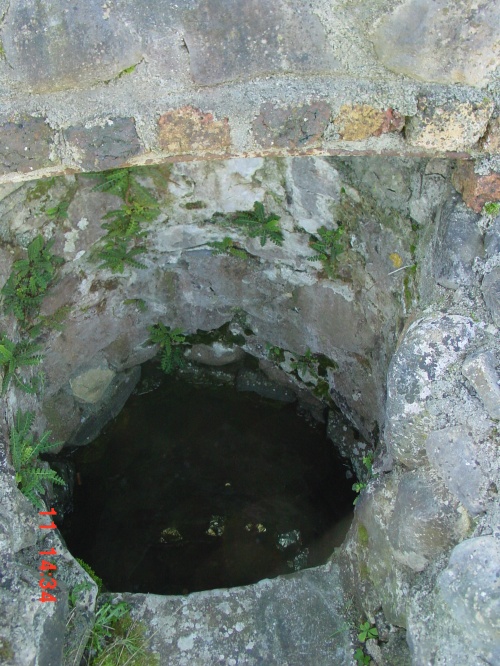
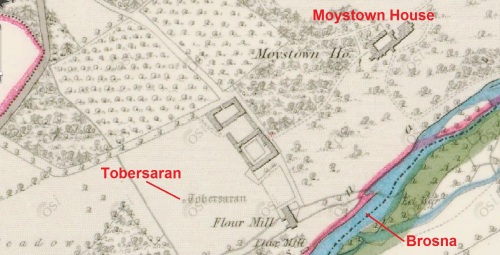
The other link I had not made was that between Tessauren and St Saran, whose well I photographed some years ago, which means that I was on the grounds of Moystown House.
Tessauren 4

St Saran’s well (Tobersaran)


St Sarans Well near Shannonbridge 03_resize

St Saran’s well

St Sarans Well near Shannonbridge 04_resize

Looking into the well


So one mystery solved, as an accidental result of a remark on the wireless, but more information about the use of the term Tessauren Ferry would be welcome.

My OSI logo and permit number for website

Brosna

The River Brosna has the distinction of supplying water to two Irish waterways: the Shannon, which it joins at Shannon Harbour, and, further up, the Royal, which is to get a supply of water pumped from Lough Ennell, outside Mullingar.

The Old River Shannon Research Group promises to give special attention to the Brosna this year, so we may expect to learn more about this interesting river — without having to get our own feet wet.

More reading material

A bit of a break from the politicking ….

First,  the long-awaited second edition of David Walsh’s extraordinary book Oileáin is now available from Pesda Press. It’s an exhaustive guide to the islands around Ireland, seen from a sea-kayaker’s perspective. It tells you where they are, how you get there, what the tides and currents and hazards are, whether you might be able to camp …. A lot of this is, of course, aimed mainly at folk rather more athletically minded than I am, but I got it for its information about the islands in the Shannon and Fergus estuaries. David’s website keeps an electronic version updated, so that you can check the latest information before you set off, but even if you’re unlikely to start paddling to the Skelligs yourself you may find the information and the photos of interest.

Shannon enthusiasts will be familiar with Richard Hayward’s Where the River Shannon Flows, written as Hitler’s war was breaking out. It is an account of a road trip down the Shannon during which a film about the river was being made: the party was in Portumna when Hayward heard, on a wireless set through a window, that Britain was at war with Germany. I was privileged, some years ago, to be able to see the film and to match it with the scenes from the book, from which L T C Rolt drew information for his Green and Silver. Hayward was a proud Ulsterman, but one who was happy to meet, converse and exchange songs with anyone of any creed anywhere in Ireland. He was, if I remember correctly, a confectionery salesman by way of a day job, but more importantly he was an actor, a writer and a singer. His style is of its time, and perhaps rather laboured by modern standards, but he was a decent skin and I haven’t read anything of his that I didn’t enjoy. I am pleased to learn that a biography, An Unrepentant Romantic — the life and times of Richard Hayward by Paul Clements, is due to be published by Lilliput Press in May.

In the same month, UCD Press is to publish James Murphy’s Ireland’s Czar: Gladstonian government and the lord lieutenancies of the Red Earl Spencer, 1868–86. That’s this chap here, whose claim to fame is that he has a dock on the Royal in Dublin, and a harbour on Lough Allen, both called after him.

I don’t know whether I want to shell out €50 for Nigel Everett’s The Woodlands of Ireland, 700–1800 [Four Courts Press, May], but I like the idea that it

Focuses on the fundamentally pragmatic and commercial view of trees adopted by Gaelic civilisation, and the attempts of the various Anglo-Irish administrations to introduce more conservative woodland practices into Ireland.

Cad a dhéanfaimid feasta gan adhmaid? Why, we’ll import seacoal from Whitehaven, of course.

Finally, I am hoping that Joe Curtis’s Terenure: an illustrated history [The History Press, Ireland, March] will have more information about the remarkable Bourne family.

The information on forthcoming books comes from the magazine Books Ireland, which was until recently edited by old Shannon hand (and, if I mistake not, former Ditchcrawler) Jeremy Addis. Jeremy has now passed over the tiller and the magazine is now edited by Tony Canavan and published by Wordwell.


Rural nitwits and retirement communities

I’ve just been writing elsewhere to the effect that national politicians are a pack of nitwits. I was cheered therefore, in a sense, to note that local politicians, at least in Co Mayo, are (if possible) even more thick-headed than their national counterparts.

However, I am happy to be able to offer a solution, one that kills two birds with one stone. There are, it seems, many English pensioners living in poverty on boats on the canals and unable (or at least unwilling) to pay for the privilege. I had intended to suggest that Waterways Ireland should provide them with moorings away from the honeypot areas.

WI could then charge more for berths at, say, Hazelhatch, Sallins, Blanchardstown and Lowtown, catering for those in work who could afford a couple of thousand a year, while the pensioners, who don’t need to be within commuting distance of Dublin, could be accommodated in rural areas where their small additional spending would make a difference. That would help to increase those community and economic benefits to which the subsidy-seeking boat-owners draw our attention, bringing spending to deprived rural areas.

I was thinking of Pollagh, for instance: it has a pub, a shop, a church and a visiting burger van, and easy access to supplies of turf.

But the Mayo problem reminds me that Mayo too has lakes. So why not ship the boats to Mayo? As the canals byelaws provide that boats should not discharge any water other than from engine-cooling, these boats must be fitted with holding tanks or other non-discharging loos, so there would be no pollution problem. In fact Mayo could advertise itself to the world as offering floating retirement communities at modest cost, thus renewing its own population while solving a problem for boat-owners. I thnk this is a winner.

Letterkenny

Why did Letterkenny, Co Donegal, have a Canal Road?

Some bastard at Ballinderry …

… shot a Lough Derg eagle.

The underwater underground canal

Some queries about the Ballykelly or Broharris Canal.

Another turf canal system

Here is a short page about a canal system I had not heard of before today. It was a network of turf canals, with a sea lock, on the estate of Scotts of Willsborough, near Eglinton, on Lough Foyle; the Scotts supplied [London]Derry with turf and, like James Macnab at Portcrusha, reclaimed the land from the bog.

“Lock keepers face uncertain future” …

it says here.

The Armagh Canal

Another unbuilt canal mentioned by the indefatigable Mr Atkinson.

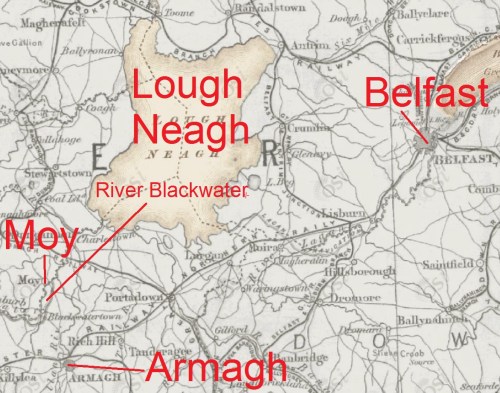
A proposal for making a canal from the city of Armagh to the river Blackwater, near the town of Moy

In order to shew, that carrying into effect the annexed sketch of a line [alas not annexed to the Google scan of Atkinson’s book], for opening a navigable communication from Armagh to the river Blackwater, would be a work of public utility, the following reasons are most respectfully submitted to the Right Honourable and Honourable the Committee of the House of Commons.

From Armagh, being the most considerable market in the kingdom for the sale of brown linens, the manufacture of that staple article is carried on to a very great extent in its neighbourhood; but this manufacture is in danger of being most materially injured, from the great scarcity of fuel, which is such as to oblige the opulent inhabitants to use English coal, at a great expense of land carriage; and they have latterly, at inclement seasons, been under the necessity of subscribing large sums, to procure that article at a low price for the poor, to prevent them from perishing.

Should a navigation be opened from Lough Neagh it would give the means of a supply of turf from the extensive bogs in the neighbourhood of the lake, would open a communication with the collieries at Coal island, in the county of Tyrone, and bring English or Scotch coal at considerably under the prices at which they can now be procured.

An extensive trade in general articles of merchandise being carried on from Armagh, not only to its own neighbourhood, but to a considerable part of the counties of Monaghan and Tyrone, by opening a navigation through Lough Neagh to the ports of Belfast and Newry, this trade would be very considerably extended, to the great advantage of Armagh, and all those places to which its trade extends, and would tend much to improve the public revenue.

To the great number of bleach-greens and flour mills in the neighbourhood of Armagh, water carriage would be of the highest importance, as well for the conveyance of bleaching stuffs, coals, grain, and flour, as of timber, slates, and other heavy articles, used in erecting and repairing the necessary buildings, machinery, &c.

In a large tract of country, from Blackwater town to Lough Neagh, and from thence up the river Bann, and along the canal to Newry (an extent of nearly 30 miles), there is no limestone whatever; so that lime can only be procured by land carriage from a distance of several miles, which prevents its being at all used in that important national object — agriculture.

Was a canal opened from Armagh, it must necessarily go through the lands in that vicinity, containing inexhaustible quantities of limestone, which could be conveyed by boats returning from Armagh, at a very inconsiderable expense, to all that part of the county above mentioned.

The cut, as laid down in the plan, would extend about five and a half miles; and according to the estimate, would, when completed, cost from £18,000 to £20,000, about one-third of which could be raised by subscription.

To keep the works in repair, and pay interest to the subscribers, would require a toll of about sixpence per ton on all boats carrying coals, or any other species of merchandise; but boats laden merely with turf or limestone might be charged only twopence per ton.

The number of horses constantly employed in bringing coals, turf, and other necessaries, to Armagh, amount to some hundreds; two-thirds of these would, from a canal, become unnecessary, and consequently make a saving to the country of their keeping, attendance, &c to a very large amount.

Should the Armagh navigation be carried into execution, it would be necessary to give the commissioners of it a power of laying on a very small toll on vessels coming into the Blackwater from Lough Neagh, to enable them to clear, and keep in order, a cut which was made many years ago (as marked in the plan), to avoid a sand bank in the mouth of the river Blackwater.


Armagh, Moy and Lough Neagh

Armagh, Moy and Lough Neagh

A Atkinson Esq (late of Dublin) Ireland exhibited to England, in a political and moral survey of her population, and in a statistical and scenographic tour of certain districts; comprehending specimens of her colonisation, natural history and antiquities, arts, sciences, and commerce, customs, character, and manners, seats, scenes and sea views. Violent inequalities in her political and social system, the true source of her disorders. Plan for softening down those inequalities, and for uniting all classes of the people in one civil association for the improvement of their country. With a letter to the members of His Majesty’s Government on the state of Ireland Vol II Baldwin, Cradock, and Joy, London 1823.

The Armagh canal document, bearing a date of June 20th 1800, is also included in Rev John Dubourdieu Statistical Survey of the County of Antrim, with observations on the means of improvement; drawn up for the consideration, and by direction of The Dublin Society Dublin 1812 [Google scan, again sketchless] but is not, oddly, mentioned in Sir Charles Coote Bart Statistical survey of the County of Armagh: with observations on the means of improvement; drawn up in the years 1802, and 1803, for the consideration, and under the direction of the Dublin Society Dublin 1804 [at archive.org here], although Coote does say of Newry

A canal has been in contemplation, to be cut from this town to Armagh, and an iron road is also talked of, but there has been no decision in either cases.

My OSI logo and permit number for website