Category Archives: Charles Wye Williams

Important topics in Ireland 1845–1850

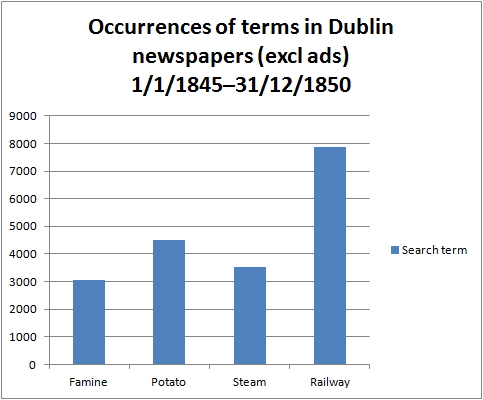
I thought it would be interesting to ask the British Newspaper Archive what people were reading about in newspapers published in Dublin between 1 January 1845 and 31 December 1850. The BNA has scans of two Dublin newspapers for that period, the Freeman’s Journal and the Dublin Evening Mail. I used the archive to search for four different words in those newspapers in that period; I then counted the numbers of results.

On the first round, I included ads and family notices.

Newspaper terms incl ads 1845–1850

Terms in Dublin newspapers (incl ads) 1845–1850

I guessed that the numbers for steam and railway might be exaggerated by their inclusion in ads so, on the second round, I excluded both ads and family notices. The result was as expected.

Newspaper terms excl ads 1845–1850

Terms in Dublin newspapers (excl ads) 1845–1850

I then asked Google’s Ngram machine to count the numbers of occurrences of four pairs of words between 1845 and 1850. I asked it to do a case-insentitive search, but it can’t do that for “compositions” (combinations of words), so it counted:

Ireland+potato
Ireland+steam
Ireland+famine
Ireland+railway.

Here is what it came up with, but whence I know not, other than that it searched the corpus English. The embedding process doesn’t seem to be working, so I’ve left the code here but also cut and pasted the output.

Google Ngram

Google Ngram

I suspect that, in recent times, the amount written about steam and railways of the period 1845–1850 in Ireland has been rather less than that about potatoes and the famine.


The Mahmoudié Canal

There is a possible link between the Mahmoudié Canal, which ran from Alexandria to the Nile, and Irish waterways. I have not managed to establish a definite link to this Irish canal-boat but it is not ruled out either, and a few other Irish connections came up along the way: Oscar Wilde’s father, for instance, who wrote about the Boyne and the Corrib, and sent his most famous son to school on the Erne, travelled on the Mahmoudié Canal.

And did you know that, in the early 1840s, you could buy bottled Guinness and Bass in Cairo? Or that, to transport 50 people (including 12 ladies and 3 female servants) and 3 bags and 62 chests of mail across 84 miles of desert, you would have needed, in 1841,

  • 130 camel men, donkey men and servants
  • an escort of 17 Arab horsemen
  • 145 camels
  • 60 donkeys
  • 12 saddle horses
  • 12 carriage horses
  • 7 carriage camels
  • 12 donkey chairs: “for invalids, or ladies, the donkey-chair forms as easy a conveyance as a palanquin or sedan”
  • 3 two-wheeled carriages
  • 1 four-wheeled carriage?

Or that, to reduce the number of rats and insects on a cangia (sailing boat) on the Nile, you should sink it for two or three days before boarding?

You can read about all of that and more in this PDF. However, it’s not for the faint-hearted: it’s 51 pages, with over 300 endnotes (which you don’t have to read) and lots of links for those who are really interested. There are illustrations in some of the linked materials.

The Mahmoudié mystery v04 iwh [PDF]

More reading material

A bit of a break from the politicking ….

First,  the long-awaited second edition of David Walsh’s extraordinary book Oileáin is now available from Pesda Press. It’s an exhaustive guide to the islands around Ireland, seen from a sea-kayaker’s perspective. It tells you where they are, how you get there, what the tides and currents and hazards are, whether you might be able to camp …. A lot of this is, of course, aimed mainly at folk rather more athletically minded than I am, but I got it for its information about the islands in the Shannon and Fergus estuaries. David’s website keeps an electronic version updated, so that you can check the latest information before you set off, but even if you’re unlikely to start paddling to the Skelligs yourself you may find the information and the photos of interest.

Shannon enthusiasts will be familiar with Richard Hayward’s Where the River Shannon Flows, written as Hitler’s war was breaking out. It is an account of a road trip down the Shannon during which a film about the river was being made: the party was in Portumna when Hayward heard, on a wireless set through a window, that Britain was at war with Germany. I was privileged, some years ago, to be able to see the film and to match it with the scenes from the book, from which L T C Rolt drew information for his Green and Silver. Hayward was a proud Ulsterman, but one who was happy to meet, converse and exchange songs with anyone of any creed anywhere in Ireland. He was, if I remember correctly, a confectionery salesman by way of a day job, but more importantly he was an actor, a writer and a singer. His style is of its time, and perhaps rather laboured by modern standards, but he was a decent skin and I haven’t read anything of his that I didn’t enjoy. I am pleased to learn that a biography, An Unrepentant Romantic — the life and times of Richard Hayward by Paul Clements, is due to be published by Lilliput Press in May.

In the same month, UCD Press is to publish James Murphy’s Ireland’s Czar: Gladstonian government and the lord lieutenancies of the Red Earl Spencer, 1868–86. That’s this chap here, whose claim to fame is that he has a dock on the Royal in Dublin, and a harbour on Lough Allen, both called after him.

I don’t know whether I want to shell out €50 for Nigel Everett’s The Woodlands of Ireland, 700–1800 [Four Courts Press, May], but I like the idea that it

Focuses on the fundamentally pragmatic and commercial view of trees adopted by Gaelic civilisation, and the attempts of the various Anglo-Irish administrations to introduce more conservative woodland practices into Ireland.

Cad a dhéanfaimid feasta gan adhmaid? Why, we’ll import seacoal from Whitehaven, of course.

Finally, I am hoping that Joe Curtis’s Terenure: an illustrated history [The History Press, Ireland, March] will have more information about the remarkable Bourne family.

The information on forthcoming books comes from the magazine Books Ireland, which was until recently edited by old Shannon hand (and, if I mistake not, former Ditchcrawler) Jeremy Addis. Jeremy has now passed over the tiller and the magazine is now edited by Tony Canavan and published by Wordwell.


Shannon traffic 2013

Some weeks ago Waterways Ireland kindly supplied me with the Shannon traffic figures for the final three months of 2013 and I have just now had a chance to add them to my spreadsheets and produce some graphs.

The usual caveats apply: the underlying figures do not record total waterways usage (even for the Shannon) as, for instance, sailing, fishing or waterskiing on lakes or river stretches, which did not involve a passage through a lock or Portumna Bridge, would not be recorded. The passage records are our only consistent long-term indicator of usage of the Shannon but they would not show, for instance, a change in the balance of types of activities from those in larger cruising boats to those in smaller (sailing, fishing, waterskiing) boats. On the other hand, they do include the Shannon’s most significant tourism activity, the cruiser hire business.

It is good to note, incidentally, that, in its draft Corporate Plan 2014–2016, Waterways Ireland says that it intends to

Develop and implement a research programme to measure waterway usage and inform planning and development.

It won’t be easy to do, but we need much better measures of all types of activities on all seven of the waterways managed by WI.

The final outcome for 2013 won’t greatly surprise anyone who has read earlier bulletins on this subject, like this covering the figures to end-September 2013. All the illustrations are based on information supplied by Waterways Ireland, with some minor adjustments by me to eliminate anomalies, but the interpretation and comments are mine own.

All boats full year

Total Shannon traffic 2003–2013, private and hired

The decline in traffic since 2003 seems to have been halted …

All boats full year %

Total Shannon traffic as a percentage of 2003 traffic

… but it is 40% below what it was in 2003.
Private boats full year %

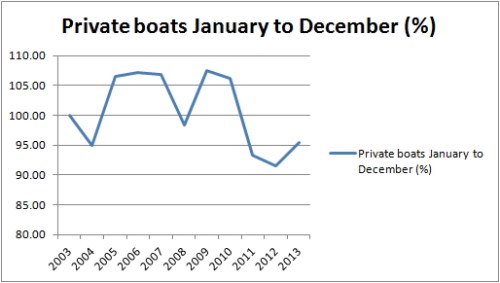
Private-boat traffic 2003–2013 as a percentage of 2003 traffic

Traffic in private boats seems to be recovering, but what is perhaps more significant is that it never went more than 10% above or below the 2003 figure. It has been remarkably stable over the period, despite the economic crash and despite the anecdotal evidence of boats being sold to overseas owners and trucked out of the country. Perhaps larger boats were replaced by smaller? Perhaps only boats bought in the boom were sold in the bust? Unfortunately the deficiencies of the registration system make it very difficult to determine what has been happening.

Hire boats full year %

Hire-boat traffic 2003–2013 as a percentage of 2003 traffic

But if private-boat traffic has been remarkably stable since 2003, the same cannot be said of hire-boat traffic. The best that can be said of 2013 is that the figures didn’t get [much] worse, but a 60% decline since 2003 is really, really dreadful.

WI’s draft Corporate Plan, which does not explicitly mention the hire industry, talks of

… unlocking opportunities to achieve recreational growth, and economic and social development.

I don’t know whether that omission means that WI sees little prospect of a rejuvenated hire-boat industry. And I note that, other than in the titles of organisations, the draft plan rarely mentions tourism or tourists. Are the waterways only for natives? If so, is that a deliberate policy decision? Or is there something that could be done, cheaply, to help to revive waterways tourism?

Emma Kennedy, writing in the Sunday Business Post on 23 February 2014, wrote about Fáilte Ireland’s latest brainwave, which is to “target” three groups:

  • social energisers, which are gangs of young people interested in “new and vibrant destinations”, which I take to mean Temple Bar
  • culturally curious folk aged 50 or over, with money, who are interested in “exploring new landscapes, history and culture”
  • great escapers, who like energetic rural holidays with their partners.

No families with kids, I see, although “Families & Loved Ones” (the latter term, by the way, nowadays seems to mean either dead people or their relicts) were one of the two “primary target customer segments” identified in Fáilte Ireland’s Inland Cruising Market Development Strategy. (Fat lot of good that strategy did, but we mustn’t be bitter.)

Anyway, without having done any market studies (though WI has funded lots of them), it seems to me that there is scope for more tourism on the waterways, but it might not be on traditional cruisers. It might involve outdoor activities like cycling and walking along the canals and Barrow: WI’s plan discusses them, but without adverting to an overseas market. And it might involve small-boat activities — canoeing, touring rowing, small-boat sailing, camping — on Shannon, Erne and SEW: WI says it will support micro-enterprises, and those providing outdoor activity holidays may need expertise and assistance rather than hard cash.

I admit to having little evidence on this, but it seems to me to be too early to give up on the tourism potential of the waterways. And the decline of the cruiser hire business does not necessarily mean that all waterway tourism is doomed.
Private -v- hire full year

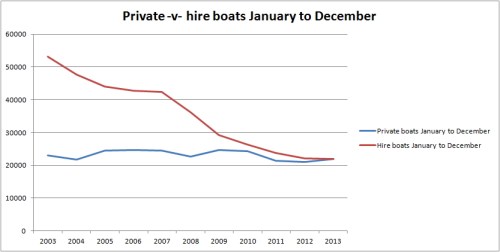
Private boats overtake hire boats

That said, 2013 was the year when, for the first time since Noah was an Able Seaman, the number of passages by private boats exceeded that by hire boats.
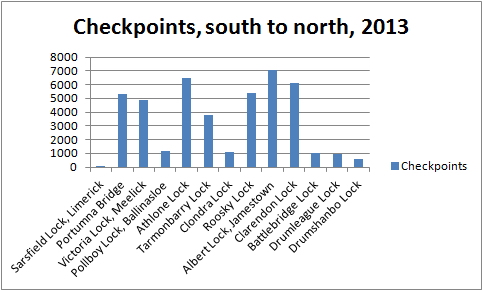
Checkpoints 2013

The points at which numbers were recorded

Finally, this chart suggests that any structures that were not built by the Shannon Commissioners in the 1840s will not attract many visitors. The extensions off the main stem of the Shannon — south to Limerick, west to Ballinasloe, east through Clondra, north to Lough Allen — are much less used than the main line from Lough Derg to Lough Key. It seems unlikely that any further extensions, especially to small towns that it would take three hours (at canal speed) to get to, are likely to be any more successful in attracting traffic.

The Gillogue railroad

Gillogue, in Co Clare, is the site of a former Burlington factory and of a Clare entrance to the University of Limerick. It is also the site of a lock on the Plassey–Errina Canal, a section of the old Limerick Navigation, and of quarries, gravel pits and lime kilns.

And, according to the 6″ Ordnance Survey map, of around 1840, Gillogue also had a railroad.

The Gillogue rail road

The Gillogue rail road (click to enlarge)

The railroad was almost certainly not for carrying passengers; it may have been a light railway, with small wagons pushed by men or pulled by horses, and designed to be taken up and moved elsewhere fairly easily. However, I have no hard information about who owned it, who built it or what it was for. I can make guesses, based on its closeness to the canal and to the quarries, but it would be nice to have evidence.

If, Gentle Reader, you know anything about it, do please leave a Comment below.

My OSI logo and permit number for website

Relieving Athlone

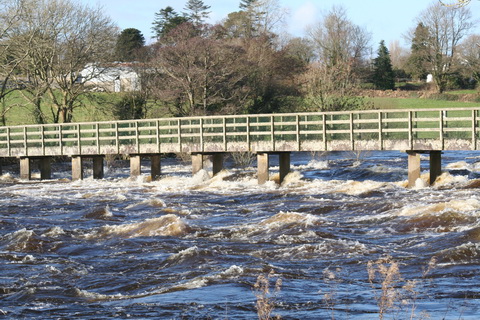
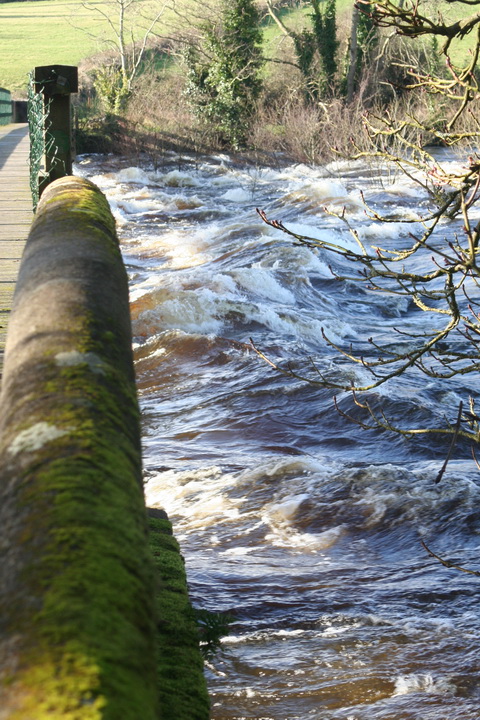
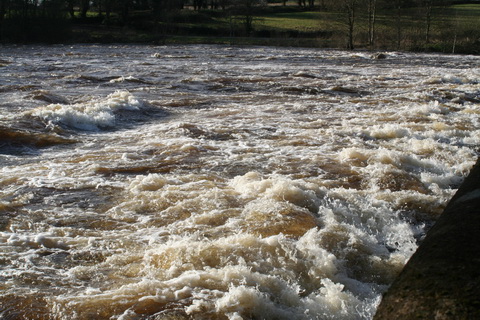
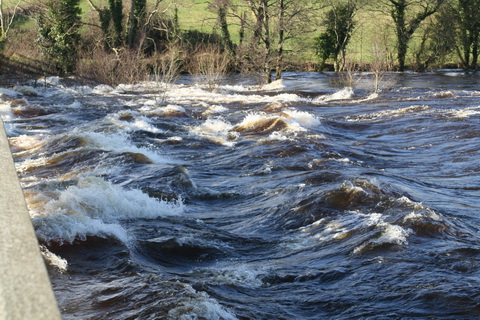
Parteen Villa Weir is sending large amounts of water down the original channel of the Shannon, and over the Falls of Doonass, to draw water off from the upper reaches of the river.

Castleconnell water level 20140210 264_resize

The footbridge at Castleconnell

Castleconnell water level 20140210 267_resize

Above the bridge

Castleconnell water level 20140210 269_resize

The downstream side of the bridge

Castleconnell water level 20140210 271_resize

A bumpy ride

Castleconnell water level 20140210 273_resize

At normal levels the bottom of the wall is several feet above the water


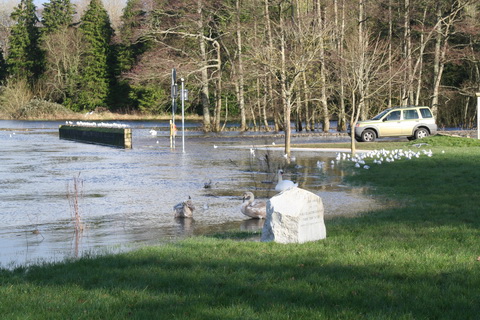
Levels below Parteen Villa have not yet reached those of 2009 and the channel can probably take more before folk get flooded.

The Old River Shannon site has some photos taken at Parteen Villa Weir.

Snails

Snails may save us from restoring the Longford Branch of the Royal. Industrialheritageireland has the story.

Might be an idea to start breeding these snails for judicious use elsewhere.

Jimmy Deenihan, cricketer

Jimmy Deenihan, minister for waterways and some other stuff, supporter of the Lartigue Monorail in Listowel, is known to have played two forms of football: rugby and Gaelic. His cricketing expertise is perhaps less well known but, in a written answer to four Dáil questions yesterday, he showed his mastery of the straight bat.

I was surprised to find Bernard Durkan [FG, Kildare North] referring to “traditional canal boat dwellers”. I suppose it depends on your timescales: in my view, anything that began after 1850 isn’t really traditional.

Drawbacks of canals

There was a proposal in the 1830s for a ship canal along the coast, outside the railway embankment, from Dublin to the asylum harbour at Kingstown. A preliminary report was provided by William Cubitt after the House of Commons Select Committee on the Dublin and Kingstown Ship Canal had reported in July 1833.

Henry E Flynn was opposed to the idea and, in his A Glance at the Question of a Ship Canal connecting the asylum harbour at Kingstown with the river Anne Liffey at Dublin &c &c &c [George Folds, Dublin 1834], dedicated to Daniel O’Connell, he wrote eloquently of the drawbacks of the proposal, which included this:

Be it remembered, that the whole coast from Ringsend to Merrion is the bathing ground for the less affluent classes of the Citizens; and hundreds get their bread by attending on and bathing the females who frequent it.

And are the patriotic Would-be’s who support a Ship Canal equally reckless of the health, the morality, and the existence of those persons? Would they have no objection to expose their mothers, wives, sisters and daughters to the immediate wanton gaze, the scoffs, the jeers, the immodest jest, the filthy exposure and indecent exhibitions which the most abandoned race of men [ie sailors] could find in their dissolute minds to perpetrate in their view, and within their hearing? And yet, all this must be the consequence of a Ship Canal in the immediate vicinity of the female baths and bathing ground along the line.

Happily, the canal was never built.

Who he?

Question 3651, put to George Halpin, Inspector of Works at the Ballast Board, Dublin, at a session of the House of Commons Select Committee on the Dublin and Kingstown Ship Canal on 16 July 1833, Daniel O’Connell in the chair:

Who is Captain Bligh?

A very eminent nautical surveyor. […]

I thought everyone would have known about Bligh: wasn’t he famous for his breadfruit?