Category Archives: Economic activities

Grand Canal announcements

The Grand Canal Company do hereby give Notice, that they are ready to receive Proposals for supplying Ashler Stones for repairing the Locks upon the Grand Canal; the Stretching Stones to be twelve Inches Bond, and the Heading Stones two Feet Bond. All Persons willing to furnish the same, are desired to apply to Captain Charles Tarrant, No 45, Cuffe street, who will inform them where the same are to be layed down. —

Proposals will be received for Building, by Contract, two Boats on the Canal (the Size and Dimentions to be known upon Application as above), the Contractor finding Timber and every Article requisite.

Also for furnishing Lime per Hogshead, in the Neighbourhood of Ballyfermott Bridge.

June 18, 1777. Signed by Order, R BAGGS, Sec

WHEREAS the Sluice erected upon the Canal in the Barrenrath Level, has been wantonly and feloniously broken down, a Reward of Twenty Guineas shall be paid for discovering and prosecuting to Conviction the Person or Persons who have committed the said Offence.

By Order of the Grand Canal Company, June 7, 1777, R BAGGS, Sec

Saunders’s News-Letter 23 June 1777

The Traveller’s Map of the River Shannon (1830)

The Traveller’s Map of the River Shannon. Arranged as a Guide to its Lakes and the Several Towns, Gentlemens’ Seats, Ancient Castles, Ruins, Mines, Quarries, Trading Stations, and General Scenery on Its Banks, Source in Lough Allen to the Sea, Leitrim, Longford, Roscommon, Westmeath, King’s County, Tipperary, Galway, Limerick, Kerry and Clare, Accurately Taken from the Survey made by J. Grantham, by order of the Irish Government, under the direction of the late J. Rennie. Printed and published for the Irish Inland Steam Navigation Company, 1830.

Oblong folio, 15 numbered maps printed in black with river and water features coloured in light blue. Original quarter calf green cloth boards, russet title to centre of upper boards, stamped in gilt with gilt fillet boarder. Repair to rear of plate 15, otherwise all maps in very good to fine condition.

Contents: 1. Map of Ireland, 2. Index Map. Lough Derg to the sea, 3. Index Map. Lough Derg to Lough Allen., 4. Kilrush to Tarbert and Foynes Island, 5. Foynes Island to Grass Island, 6. Grass Island to Limerick and O’Brien’s Bridge. 7. O’Briens Bridge to Killaloe and Dromineer. 8. Dromineer to Portumna and Redwood Castle. 9. Redwood Castle to Banagher, and Seven [Churches (Clonmacnoise)], 10. Seven Churches to Athlone and Lough Ree, 11. Lough Ree to Lough Forbes. 12 Lough Forbes to near Leitrim. 13. Leitrim to Head of Lough Allen. 14. map of Limerick, 15. Map of Killaloe.

Map 1 shows Ireland and its waterways at scale of 1″ equals 20 miles, Maps 2 and 3 show the key for 4-13, with table of falls of water along the route on former and table of distances on latter; Maps 4-14 each have a short descriptive panel; Map 14 shows Limerick from the north of King’s Island to the New Barrack in the south with key Map 15 from the town at left to Beal Boru at right.

Yours for only €1800 at Ulysses Rare Books in Dublin.

Eel fishing

In Foreign Parts.

h/t Tyler Cowen

Goodbye Shannon–Erne Waterway?

Brian Lucey suggests that we should consider [note: not that we should definitely decide on] sealing the border with Northern Ireland. That would mean running a wall down the middle of the Woodford River section of the Shannon–Erne Waterway and would put paid to this business idea. We could of course cover it with solar panels, but I hope Prof Brian isn’t suggesting the Mexicans should pay for it.

Manby, Napier, Oldham, Williams, Grantham

Here is a piece about the Aaron Manby, the first iron steamer to make a sea voyage, and its links to Irish inland waterways transport.

The piece was first published in the rally magazine of the Inland Waterways Association of Ireland Lough Derg Branch in July 2017.

Handsacrosstheborderism

I see from the blatts that there are

Fears over future of Narrow Water bridge project

and that

Planning permission for development at Carlingford Lough due to expire in October.

This is encouraging: I hope that the planning permission will be allowed to expire, unmourned by anyone, and that the project will be buried at the crossroads with a stake through its heart.

Like the Clones Sheugh, this scheme put symbolism over practicality and usefulness. It would require motorists from the south to drive to the middle of nowhere to cross the Newry River, when what is needed is an eastern bypass of Newry. Those living towards the eastern end of Carlingford Lough would be better served by a ferry, and I see that such a service is now proposed, to run between Greenore and Greencastle.

The only possible justification for the proposed bridge would be to build it without access roads, name it Garvaghy Road and allow — nay, sentence — Orange Order members to march up and down it in perpetuity.


R&CHS Longford

The current issue of the Railway & Canal Historical Society‘s Journal contains an article on the sinking of the passage boat Longford on the Royal Canal in 1845 and the fifteen deaths that resulted. The story has also been told here, starting from this page.

The Lady of the Shannon

Folk interested in early steam transport in Ireland may wish to know that the latest issue [Vol 41] of The Other Clare, journal of the Shannon Archaeological & Historical Society, has an article, “Mr Paterson’s steamer”, about the Lady of the Shannon, the steamer built on the Clyde in 1816 for James Paterson of Kilrush.

While the steamer and its operations are well known (see for instance the page by Senan Scanlan on the Clare County Library site), a lack of contextual information has meant that the scale of Paterson’s achievement is not widely appreciated. His steam boat was built only four years after PS Comet, Europe’s first commercially viable steamer, began operations on the Clyde. Paterson, who built baths at Kilrush at the same time as he acquired his steamer, may have intended to imitate Henry Bell’s operations.

At the time, most steamers operated on rivers and estuaries, but some undertook longer delivery voyages to new areas of operation in Britain and Europe. But Paterson’s may have been the first to brave the rigours of the Atlantic: it probably travelled west off Ireland’s north coast, and then down the west coast to the Shannon. Ensuring that coal was available along the way must have required a good deal of planning.

Commercially, Paterson’s steamer was not a long-term success, and the possible reasons for its failure are explored briefly in the article.

The Shannon Archaeological & Historical Society does not itself appear to sell its journal online; Scéal Eile Books in Ennis may be able to supply it by post, as may the Celtic Bookshop in Limerick.

A post-Brexit business opportunity

While running trip-boats has not always been the way to wealth on Irish waterways, we must always be alert to new business opportunities arising from changing circumstances. Brexit, the impending departure of HM Realm from the European Union may offer one such opportunity for a tourism-related business on the Shannon–Erne Waterway, perhaps around Aghalane.

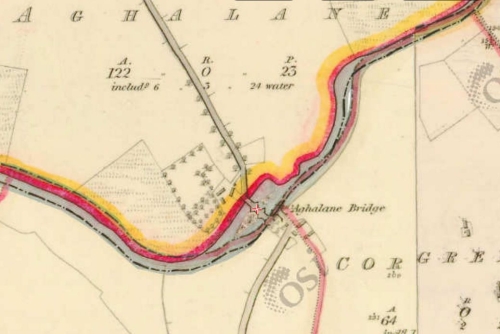
The old bridge at Aghalane (OSI ~1840)

Here, scenic boat trips could be provided. Of course not everybody likes long boat trips, so there could be a market for short trips, perhaps from one side of the Woodford River (which here constitutes the Shannon–Erne Waterway) to the other.

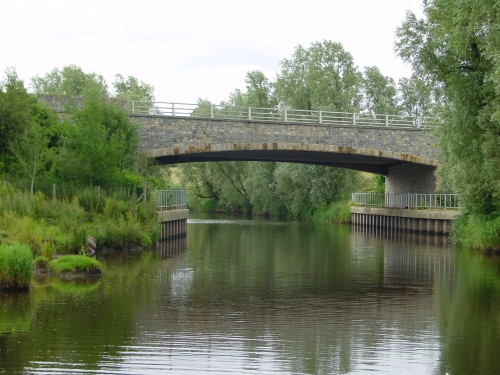
The new bridge at Aghalane

Such trips could feature in package tours, including flights into Ireland, accommodation and leisure activities. But the Irish tourism board (whatever it’s called nowadays) needs to open up new markets: these tours might be attractive to our fellow-EU citizens from Eastern Europe.

There is another possibility for development here, combining economic growth with humanitarianism. Ireland could offer to open refugee camps in the area, thus sharing the burden with Calais, Greece, Italy and other places currently accommodating these unfortunates. This would not be entirely selfless: there would be a stimulus to the local economy from the construction and operation of the camps. Should demand for camps along waterways exceed supply, the re-opening of the Clones Sheugh could be considered.

I regret that the north side of the river is blank on the modern OSI map; that area is part of the United Kingdom of Great Britain and Northern Ireland.

Ardnacrusha tours

From 26 June through 1 September 2017, ESB will be providing guided tours of Ardnacrusha hydroelectric power station. It’s not usually open to the public and, if you haven’t seen it, it’s well worth a visit. Go here to book.

I have some information about the site here, here and here, but you should try to see it for yourself.

Update July 2018: tours available again this year.