Scalded Pigs, 33s to 34s per cwt; Singed 35s to 36s; Pigs Heads, scalded, 25s; Singed, 26s; Offal, 20s; Pigs Feet, 12s to 00s [sic] per cwt.
From the Limerick Market Note in the
Limerick Reporter 26 May 1840

Scalded Pigs, 33s to 34s per cwt; Singed 35s to 36s; Pigs Heads, scalded, 25s; Singed, 26s; Offal, 20s; Pigs Feet, 12s to 00s [sic] per cwt.
From the Limerick Market Note in the
Limerick Reporter 26 May 1840
A steamer called the Clarence served on the Shannon estuary in the 1830s. There are different accounts of when she left the Shannon. Here is an attempt at resolving the problem.
According to the Clydebuilt database of ships on www.clydesite.co.uk, a paddle steamer called the Clarence was built in 1827 and “launched on” by Robert Napier of Govan. A note to the entry says that this was presumably the same vessel as that listed for Denny.
The Denny entry says that a 70-ton wooden paddle steamer called the Clarence was “launched on” in 1827 by William Denny and A McLachlan of Dumbarton for R Napier. Its owners are listed as R Napier and, from 1829, “Inland Steam Nav Co, Limerick”; it is said to have run between Limerick and Clare Castle on the River Shannon between 1829 and 1840.
The Clydeships database has one entry for Clarence, a wood paddle steamer launched in 1827 by Messrs Lang & Denny of Dumbarton. A passenger vessel, its tonnage is given as 60 nrt, 70 om, 60 nm. Its dimensions are given as
Length 92′ 0″
Breadth 16′ 3″
Depth 8′ 0″
Draft —
Its 45hp beam engine was supplied by Robert Napier & Sons and its first owner was Robert Napier of Glasgow; it served Glasgow, Greenock and Helensburgh. It is said to have been owned by the Carlisle Canal Company (The Carlisle and Annan Steam Navigation Company) from 1839 and used for passenger tendering and for towing between Annan Water-Foot and Port Carlisle. Its dimensions in 1839 are given as 96.9 x 15.1 x 8.0 ft. It went on fire in 1846 and, after repair, was used on the Eastham Ferry service on the Mersey. The Clydeships site does not mention any service in Ireland.
D B McNeill, in Irish Passenger Steamship Services Volume 2 South of Ireland (David & Charles, Newton Abbot 1971) says that the Clarence, built in Dumbarton in 1827, was the first steamer on the Shannon estuary [he omits the Lady of the Shannon, the Mona and the Kingstown], having been reported in 1829 as working between Limerick and Clare Castle. He says
Trade must have been bad, for in 1833 she was back on the Clyde working from Gareloch.
He agrees that Clarence was a wooden paddle steamer built in Dumbarton; he gives her dimensions as 92 ft by 16 ft, with a single-expansion steam engine; he says she was broken up around the 1840s.
Malcolm McRonald, in his invaluable The Irish Boats Volume 1 Liverpool to Dublin [Tempus Publishing Limited, Stroud 2005], says that the City of Dublin Steam Packet Company operated the Mona on the Shannon estuary in 1829 and the Kingstown in 1830, then abandoned the estuary later in 1830 and resumed it in 1832 [the Kingstown operated on the estuary until at least the end of November 1830 and was there in April 1831]. The service was resumed, McRonald says, “using the chartered Clyde steamer Clarence“, which also operated there in 1833 and 1834.
Clarence was back on the Clyde in 1835, but returned to Limerick by 1837, to operate a service from Limerick to Clarecastle and Ennis. […] Clarence was sold to the Carlisle Canal Co in 1838, but there is conflicting evidence over her date of departure from the Shannon. She was advertised on the Clare service as late as April 1840, although the local Carlisle newspaper had expected her in service there in June 1838. [page 20]
In the fleet lists, McRonald shows the Clarence as having been 96′ 10″ X 15′ 2″ X 8′ 0″, 70 gross tons, made of wood, with a 45hp condensing steam engine. She was built, he says, in 1827 by James Lang of Dumbarton, for Robert Napier of Glasgow, who also provided the engines. She was chartered to the City of Dublin Steam Packet Company from 1832 to 1839, then sold to the Carlisle Canal Co.
The accounts by McNeill and McRonald suggest that there was a single steamer called the Clarence, which moved to the Shannon in 1829 [McNeill] or 1832 [McRonald], then to the Clyde in 1833 [McNeill] or 1835 [McRonald], then back to the Shannon in 1837 before being sold to the Carlisle Canal Company in 1838 or 1839 [McRonald]. McRonald does note, however, that the Clarence was advertised as running on the Shannon in 1840.
Steamers did move between stations and owners or operators, and could thus serve in two areas in the same year. However, I think that the evidence of the Clarence‘s activity on the Shannon is strong enough to show that there must have been two steamers with that name: one which started on the Clyde and was bought by the Carlisle Canal Company in 1839, the other serving on the Shannon until 1841.
McNeill says that the Clarence was back on the Clyde in 1833. The Morning Post of 27 August 1833 quoted the Limerick Chronicle of 21 August 1833, which said that the Clarence had carried Captain Brown’s company of the 28th Regiment from Limerick to Kilrush on the previous day; it had also carried some detachments to the forts of Tarbert and Carrig Island. There are similar reports for July and September.
McRonald says that the Clarence operated on the Clyde between 1835 and 1837. Yet she is shown operating on the Shannon in City of Dublin Steam Packet Company ads for June, July, August and October of 1835, for every month in 1836 and for every month in 1837.
To judge by the local newspapers, it was in 1839, not 1838, that Carlisle acquired a Clarence steamer. The Carlisle Journal of 12 January 1839 said that the canal company and the two steam companies had purchased a steamer called Clarence from Robert Napier of Glasgow: 96′ X 16′ X 8′ depth of hold, with a 45 hp engine and very handsome cabins, being “fitted up entirely for passengers”, although she was intended to tow lighters too. She was having an overhaul and a new boiler and was expected in Carlisle in two or three weeks.
On 23 February 1839 the Carlisle Patriot carried an ad seeking a master for the Clarence; it seems that Thomas Maling got the job, as the Patriot named him as master in its report, on 20 April 1839, of a collision involving the Clarence. On 1 July 1839 she took fifty gentlemen — the Managing Directors of the Carlisle and Newcastle Railway, the Commissioners of the Nith Navigation, the members of the two Carlisle and Liverpool steam navigation companies, all invited by the Commissioners of the Carlisle Canal Company — on a voyage of inspection of the buoyage of the Solway. Dinner was provided by Mr Gray of the Coffee House but, after the meal, the toasts and the speeches, several of the gentlemen were seasick on the way home. The voyage was reported in the Ayr Advertiser, or West Country Journal on 4 July 1839 and in the Carlisle Journal on 13 July 1839.
It is clear, then, that there was a Clarence on the Solway Firth in 1839. However, both during and after 1839 the Clarence continued to be advertised as serving on the Shannon. A long-running series of ads promoted “Cheap travelling between Dublin and Limerick” using the boats of the Grand Canal Company from Dublin to the Shannon and the steamers of the City of Dublin Steam Packet Company on the inland Shannon and its estuary. The estuary section began
GARRYOWEN, KINGSTOWN AND CLARENCE
Steamers on the Lower Shannon
The ads appeared in many Irish newspapers and the series ran until 13 March 1841 when it appeared in the Warder and Dublin Weekly Mail. The ads were not updated to reflect seasonal changes in the estuary steamers’ sailings, but a paragraph about the service from Limerick to the town of Clare [now Clarecastle, near Ennis] was dropped in 1840. That presumably signified the ending of the service, but the Clarence continued to be listed amongst the estuary steamers until the ad’s final appearance in March 1841.
Up to December 1840, the City of Dublin Steam Packet Company ran its own series of ads, promoting its Irish Sea as well as its inland services, and listing its vessels. The list included the Clarence and the Kingstown amongst those “Plying on the Shannon”, for instance in the ad in the Dublin Weekly Herald of 12 December 1840. That ad does not seem to have been used in 1841.
The company also advertised in local newspapers: in 1839 the Clarence was mentioned in ads in the Clare Journal, and Ennis Advertiser on 2 May, 2 September, 7 October and 16 December. The same paper mentioned the Clarence in news reports on 30 May 1839 and 7 May 1840.
In 1841 the City of Dublin Steam Packet Company bought the Dover Castle from a rival operator on the Shannon estuary; its new-built iron steamer Erin go Bragh also joined the estuary fleet. The Clarence and the Kingstown seem to have left the estuary service at or around that time, the Clarence going first: the company’s ad in the Limerick Reporter of 9 March 1841 mentions the Kingstown and the Garryowen but not the Clarence. By 11 May 1841, ads in the same paper listed the Garryowen and the Erin go Bragh; the Kingstown was no longer mentioned.
I have not been able to find any information about the history of the Clarence before it came to the Shannon estuary or after it left the estuary service. However, because there is so much evidence that a Clarence was still in service on the estuary after a Clarence was bought by the Carlisle Canal Company, I cannot accept that the two Clarences were the same vessel. I believe that there must have been a Shannon Clarence as well as a Clyde/Carlisle Clarence.
The newspapers referred to here were found on the British Newspaper Archive, a service is owned and run by Findmypast Newspaper Archive Limited in partnership with the British Library.
Posted in Canals, Charles Wye Williams, Economic activities, Extant waterways, Foreign parts, Forgotten navigations, Historical matters, Ireland, Irish inland waterways vessels, Operations, Passenger traffic, Sea, Shannon, shannon estuary, Sources, Steamers, waterways, Waterways management
Tagged Carlisle Canal Company, City of Dublin Steam Packet Company, Clare, Clarecastle, Clarence, Clydebuilt, Clydeships, D B McNeill, Dover Castle, Ennis, Erin-go-Bragh, Garryowen, Kilrush, Kingstown, Limerick, Malcolm McRonald, Robert Napier, Tarbert
From our own correspondent, Dublin, Dec 11
You may remember a statement I sent last week, respecting the arrival of the Penelope war steamer, with six gun-boats of formidable calibre, which were sent down by the Grand Canal to Banagher, in order to guard the pass across the Shannon between Leinster and Connaught. A letter which I have seen this morning, from that place, announced that the gun-boats reached their destination, but, strange to say, no one can be induced to come forward and take charge of them. All persons in authority, who had been applied to, disavowed all responsibility regarding them; and an application has been made to the Castle on the subject, to ascertain what is to be done with these formidable gun-boats. The wisest course would be to take them back to the dock-yard from whence they have been imported.
Morning Chronicle 13 December 1843
Posted in Canals, Extant waterways, Historical matters, Ireland, Irish inland waterways vessels, Operations, Shannon, Steamers, waterways
Tagged Banagher, Grand Canal, gunboat, Penelope, Shannon, steamer
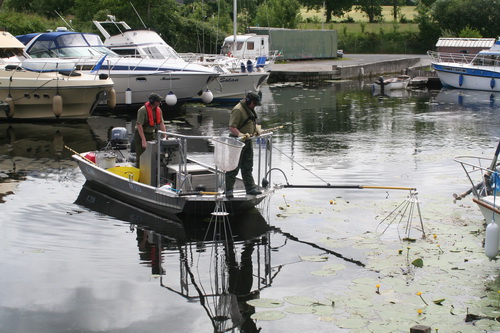
Who are these chaps? What are they doing? Why are they doing it in a marina on Lough Derg? Are they inserting large numbers of volts into the water and, if so, what effect might that have on boats? Answer on a postcard, please.
To take place on 1st and 2nd Oct, 1850
£ s d
1st For all Four Oared Gigs 5 0 0
Entrance 0 10 0
Second boat to save entrance money
2nd For all First Class Cots 3 0 0
Entrance 0 5 0
Second Boat 0 15 0
3rd For all Fishing Cots to be rowed down stream and polled back with 2 Polls
First Boat 2 10 0
Second do 0 15 0
Entrance Each 0 2 6
4th For all Cots to be paddled down River with 2 Paddles and polled back with 2 Polls
First Boat 1 10 0
Second Boat 0 7 6
First — For all Four Oared Gigs 4 0 0
Entrance 0 2 6
Second Boat to save Entrance Money
Second — For all Fishing Cots to be rowed with
two oars and a paddle 2 0 0
Second Cot 0 10 0
Entrance 0 2 6
Third Race — For all Fishing Cots to be rowed
down the river with two oars and paddled
and polled back with two poles 1 10 0
Second Boat 0 10 0
Entrance 0 2 6
Fourth Race — For all Fishing Cots with
one paddle 1 0 0
Second Boat 0 5 0
Six to start or no race
NB No Race for any of the above Plates, unless 3 Boats start.
The decision of the Stewards to be final in all cases, and by whom the distance on the river will be laid out.
Boats for the First Race to start at Ten o’Clock precisely, and to be entered at Mr Wilson’s before Ten o’Clock each day.
An Ordinary at Wilson’s Hotel each day.
There will be a Ball at the Old Assembly Rooms, of which further notice will be given on Saturday.
Sir Richard De Burgho, Bart
Colonel Vandeleur
Captain Wyndham 1st Royals
S Vansittart 1st Royals
A Vincent Esq
A W Heard Esq
Limerick and Clare Examiner 25 September 1850
From the British Newspaper Archive run by Findmypast Newspaper Archive Limited, in partnership with the British Library.
On Friday, 25th ult, the Antrim and Tyrone Lough Neagh Steam Ferry Company’s first boat, the Enterprise, was launched from Port Armagh, on the Tyrone side of Lough Neagh. She is a most beautiful boat, and does great credit to Mr Hiram Shaw, of this town, for his exertions in bringing her out in such fine style. Her engines were built by M’Adam, Currell, and Company, of Belfast.
The Vindicator, Belfast 7 August 1839
From the British Newspaper Archive run by Findmypast Newspaper Archive Limited, in partnership with the British Library.
[Notes: I do not know where Port Armagh is or was. The Enterprise is not mentioned in D B McNeill Irish Passenger Steamship Services Volume 1: North of Ireland Augustus M Kelley Publishers, New York 1969]
Posted in Economic activities, Engineering and construction, Extant waterways, Foreign parts, Forgotten navigations, Historical matters, Ireland, Irish inland waterways vessels, Operations, Passenger traffic, People, waterways
Tagged Antrim, belfast, Enterprise, Hiram Shaw, Lough Neagh, McAdam Currell and Company, Port Armagh, steam ferry, tyrone
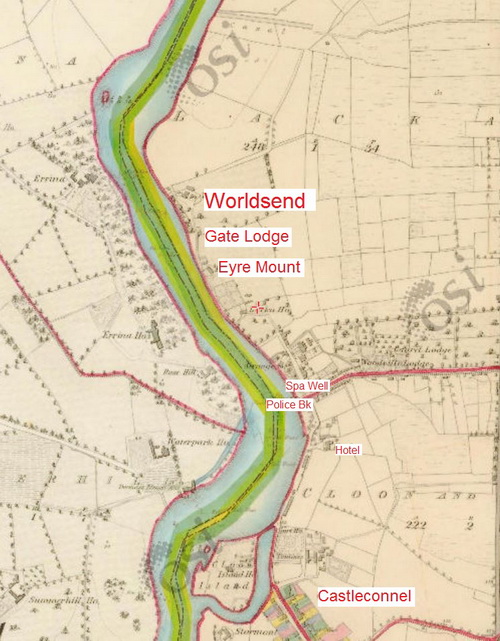
The authors of a book called Village by Shannon, about Castleconnell, Co Limerick, say that the area of Worldsend, at the northern end of Castleconnell, derives its name from Worrall’s Inn, an establishment operated by a Mr Worrall in the early eighteenth century.
That may be so, but the book’s accounts of river-borne traffic — to a quay at the inn — do not seem to accord with what is known about the history of the Shannon navigation, and in particular of the Limerick Navigation between the city and Killaloe. Here are some of the problems.
Posted in Ashore, Built heritage, Canals, Charles Wye Williams, Drainage, Economic activities, Engineering and construction, Extant waterways, Forgotten navigations, Historical matters, Industrial heritage, Ireland, Irish inland waterways vessels, Operations, Passenger traffic, People, Shannon, Sources, Steamers, waterways, Waterways management
Tagged Castleconnell, convicts, Errina, inn, Killaloe, Limerick, Limerick Navigation, O'Briensbridge, Plassey, Shannon, steamer, World's End, Worldsend, Worrall
The City of Dublin Steam Packet Company have kindly given the use of the Dover Castle, steamer, to the Ladies of Limerick, for Friday next, when the ceremony of laying the foundation stone of the New Docks will be performed. A band will be on board the steamer.
Limerick and Clare Examiner 4 July 1849
Immediately alongside the spot where the stone was to be placed floated the Dover Castle steamer, filled principally with ladies. The excellent Band of the 74th Highlanders was also on board, and contributed much to the delight that animated many a countenance. Several boats and barges were also provided for the accommodation of ladies. Most of the spectators were invited by Cards issued from the Office of Public Works.
Limerick Reporter 6 July 1849
Loud cheering attested the joy that pervaded every bosom at the prospect of employment, which the ceremony held out. The Dover Castle, moored within a few yards of the large platform, was, as a matter of course, the most attractive appendage. It was occupied by the ladies of Limerick. They, too, evidenced by waving their white handkerchiefs (the symbol of their purity, their virtues and sympathy for the suffering poor) how sincerely they felt the importance of the occasion. A stream of music was then poured forth by the beautiful brass band of the 74th, which was quite in keeping with the general harmony.
The proceedings of the day were then brought to a pleasing and chearful close. The military filed off; the Artillery withdrew; the masts and pinnacles became deserted; the groups, about the ground, dissolved; the Corporate functionaries retired; the mace-bearer beat a modest retreat; the ladies were led off by their attendant squires; the people wended their way homewards, the boats disappeared, and the Dock works and ground were left to the sole possession of their ordinary occupants.
May we not hope — at all events, let us pray, that yesterday was an auspicious day for Limerick.
Limerick and Clare Examiner 7 July 1849
From the British Newspaper Archive run by Findmypast Newspaper Archive Limited, in partnership with the British Library.
Posted in Ashore, Built heritage, Charles Wye Williams, Economic activities, Engineering and construction, Extant waterways, Historical matters, Industrial heritage, Ireland, Irish inland waterways vessels, Operations, Passenger traffic, Sea, Shannon, shannon estuary, Sources, Steamers, Waterways management
Tagged City of Dublin Steam Packet Company, Dover Castle, floating docks, foundation stone, handkerchiefs, Ireland, ladies, Limerick, purity, Shannon
A superb boat or gondola has been recently finished at the Grand Canal, and is painted and decorated in a most elegant manner. It is of a smaller size than the packet boats, and intended for convenience or pleasure of the directors of that great national and useful undertaking, in order to make occasional excursions therein on the different lines of that navigation — it now lies in one of the harbours near the city Bason.
Saunders’s News-Letter 20 April 1795
The elegant gondola which we mentioned to be lying at the Canal Harbour, and to be intended for the use of the Directors, we learn is not for the use of those Gentlemen, but to carry passengers from and to Portobello, to and from the first lock to meet the passage-boats (as lately advertised) and to gratify with a short voyage on the Canal, from Portobello to James’s-street Harbour, such persons as, having no call of business or pleasure towards the county of Kildare, have not otherwise an opportunity of enjoying that gratification, which latter use of the boat is now making by many persons every fine day.
Saunders’s News-Letter 23 April 1795
From the British Newspaper Archive run by Findmypast Newspaper Archive Limited, in partnership with the British Library.
Charles Connors, of Castleconnell, cot builder, has been committed to Killaloe bridewell, for violating the person of a servant girl on Monday morning, at the Doonass side. He crossed the river in a boat, upon the pretence of ferrying her over, and then committed the offence.
Tipperary Vindicator 9 December 1859
From the British Newspaper Archive run by Findmypast Newspaper Archive Limited, in partnership with the British Library.
Posted in Ashore, Extant waterways, Historical matters, Ireland, Irish inland waterways vessels, People, Shannon, waterways
Tagged boat, bridewell, Castleconnell, Connors, cot, Doonass, ferry, Killaloe, Shannon, violating the person