Category Archives: Tourism

Tepid baths

1823

KILRUSH HOTEL, AND TEPID BATHS

This Elegant Establishment is fitted up in a superior style for the accommodation of Visitors, on the reduced terms of last Season.

The House adjoining the Hotel, now occupied by Mrs Colonel Stammers, of Cahernelly, will be Let, from the 12th of June, for the remainder of the Season; it has ample accommodation for a large Family, who can be supplied with any thing they may require from the Hotel; they will also have the use of the Bathing Machines and Bathing Houses — from this House to the Tepid Baths there is a covered passage.

The Lady of the Shannon steam packet sails from Limerick for the Hotel, on Tuesdays, Thursdays and Saturdays, and returns on Mondays, Wednesdays and Fridays, making her passage in five hours.

Kilrush, May 15th, 1823

Dublin Evening Post 20 May 1823. From the British Newspaper Archive run by Findmypast Newspaper Archive Limited, in partnership with the British Library.

1829

[…] The hotel and baths, for which this Town was remarkable, have been suffered to go to decay — at least, are not occupied as such at present.

Limerick Evening Post 8 May 1829. From the British Newspaper Archive run by Findmypast Newspaper Archive Limited, in partnership with the British Library.

The disappointed steamer

For one brief moment it seemed that the humble steamer Ballymurtagh might have a glittering future as a passenger vessel. Alas, it was not to be.

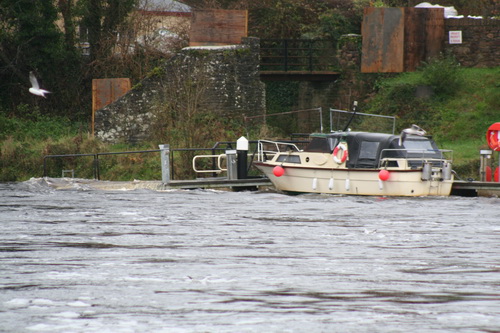
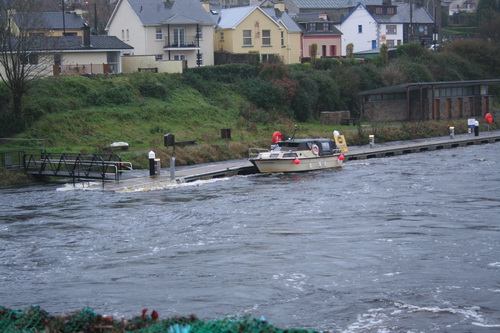
The Ballina pontoon

That’s Ballina, Co Tipperary, on the Shannon, opposite Killaloe.

Killaloe 20160101 14_resize

Looking upstream

Killaloe 20160101 15_resize

The ramp

Killaloe 20160101 20_resize

Looking downstream

Killaloe 20160101 21_resize

From the railway footbridge

Photos taken on 1 January 2016.

The pontoon seems to be more severely affected than it was in the last big floods, on 22 November 2009.

New Ballina pontoon in floods 20091122 1_resize

From across the river

New Ballina pontoon in floods 20091122 2_resize

From the bridge


Shannon lake levels

According to the Shannon Catchment-based Flood Risk Assessment and Management (CFRAM) Study Technical Assessment: River Shannon Level Operation Review [PDF: Office of Public Works v2_0 July 2012]

ESB collects and maintains records of rainfall, river and lake levels and flow data. Even though ESB has no responsibility to supply flood warnings under their regulations, it issues twice weekly lake level forecasts to all the relevant stakeholders since 2010.

Those stakeholders include Waterways Ireland.

As the levels of the lakes are of great interest to boat-owners and others, it would be really nice if either the ESB or Waterways Ireland were to publish those forecasts. WI wouldn’t need any elaborate new system: they could send them around as marine notices, and the cost would be minimal.

But perhaps the forecasts are already published somewhere? If, Gentle Reader, you know where they are, do please leave a Comment [preferably with a link] below.

Shannon traffic figures to October 2015

I have not posted charts of Shannon traffic figures for some months now. That was not Waterways Ireland’s fault: it has kindly continued to send the figures to me, but other demands on my time have intervened. However, I have now charted the figures to the end of October 2015, which takes in the bulk of the year’s boating activity. All the usual caveats apply:

  • the underlying figures do not record total waterways usage (even for the Shannon) as, for instance, sailing, fishing or waterskiing on lakes or river stretches, which did not involve a passage through a lock or Portumna Bridge, would not be recorded
  • the passage records would not show, for instance, a change in the balance of types of activities from those in larger cruising boats to those in smaller (sailing, fishing, waterskiing) boats
  • figures like these will not necessarily be representative of those for the year as a whole.

On the other hand, the figures do include the Shannon’s most significant tourism activity, the cruiser hire business. And they are our only consistent long-term indicator of usage of the inland waterways.

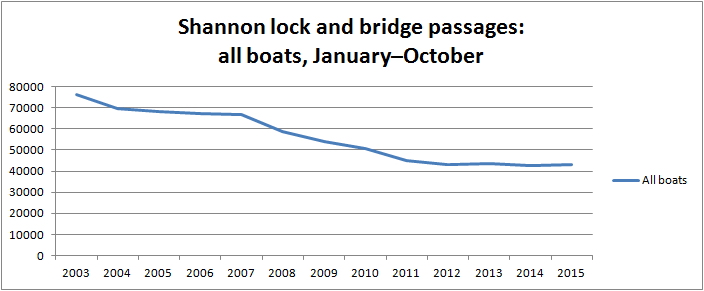
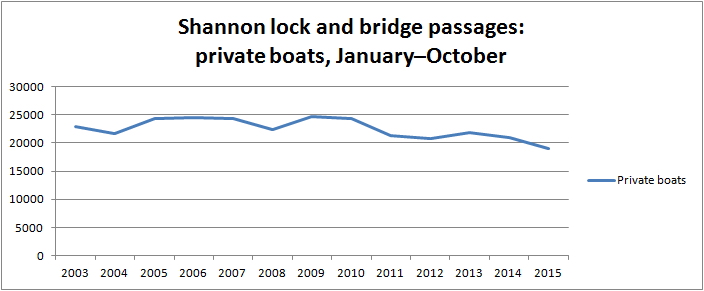
There has been a very slight increase in total traffic, although it might be better to regard the figures as confirming that traffic has stabilised at the new, lower level established around 2011.

Shannon JanOct all boats

All boats. The slight increase in total traffic seen up to May has continued to October

I commented on the May figures:

The big news is that there is an increase in the amount of hire-boat traffic and a decrease in the amount of private traffic. [Personal observation suggests very little activity on Lough Derg, apart from the sailing bods.]

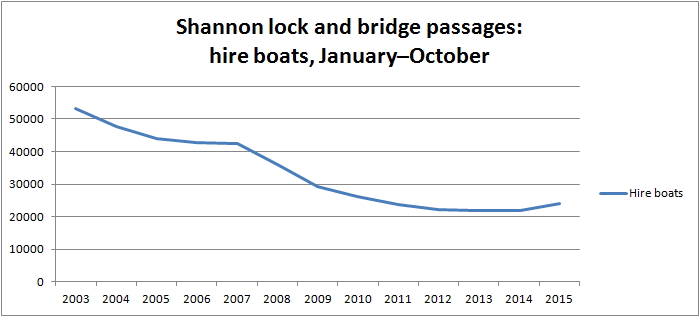
Again, that trend has continued. Hire-boat traffic is up …

Shannon JanOct hired

Hire-boat traffic is up

… and private-boat traffic is down.

Shannon JanOct private

Private-boat traffic is down

Perhaps the private boats were afraid to move from the new berths in Killaloe where they wanted to spend the winter at Waterways Ireland’s ridiculously low rates. Is this some delayed effect of the death of the Celtic tiger? Or was it the weather? Neither hire nor private figures changed hugely, but change they nonetheless did.

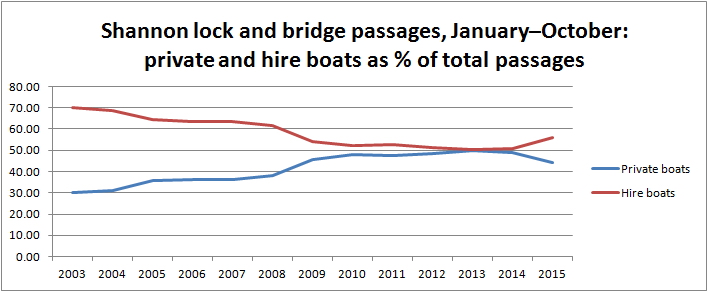
Shannon JanOct private -v- hired

After a brief period when it seemed that private traffic was overtaking hired, the hire-boats are in the lead again

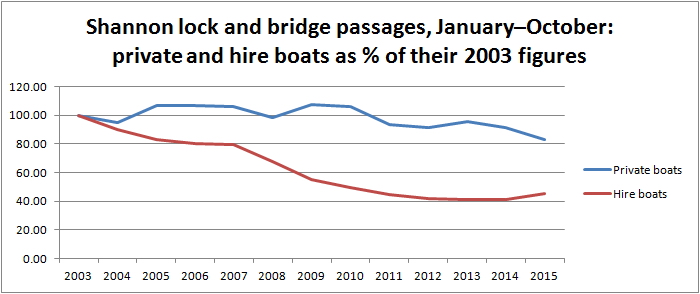
Of course hire-boat traffic fell much further from its 2003 figure: it dropped to 40% and is still not much higher, whereas private traffic is still more than 80% of its 2003 figure.

Shannon JanOct v2003

Change (private and hired) since 2003

It would be nice to have data on other forms of waterways usage.


The sinking of the Longford 2

Here is the second page of the saga. This one gives background information about the passage boat service, the boats and the crew of the Longford. The shock-horror stuff will be in later pages.

Aw sheughs

On 6 November 2015 there was a meeting of the Inland Waterways flavour of the North South Ministerial Council, whereat the Minister for Fairytales (RoI) and the Minister for Marching Bands (NI), each with a sidekick, discussed waterways matters. The joint communiqué, artfully written to provide outsiders with as little information as possible, is available here [PDF], but here’s a summary:

  • WI’s “capital expenditure focused on infrastructure repairs”, presumably because it has no money for any improvements or extensions, except a bit of dredging in or near the constituency of the Minister for Fairytales
  • yes, that means the River Finn, Saunderson’s Sheugh, which we’re pretending is or was part of the Clones Sheugh or Ulster Canal
  • WI has managed to get “third party funding” of over €1 million for waterside developments, which is good: much better than transferring WI money to other bodies. WI is trying to nab euroloot but, as there were no announcements of success, we must assume that this is work in progress. Mind you, the ministers would probably claim the success (and the photoshoots) anyway
  • WI may sell some unspecified property
  • the important one:

LEGACY SCALE LINKAGES FOR NORTHERN BASED WATERWAYS IRELAND STAFF

The Council approved the determination made by Waterways Ireland regarding legacy scale linkages for northern based staff.

I knew you’d want to know about that. Whatever it means.

On 17 November 2015 the latest attempt to get the boys and girls of the Northern Ireland Assembly to be nice to other reached some sort of conclusion, which you can read about in the Irish Times (until it disappears behind a paywall) and the Manchester Guardian. But of course the important question is whether we southron loons have to buy sweeties (sheugher candies) for our northern brethren to persuade them to be polite. For that, gentle reader, you must turn to the inspiringly-titled A fresh start — the Stormont Agreement and implementation plan, available here [PDF].

You will not, of course, want to bother reading most of it, so we can skip straight to Section E Irish Government Financial Support on page 30. New readers may wish to know that, many NI disagreements ago, the Irish government, led at the time by a group of leprechauns who believed they possessed a pot of gold, resolved to impress the poor benighted northerners with a display of southern wealth and power. Accordingly, it promised to pay for all sorts of transport infrastructure, provided that it could be claimed to have some sort of cross-borderality and preferably looked iconic. Whether there was any point to any of the schemes was a matter omitted from consideration.

The three main proposals, IIRC, were

  • the A5, a road in Northern Ireland
  • the Narrow Water Bridge, which would cross the Newry River in the middle of nowhere (whereas a south-eastern bypass of Newry might actually be useful). And it would have an opening span for the many vessels that visit Newry by the Ship Canal
  • the Clones Sheugh, a short section of the Ulster Canal.

Unfortunately the hardheaded northerners have long memories and they keep looking for their three sweeties long after the Free State realised that it couldn’t afford them. So has this latest throwing of their toys out of the pram forced the Free Staters to give in and buy them the A5, the iconic bridge and the Clones Sheugh?

Up to a point, Lord Copper.

The Irish government says it’s all in favour of, er, “investing” in infrastructure “to support North-South co-operation to help unlock the full potential of the island economy”, where no doubt eighteenth century transport methods will prove to as important as they were in the time of Grattan’s Parliament. But with that, and all the other waffle and irrelevancies shoved in at the start of the section, it is clear that the Irish government is trying to big up a small contribution. It drags in the European Union, the Dublin to Belfast railway, flood relief, energy, communications and health, which have nothing to do with the case, but which between them fill almost the whole of the first page.

From there, though, it has to get specific, or at least look as if it’s doing so. Accordingly, each of the three white elephants gets a subsection to itself, with numbered paragraphs, from which we learn that:

  • the Free State government “remains supportive of the commitment under the St Andrews Agreement” to co-fund the A5. It’s going to pay more (I think): £25 million a year in the years 2017–2019, up from a total of £50 million
  • the Free State government “remains committed to the concept of the Narrow Water Bridge”, which has “potential to provide jobs” [how?]; it will review the plans with the NI Executive and think about it by June 2016. It says nothing about the disappearance of funding
  • the Free State government does not say that it “remains supportive of the commitment under the St Andrews Agreement” to fund the Clones Sheugh. Nor does it say that it “remains committed to the concept”. What it does say about the sheugh is that it is funding Saunderson’s Sheugh (see above), it will think about more cross-border greenways and blueways including the Ulster Canal and it and the NI Exec will identify “options for jointly developing future phases of the Ulster Canal restoration project”, which I take to mean that the southron taxpayer won’t be stuck with the entire bill. Oh, and it’s going to think about funding a bleeding sail training vessel, another exercise in pointlessness and nitwittery.

That’s almost it: there is something about a north-west thingie, senior officials will meet and there will be progress reports.

These documents are not necessarily constructed to provide information to outsiders, but my sense is that the Clones Sheugh danger to the southron taxpayer has receded for the moment, although the Narrow Water Bridge and the sail-training nitwittwery need to be blown out of the water (or into it). The A5 road is to go ahead: I don’t know much about it but it might be the least objectionable of the lot.


The Groody turnpike

The River Groody flows into the Shannon downstream of Plassey, where the University of Limerick is located.

Groody 04_resize

Groody and Plassey (OSI ~1840)

The river itself may be hard to see, but the green wriggly line follows the course of the Groody except just north of Groody Bridge, where the river takes a more direct course towards the Shannon.

The road crossing Groody Bridge was the main road from Dublin to Limerick and the route followed by the mail-coaches. And, just to the west of the bridge, the 6″ Ordnance Survey map (of about 1840) shows a Turnpike, presumably controlling access to the road to Dublin. The road between Naas and Limerick, in other words most of the way to Dublin, was controlled by the Bourne family, who also ran the Dublin to Limerick mail coaches (which were amongst the few in Ireland to achieve an average of eight miles an hour).

Groody turnpike 03_resize

Groody bridge and turnpike (OSI ~1840)

I met a man who told me that his family owned this building, which is opposite the Aldi shop on the Dublin Road, Limerick.

Groody turnpike 01_resize

The building 1

It had been a shop at some stage and had had an extra window inserted, but he said it was originally a toll cottage. I don’t think it was for collecting the Limerick tolls [I don’t know where they were collected on the “Groody approach”, but I suspect it may have been near Pennywell]; I think it was for collecting the turnpike charges. Its position seems to match that of the turnpike building shown on the map.

However, I haven’t been able to find evidence on the matter one way or the other. I can’t find the building on the Griffith Valuation, perhaps because its value was too low to be recorded. And the Land Registry’s information doesn’t go back beyond 1982.

Groody turnpike 02_resize

The building 2

I would therefore be grateful to anyone who can provide evidence on whether this building was the turnpike cottage for the road to Naas.

My OSI logo and permit number for website


Pollboy Lock

I mentioned some time ago that, according to its Business Plan 2015, Waterways Ireland was considering automating Pollboy Lock, on the River Suck to Ballinasloe, in order to save costs. Like other offshoots from the main Shannon Navigation [Killaloe to Lough Key], the Suck is relatively little used.

According to the Connacht Tribune, the automation is to proceed and the lockkeeper is to be reassigned. It seems that some local councillors and “business interests” — who do not, as far as I know, contribute to Waterways Ireland’s income — regret the loss of an ambassador for the town. The keeper, Mr Coyne, was indeed extremely helpful to visiting boaters.

However, he could help only those who arrived at his lock: he could do nothing to attract more boating visitors to the town. That is not in the least a criticism of him, but rather a suggestion that councillors and business interests might perhaps have done, or yet do, more to attract visitors and increase the usage of the splendid harbour in Ballinasloe. Perhaps they might even appoint and pay a town ambassador?

A Sinn Féin councillor quoted in the article seems not to be entirely familliar with the duties of lockkeepers. Furthermore, he does not take account of the fact that the Shannon–Erne Waterway succeeds without lockkeepers — or that it was proposed that the Clones Sheugh [not-the-Ulster-Canal] operate in the same way. Surely a Sinn Féin councillor is not suggesting that, without keepers, the Sheugh might not be the enormous success that his party purports to believe it would be?

PS: the Tribune also has a piece about rubbish at Castle Harbour, Portumna.


WI and the RoI budget for 2016

Budget documents [available here] include the Part IV Estimates for Public Services 2016 [PDF]. The Summary of Gross Expenditure (Capital and Current) by Ministerial Vote Group shows that the Department of Fairytales [aka Arts, Heritage and the Gaeltacht], RoI parent of Waterways Ireland, is to get an increase in its budget.

Its forecast outturn for 2015 matches its estimate for the year at €277,434,000, of which €215,854,000 is current and €61,580,000 is capital spending. However, the estimates for 2016 show €234,430,000 current + €76,000,000 capital = €310,430,000 total, an increase of €32,996,000. Current spending is up 8.6% and capital by 23.4%; total spending is up by 11.9%. Perhaps the extra €14,420,000 in capital spending is to extend Saunderson’s Sheugh to Clones?

Skipping the numerous tables that repeat more or less the same gen in different ways, and skipping too the unimportant government departments, we zoom forward to the details of the Department of Fairytales estimates.

But there we find, alas, that while the department as a whole has secured lots of extra lolly — and it’s going to be shovelling 18% more to the luvvies [Arts, Culture and Film], 11% more to heritage and 3% more to the BéalBochters — it intends to cut spending on North-South Cooperation, which is where Waterways Ireland gets its money.

The 2015 estimate for NSCoop current expenditure was €35,072,000; the 2016 estimate is €34,925,000, which is a cut of only about half of one per cent. But capital spending on NSCoop is down almost 20%, from €3,487,000 to €2,799,000, and total spending down 2% from €38,559,000 to €37,724,000.

The NSCoop figures are “subject to the North-South Ministerial Council”, which means that the (southern, Fine Gael) Minister for Fairytales has to persuade the (northern, Sinn Féin) Minister for Marching Bands that the cross-border language and waterways bodies aren’t getting any increase in their funding from the Free State, at least not while there is an election to be won. However, HM Devolved Administration didn’t seem too keen on allocating extra money to waterways last time I looked.

Regular readers will not need to be reminded that 85% of WI’s current budget is supplied by the RoI government and 15% by the NI administration, while capital expenditure is paid for by the state in which it occurs.

The estimates figures as shown don’t tell us the precise impact on Waterways Ireland’s current budget: the money is divided between WI and the language shamrock but the document doesn’t tell us which gets how much. [The last time a breakdown was given was in 2011, when WI got roughly 60% of the total.] However, most of the department’s NSCoop capital expenditure is undertaken by WI, and little or none of it by the language shamrock, so we can say that the 20% cut in NSCoop capital spending means a 20% cut in capital spending on waterways in the Free State.

The breakdown of the Multi-Annual Capital Investment Framework confirms that: in 2015 €3,368,000 of the €3,487,000 NSCoop capital budget (96.5%) went to WI, and in 2016 WI will get €2,680,000 of the €2,799,000 NSCoop capital budget (95.7%). I imagine that the language folk prefer sitting i dtóin an tí and don’t want fancy buildings.

WI’s capital budget for RoI is down from €11,000,000 in 2008.

According to the Multi-Annual Capital Investment Framework 2016 to 2021 (Table 1), the Department of Fairytales as a whole is getting an unusually large amount, €76,000,000, of Exchequer Capital Funding in 2016; the total is to fall back to €45 million in 2017 and €43 million in 2018, before rising to €46 million in each of the years 2018, 2020 and 2021. So, in a year in which the department is getting much more money for capital spending, NSCoop and, specifically, waterways are getting significantly less.

Looking at the breakdown (Table 2), it seems that the big changes in the department’s capital spending are:

  • a major cut in the grant-in-aid to the Crawford Gallery (€12,100,000 to €6,100,000)
  • cuts of €1,312,000 to the National Parks and Wildlife Service and €1,000,000 to Údarás na Gaeltachta
  • a cut of €688,000 to WI
  • an extra €1,150,000 for Teach an Phiarsaigh under the Decade of Centenaries heading
  • a new thing called Built Heritage Jobs Leverage Scheme gets €2,000,000
  • another new thing called Cork Event Centre gets €5,000,000
  • and, the biggest of the lot, Decade of Centenaries 1912–1922 gets an extra €15,270,000, to bring its capital budget to €28,800,000, by far the largest item in the budget.

There are a few other minor changes, but the increased allocation of €15,270,000 to the main Decade of Centenaries item has more than swallowed the extra €14,420,000 allocated to the department. Three other significant items — Teach an Phiarsaigh, the Cork Event Centre and the Built Heritage Jobs Leverage Scheme, which between them have been given an extra €8,150,000 — have been funded by the reduced allocations to the Crawford Gallery, the National Parks and Wildlife Service, Údarás na Gaeltachta and Waterways Ireland.

So there’s no money for Sinn Féin’s beloved Clones Sheugh.