Category Archives: Unbuilt canals

Canals conference 7 March 2015

Information posted at the request of the organisers


Inland Navigations of Ireland Historical Society
in partnership with
The Heritage Boat Association

The Canals of Ireland

Saturday 7 March 2015

Hugh Lynch’s Function Room, Tullamore, Co Offaly

Programme

Memorial Slides Conor Nolan 09.30
Welcome Gerard Bayly 09.55
Session 1 Chairperson Judie Lambert
The Canals of Europe Mike & Rosaleen Miller 10.00
The Canals of Ireland Colin Becker 10.20
Coffee break 10.40
Saving the Royal Niall Galway 11.00
Fighting for the Grand Mick Kinahan 11.20
Living on a Canal Eric Kemp 11.40
Morning Question Time 12.00
Lunch break 12.30
Session 2 Chairperson Kristina Baker Kenny
Newry Canal Geraldine Foley 13.30
Limerick Navigation Raymie O’Halloran 13.50
John’s River Brian Simpson 14.10
Grand Canal Kilbeggan Branch James Scully 14.30
Boyne Navigation Seamus Costello 14.50
Coffee break 15.10
The Future Joe Treacy 15.25
The Future Brian J Goggin 15.45
The Future Nigel Russell 16.05
Evening Question Time 16.25


Details

Admission:                          €12
Breaks:                                Tea/coffee included
Lunch in room:                   Soup and sandwiches included
Music:                                 Live music session during lunch
HBA:                                   Merchandise for sale
IWAI:                                  Merchandise for sale
Authors:                              Books for sale

Directions

Hugh Lynch’s Pub, Kilbride Street, Tullamore, Co. Offaly

087 250 5422


The madness of Daniel O’Connell

In 1828 Daniel O’Connell was elected to the House of Commons for County Clare. As a Roman Catholic, he could not take the Oath of Supremacy [Frizzell, the illustrator, seems to have got his date wrong] and so could not take his seat, but the Emancipation Act 1829 removed that obstacle. However, it was not retrospective, so O’Connell had to stand again in County Clare; he was elected unopposed in July 1829.

On Sunday 31 January 1830 “The Patriotic member for Clare, Daniel O’Connell Esq, sailed from Howth […] at 8 o’clock, for England, to attend his Parliamentary duties” [Tipperary Free Press 3 February 1830] and when Parliament resumed on Thursday 4 February 1830

Daniel O’Connell Esq took the oaths prescribed by the Catholic Relief Bill, and his seat as a member for the county of Clare. The honourable member seated himself on the third row of the opposition side of the house, and exactly opposite to Mr Peel.

[London] Standard 5 February 1830

O’Connell’s letter

Before he left Ireland, O’Connell issued a letter to “the people of the County of Clare”; according to the Morning Post of 20 January 1830 it was issued from the Parliamentary Intelligence Office, 26 Stephen-street, on 15 January 1830. It began

MY FRIENDS AND BRETHREN — I take up the pledges which I made to you when I called on you to repose in me the high and awful trust of being your Representative. I will endeavour honestly to redeem those pledges.

For this purpose I propose to leave Dublin on the 26th of this month. I go off at the commencement of Term, and I shall be absent for two, if not three, entire Terms. Men will sneer at me for talking of these sacrifices to public duty, who, themselves, seek their own individual advantage in all their political exertions. I readily consent, and will proceed to do my duty to you with alacrity, zeal, and perseverance.

There was more along those lines, and then he said

My Parliamentary duties will naturally divide themselves into two distinct branches: the first relates to your local concerns; the second, to those mighty interests in which your prosperity is involved with that of all Ireland.

There were four local concerns: two about canals and two about ports.

An asylum harbour

West Clare [OSI ~1900]

West Clare [OSI ~1900]

The first port proposal was to build an “asylum harbour” on the west coast. An asylum harbour was a port that provided refuge in storms: Kingstown [Dun Laoghaire] was an asylum harbour (amongst other things). O’Connell thought an asylum harbour on the west coast would provide a safe haven for vessels coming across the Atlantic, feeling the force of the Gulf Stream and the prevailing westerly winds: they risked being “embayed on the iron-bound coast between Loop Head and Hag’s Head” where the Cliffs of Moher are. It is not clear how vessels could safely enter such a harbour, given that it would require them to come close to the lee shore, but O’Connell said

The existence of an asylum harbour on Malbay would be of the greatest value to the trade of the British Isles. I do hope to be able to realise this project, in the execution of which the talents of my most valued friend THOMAS STEELE would be found to be most highly beneficial to that county which he adorns by his abilities and patriotism.

O’Connell no doubt had in mind Thomas Steele’s talents as a urinator.

Carrigaholt and Kilrush

O’Connell also wanted

[…] the construction of two suitable piers, with other works, completely to protect shipping; the one on the Bay of Carrigaholt, the other on Scattery or Kilrush Harbour.

The commerce of Kerry, Clare, and Limerick, are interested in these works. We shall certainly obtain the powerful assistance of the patriotic Member for Limerick. His assiduity, information, and public spirit, render him a model which Irish representatives should imitate.

He wasn’t quite as complimentary about Thomas Spring Rice a few years later, when O’Connell’s five-hour speech in favour of the repeal of the Acts of Union was topped by Spring Rice’s six-hour contribution.

Here is a page about Kilrush. I haven’t done a page about Carrigaholt so there follows some information to fill the gap until I get around to doing it properly.

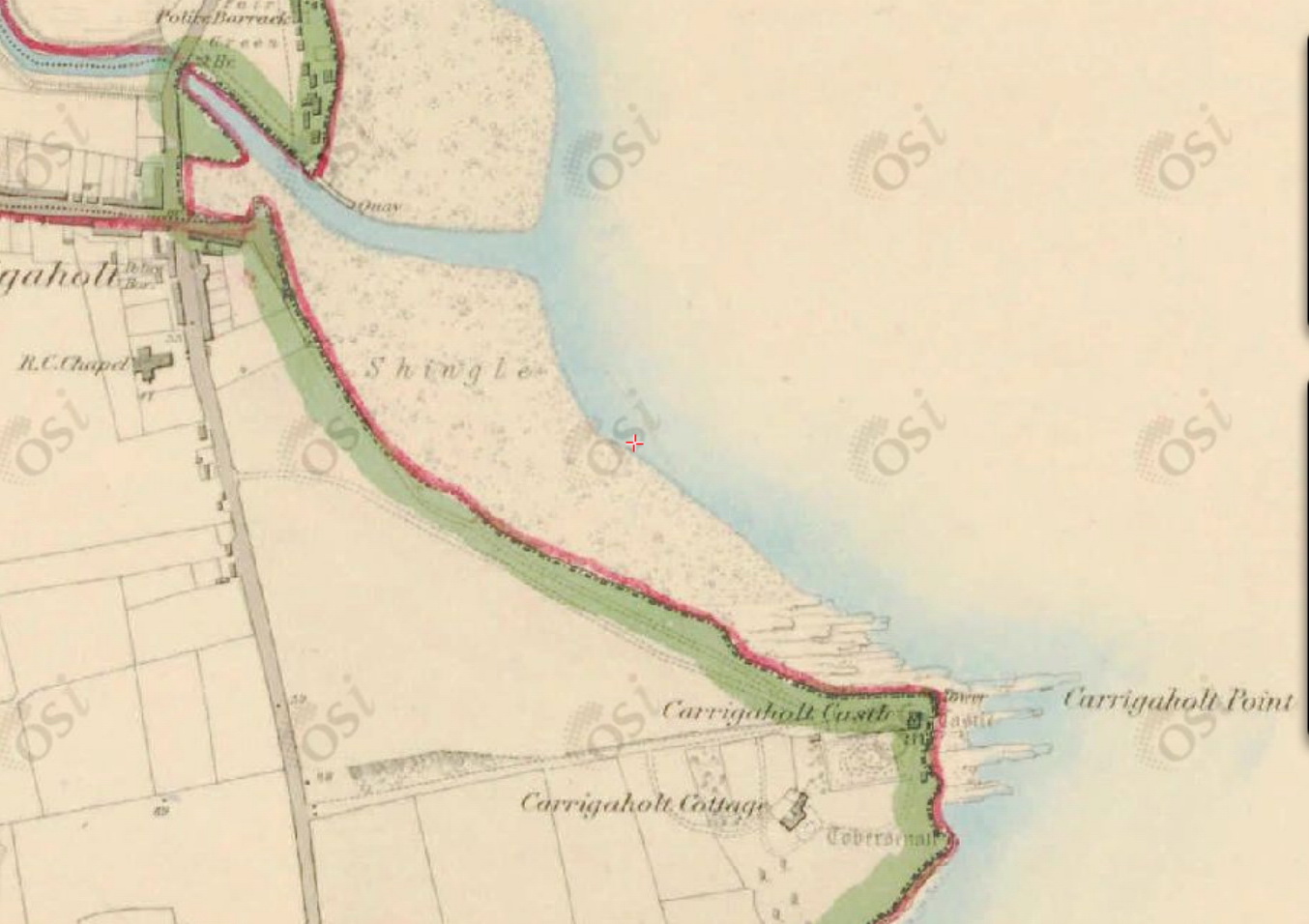
The earlier pier at Carrigaholt was built by Alexander Nimmo and was more successful than his harbour down the road at Kilbaha. Despite the description on the DIA site, I assume that it is the one shown on the 6″ OSI map.
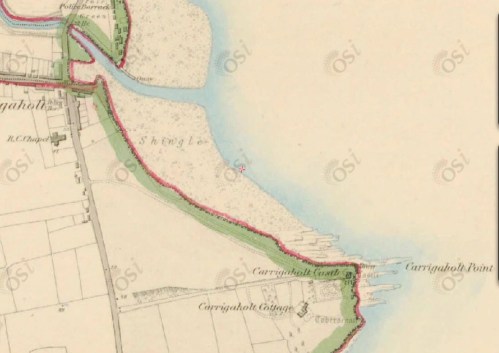
Carrigaholt map 1

The old quay at Carrigaholt (OSI ~1840)

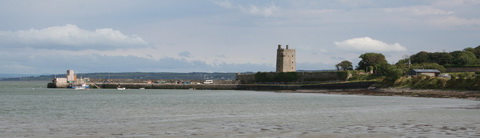
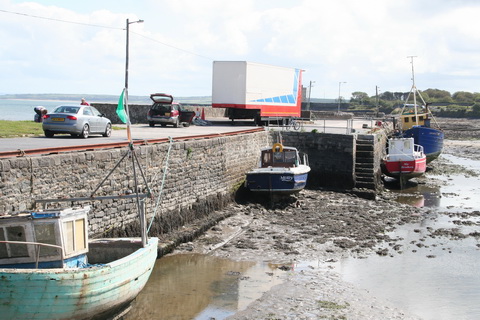
Here’s a photo.
Carrigaholt August 2011 7_resize

The old quay at Carrigaholt as extended

Commander James Wolfe’s Sailing Directions [PDF], compiled some time before 1848, say

Round Kilcradan, to the northward, and protected by it, is the anchorage or Road of Carrigaholt. It is a very fine secure anchorage with all winds from the westward, but from the ENE to S much sea prevails, though not heavy enough to endanger a vessel well found in ground tackling. With SW gales, a long rolling swell sets in round Kilcradan Point, which renders riding here at those times very uneasy. These roads have the advantage of being free from any great strength of tide.

The ground is level all over the road, but from six fathoms it shoals gradually towards the shores; the bottom, of sand over clay and mud, is generally considered good holding ground. The best anchorage for a large ship is with the top of Ray Hill in one with the Coast-guard Watchhouse W ¾ N, and Moyarta Lodge, just open of the point on which Carrigaholt Castle stands, nearly N ½ W in 5½ to 6 fathoms low-water springs.

The shore forms two smaller bays, the northern of which takes its name from the village which stands on its shores, and the southern is called Kilcradan. Both are very flat and shallow; in the latter there is a coast-guard station, but it is not a boarding station. The village is a poor miserable place, and does not afford supplies of any sort, nor can a ship complete water here. At the village is a small pier, accessible only (to loaded boats) at high water. It is used by the turf-boats, though most of these load on the beach.

Carrigaholt Castle, a high square tower on the point, and the chapel, a cruciform building, with its belfry, are very conspicuous objects.

As those directions were written some years ago, I suggest that you should not use them for navigating nowadays. You can tell that they are out of date because the village does now afford most excellent supplies, chiefly in the Long Dock. The Long Dock does not, alas, seem to have updated its website since 2006, having gone over to the Dark Side of FaceTweet which, at least to me, is impossible to search, so I can’t point you to a list of the interesting beers the Long Dock stocks in addition to its excellent food.

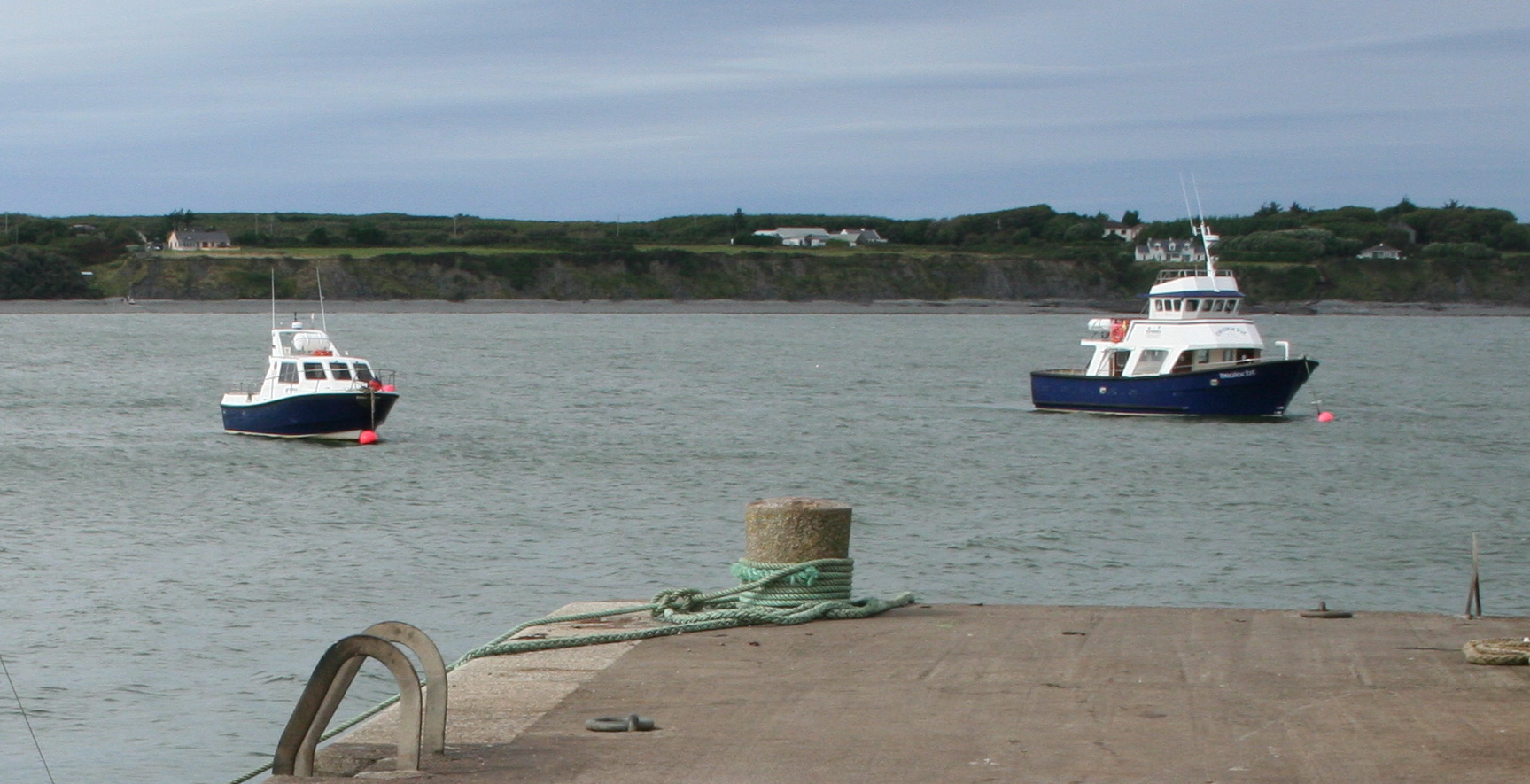
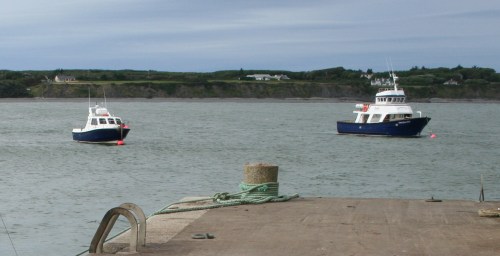
My spies tell me that, if you happen to be driving a barge from, say, Donegal to Limerick — not that I’m encouraging you to do anything of the sort — Mr Luke Aston of the Carrigaholt Sea Angling Centre will be able to advise on moorings. He’s got a Lochin, so he must be sound. You can have a day’s sea angling with him or a day watching dolphins with Geoff Magee (to whom I owe a glass of sherry), followed by a meal at the Long Dock: what more could you want?
Carrigaholt new harbour 24

Luke Aston’s Lochin [I assume] and Geoff Magee’s Draíocht

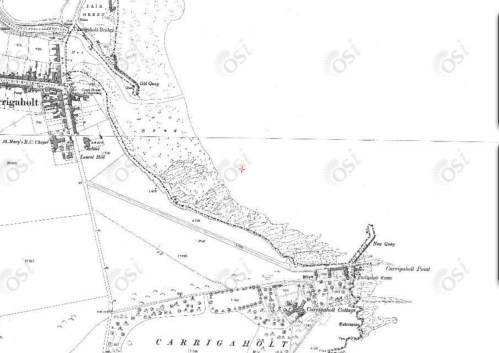
Well, if you were Daniel O’Connell, you’d want a new pier or quay.
Carrigaholt map 2

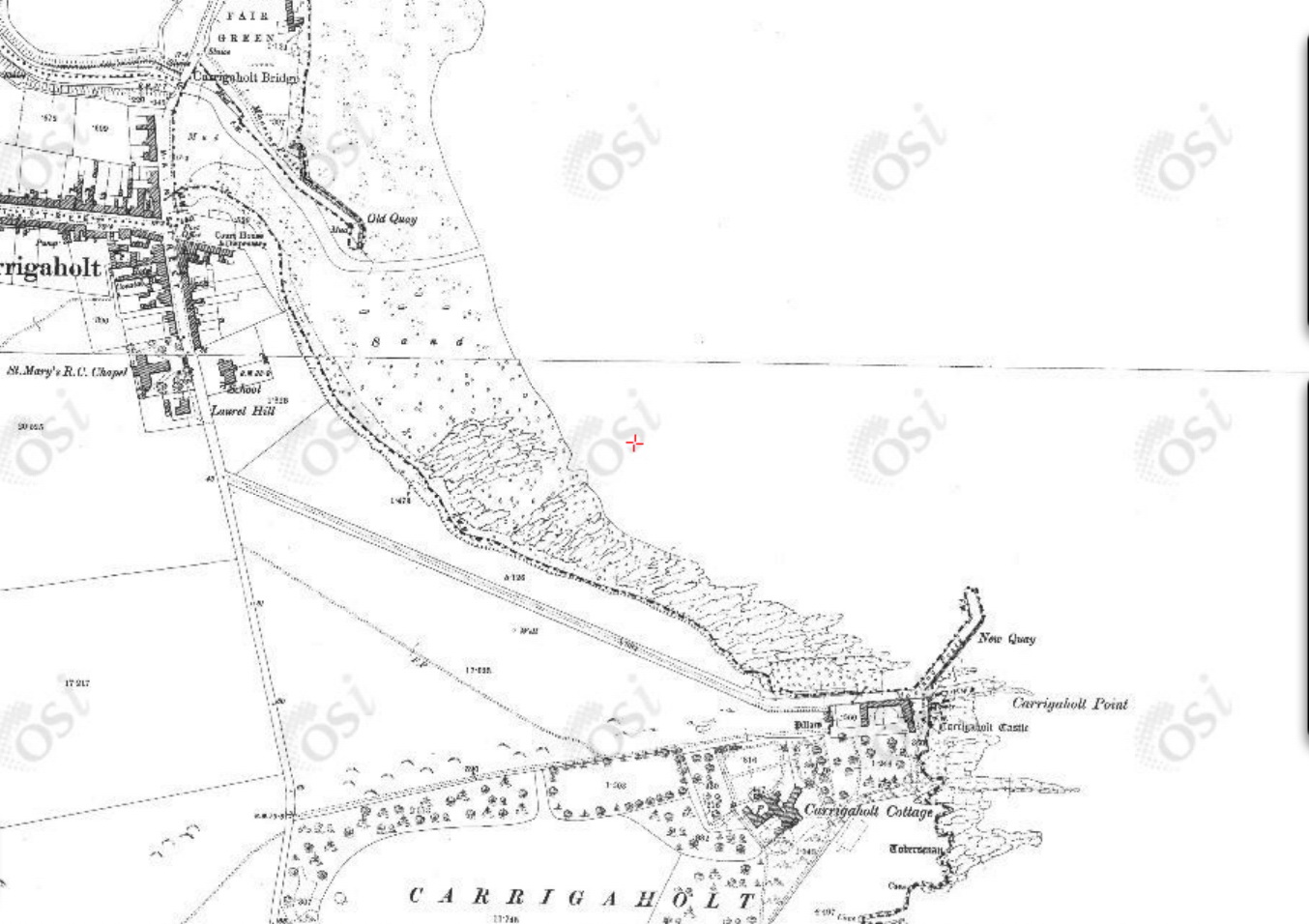
Carrigaholt old and new quays [OSI ~1900]

The old quay was extended at some stage and a new quay was built at the castle. I don’t know have dates for either of those, but I think the new quay was built as a fisheries pier in the 1890s. If, Gentle Reader, you know the dates, and can save me from having to plough through years of Board of Works reports, do please leave a Comment below.

If O’Connell had any role in having the old pier extended, that would have been the only one of his four local concerns on which he had any success, although he could also claim a minor supporting role in having the pier at Cappa, Kilrush, extended in the 1840s.

Carrigaholt new harbour 30_resize

Carrigaholt new quay seen from the old quay

The canal to Ennis

Daniel O’Connell’s third local concern was

The opening of the navigation of the Fergus to Ennis, so as to make that town a sea-port. The tide rises about half a mile beyond that town; and if there were a short canal cut near the village of Clare, of about 300 yards, vessels of burden could deliver their cargoes at Ennis, and carry away the produce of the country to the most remote markets.

This was a proposal that came up several times, but it was never implemented. The Shannon Commissioners built a fine quay at Clare [now Clarecastle] in the 1840s, but they left it as the head of the navigation.

Wolfe’s Sailing Directions made it clear that the passage of the Fergus estuary was not to be undertaken lightly:

A mile to the eastward of the Beeves is the principal and only navigable entrance to the River Fergus, which comes from the NNE amid vast banks of mud, and numerous islets and rocks. Having passed the Beeves, steer up for Feenish Island till you bring the tall square tower of an old castle (called Court Brown) in one with the north point of Low Island, WNW¼W, which is studded with white houses.

You must then keep rather more to the northward for the round hill of Coney Island, until Cannon Castle is in one with the peak of Grady Island, W¼S, when you must bear away for the east point of Coney Island; you will then shortly come into five and six fathoms, where you must anchor with the sharp peak of Coney Island bearing N by E and Cannon Castle WSW1/3W in about six fathoms soft muddy bottom.

Grady's and Cannon Islands from off Innish Corker [Admiralty Surveyors 1841 by kind permission of the UK National Archives]

Grady’s and Cannon Islands from off Innish Corker [Admiralty Surveyors 1841 by kind permission of the UK National Archives]

Beyond this it would be impossible to proceed without a pilot. The river beyond Coney Island winds through vast banks of mud, extending from 1 to 1½ miles from the shore, decreasing gradually in width from 600 yards, and varying in depth from nine to three feet up to the town of Clare, nearly seven miles in a direct line, and nine following the channel.

At Clare the bed of the river is dry at low water, but there is a quay, alongside of which vessels load. Clare is a miserable place, though the shipping port of Ennis. It is a military station.

Pilots may be had at Low Island, but no vessel above 150 tons should go up to Clare.

Clare_resize

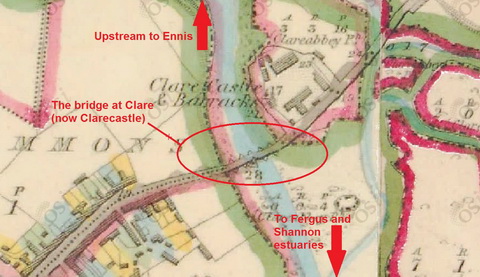
The bridge at Clare[castle] [OSI ~1840]

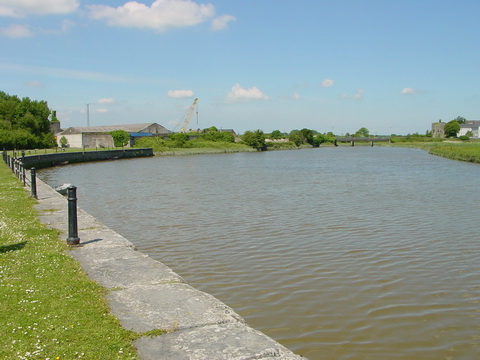
As well as a lock, some opening mechanism would have been required for vessels to get though the bridge, which was not the current flat structure; here is a photo of the old bridge.
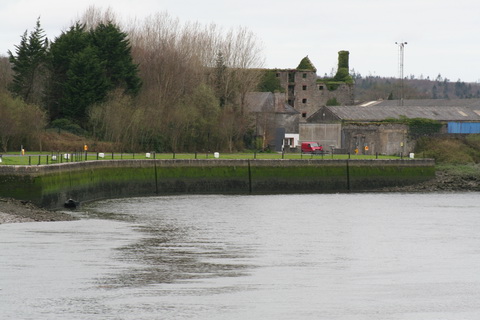
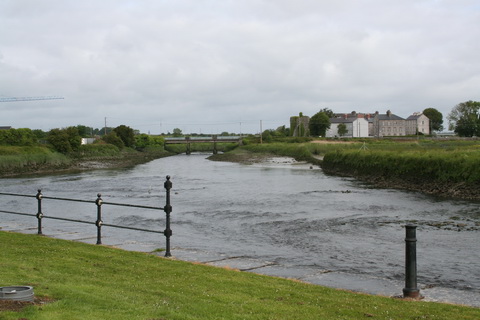
Clarecastle Fergus Navigation June 2007 07_resize

Looking from the Shannon Commissioners 1840s quay at Clare towards the bridge
Clarecastle November 2014 16_resize

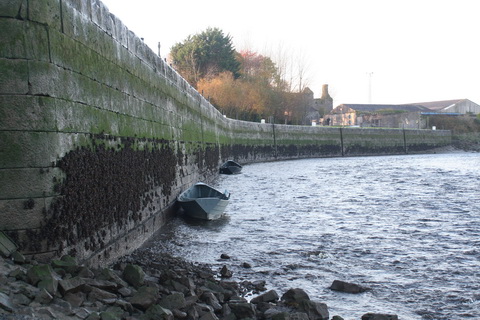
Clarecastle gandalows at the quay

Clarecastle old quay from far side 03_resize

The quay from across the river

Very low water at Clarecastle 5_resize

Low water at Clarecastle

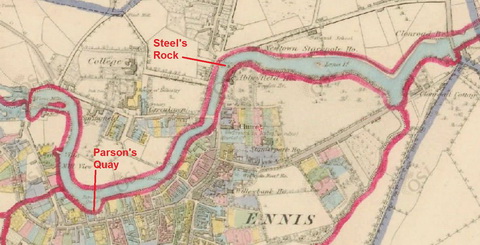
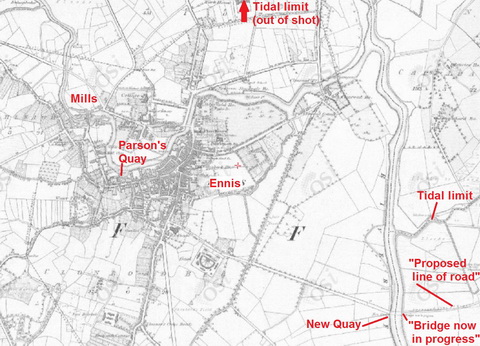
The interesting thing is that, even though a boat could not pass through Clarecastle to the estuary, there must have been some navigation on the Fergus; I would like to know more about what and how much was carried when. There was a quay, Parson’s Quay, in Ennis …
Ennis_resize

Parson’s Quay in Ennis [OSI ~1840]

… and another quay further downstream. I put the next map in black and white to make it easier to see things; it’s scaled down from the Ennis map.
Quays_resize

Ennis and district [OSI ~1840]

The map also shows that O’Connell was right about the tide: it did flow well above Ennis.

The other canal

Although the first three proposals were not implemented, and probably would have been either uneconomic or unsuccessful, they weren’t absolutely bonkers. His fourth idea, though, was nuts.

The fourth local concern relates to a communication by a canal from the bay of Galway to Limerick. The point of junction should be somewhere in the neighbourhood of Killaloe. The entire of the western and midland counties of Ireland would derive great advantage from such a canal.

Getting through the hills above Killaloe would have been fun. But the real problem with the proposal is that O’Connell fundamentally misunderstood the nature of the Irish economy. Each Irish port served its own hinterland, shipping out its produce and shipping in coal, timber and other overseas goods. But the ports did not need to trade with each other, as each performed the same function.

The exception to that was created by the application of steam on the inland Shannon, which allowed perishable produce from the Limerick area to be carried across Ireland for export through Dublin to Britain. That role was soon taken over by the railways.

But there was no point in connecting two westward-facing ports by canal: if they needed to trade with each other, they could do so by sea.

My OSI logo and permit number for website

Brendan Smith TD and W T Mulvany

Wednesday 22 May 2013

Brendan Smith [FF, Cavan-Monaghan]: To ask the Minister for Arts, Heritage and the Gaeltacht the position regarding the feasibility study that has been underway for some time in relation to the proposed extension of the Erne Navigation from Belturbet to Killykeen and Killeshandra; when this study will be completed; and if he will make a statement on the matter.

Jimmy Deenihan [FG Kerry North/West Limerick]: I am informed by Waterways Ireland that the current position is that work is continuing on the collection of data relating to this project and Waterways Ireland is currently preparing draft options for the project. At that point consultants will then assess the environmental implications of the options. It is expected that the feasibility study will be completed as planned by the end of 2013.

19 December 2013

Brendan Smith: To ask the Minister for Arts, Heritage and the Gaeltacht if he has received the feasibility study on the proposed extension of the Erne navigation from Belturbet to Killeshandra and Killykeen; and if he will make a statement on the matter.

Jimmy Deenihan: I am informed by Waterways Ireland that it commissioned a Strategic Environment Assessment for the possible extension of the Erne Navigation from Belturbet to Killeshandra and Killykeen.

On reviewing the environmental information from this process, Waterways Ireland considers that the environmental designations of this lake complex make the feasibility of the proposed navigation extension highly unviable. For that reason, I am advised that Waterways Ireland does not propose to pursue this project any further at this time.

11 December 2014

Brendan Smith: To ask the Minister for Arts, Heritage and the Gaeltacht the position regarding the proposal to extend the Erne navigation from Belturbet to Killykeen and Killeshandra, County Cavan; when this project will proceed to the next stage; and if she will make a statement on the matter.

Heather Humphreys [FG, Cavan-Monaghan]: I have been informed by Waterways Ireland that it commissioned a Strategic Environmental Assessment for the proposed extension of the Erne Navigation from Belturbet to Killeshandra and Killykeen in County Cavan. I am further advised that, on reviewing the environmental information from this process, Waterways Ireland’s considered view is that the development of a viable project is not feasible, given the conservation designations of the lake complex. Waterways Ireland does not, therefore, propose to pursue the proposal further at this time.

It would be nice if Mr Smith would (a) check what he was told last time and (b) tell whatever constituent is lobbying for this scheme to get stuffed. Even W T Mulvany wasn’t able to get a navigation to Lough Oughter.

Building more navigations in Ireland is a waste of money: it simply spreads the existing business more thinly. It will not attract extra business from inside or outside the state (apart from a small number of waterway twitchers). Some pub-owners in Killykeen or Killeshandra might sell some more beer-like substance, and if they would like to pay for a navigation that’s fine, but there is no advantage to the state in paying for it.

Thanks to KildareStreet for the notification.

Nenagh Canal

Canal between Nenagh and the River Shannon

At a numerous and highly respectable Meeting of the Gentry, Merchants, Traders, and Freeholders of the Baronies of Upper Ormond, Lower Ormond, and Owney and Arra, held at Nenagh, County of Tipperary, on Wednesday, the 30th day of January, 1839.

PETER HOLMES, Esq, JP, and DL, in the Chair.

Moved by John Bayly, Esq; seconded by the Rev J H Poe, Rector of Nenagh:

Resolved — That we consider a Canal communication between Nenagh and the River Shannon, of vital importance to the prosperity of the town and neighbourhood, as increasing commerce, lessening the cost of fuel, facilitating intercourse with the sea ports of the country, and giving employment to the poor.

Moved by John Bouchier, Esq; seconded by the Reverend Ambrose O’Connor, PP of Nenagh:

Resolved — That we have heard with interest the Report of Mr Henry Buck, Engineer, on the proposed line of Canal; and recommend the adoption of the line he has surveyed.

Moved by John M’Keogh Dwyer, Esq; seconded by Thomas Maguire, Esq:

Resolved — That we recommend the adoption of the Prospectus that we have heard read.

Moved by Hastings Atkins, Esq; seconded by J J Poe, Esq:

Resolved — That we appoint Peter Holmes, Esq, a Commissioner, who is to name a second, the second a third, and so on, until the whole are appointed.

Moved by O’Brien Dillon, Esq; seconded by John Bayley, Esq:

Resolved — That the names of Lords Dunally, and Orkney be added to the list of Commissioners.

Moved by Doctor Quin; seconded by Doctor Dempster:

Resolved — That we recommend the proceedings of the Meeting to be published in the Nenagh Guardian, Limerick Chronicle, and other Papers, and that the Secretary be instructed to get printed 300 copies of the Prospectus.

Moved by John M’Keogh Dwyer, Esq; seconded by Thos Maguire, Esq:

Resolved — That we now enter into a Subscription list for Shares, according to the provisions of the Prospectus read at this Meeting.

PETER HOLMES, Chairman.
O’BRIEN DILLON, Secretary.

Mr Holmes having left the Chair, and Mr Bayley having been called thereto —

Resolved — That the thanks of the Meeting are due, and hereby given, to Peter Holmes, Esq, for his impartial conduct in the Chair, and for the spirited example he has set in being the first to subscribe for Fifty Shares.

JOHN BAYLEY, Chairman.
O’BRIEN DILLON, Secretary.

Dublin Monitor 7 February 1839

River Nore heritage

On its page headed Heritage Audit of the River Nore, Kilkenny County Council says

Phase 2 of the survey (from Kilkenny City to Inistioge) commenced in 2011 and will be completed in 2012.

It also says (on the same page)

Phase 2 of the survey (from Kilkenny City to just north of New Ross) is in the final stages of editing and will be completed in early 2014.

If anyone has seen any sign of it, I would be grateful for a link.


A puzzle in waterways history

According to the Lagan Canal Trust,

The Lagan Navigation also forms part of a wider all Ireland waterway network. This network of waterways once traversed through the towns and cities of Ireland delivering goods and produce, helping to shape the economic fortunes of the country.

I would be grateful for information about any goods or produce that were ever carried from the Shannon, or from the Royal or Grand Canals or the River Barrow via the Shannon, through the Junction Canal in the Ballinamore & Ballyconnell Drainage District [later called the Ballinamore & Ballyconnell Canal and later still the Shannon–Erne Waterway] and then the Ulster Canal to Lough Neagh or any of the waterways connected therewith. Or, of course, in the opposite direction.

As far as I can tell, outside the sales blurbs written by engineers seeking employment and waterway owners seeking subsidies, there was never a connected all-Ireland waterways network; nor was there ever any need or demand for such a thing.

Any more than there is now.


Steam, the Shannon and the Great British Breakfast

That is the title of the Railway and Canal Historical Society‘s 2014 Clinker Memorial Lecture, to be held at the Birmingham and Midland Institute, Margaret Street, Birmingham B3 3BS, at 1415 on Saturday 18 October 2014.

The lecture will concentrate on the period before 1850 with such interesting topics as

  • Shannon steamers
  • the Grand and Royal Canals
  • the first Irish turf (peat) to reach the USA (possibly)
  • port developments in Dublin, Limerick and Kingstonw
  • the Dublin and Kingstown Ship Canal
  • the Midland Great Western Railway
  • what “cattle class” really means
  • bacon and eggs.

Admission is free and booking is not required. However, if you plan to attend, it would be helpful if you could e-mail […] to this effect.

The Clinker Memorial Lecture is named for Charles R Clinker, an eminent railway authoe and one-time historian of the Great Western Railway, who died in 1983.

If you would like the contact email address, leave a Comment below and I’ll get in touch with you direct.


Shannon traffic figures to July 2014

I am grateful to Waterways Ireland for letting me have the Shannon traffic figures for July 2014. All the usual caveats apply:

  • the underlying figures do not record total waterways usage (even for the Shannon) as, for instance, sailing, fishing or waterskiing on lakes or river stretches, which did not involve a passage through a lock or Portumna Bridge, would not be recorded
  • the passage records would not show, for instance, a change in the balance of types of activities from those in larger cruising boats to those in smaller (sailing, fishing, waterskiing) boats
  • figures like these, for a small number of months, will not necessarily be representative of those for the year as a whole. The winter months, January to March, see little traffic in any year; for April, May and June, the weather can have a large influence on the amount of activity especially, I suspect, in private boats.

On the other hand, the figures do include the Shannon’s most significant tourism activity, the cruiser hire business. And they are our only consistent long-term indicator of usage of the inland waterways.

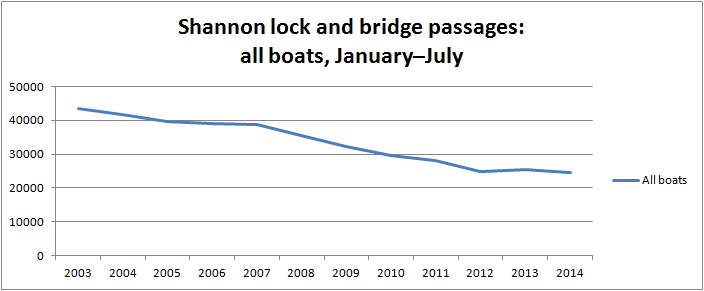
Shannon all boats Jan to Jul 2014

Total (private + hired) traffic for the first seven months of each year

Traffic in 2013 was up a bit on 2012; 2014 is down slightly below the 2012 level. It’s the lowest seven-month figure in the series (ie since 2003), which is a bit of a surprise: I thought that the good weather would encourage more boating.

The changes are small, so their importance must not be exaggerated, but they’re not cause for celebration. Let’s see whether the drop was amongst private or hired boats (or both).

Shannon private boats Jan to Jul 2014

Private-boat traffic for the first seven months of each year

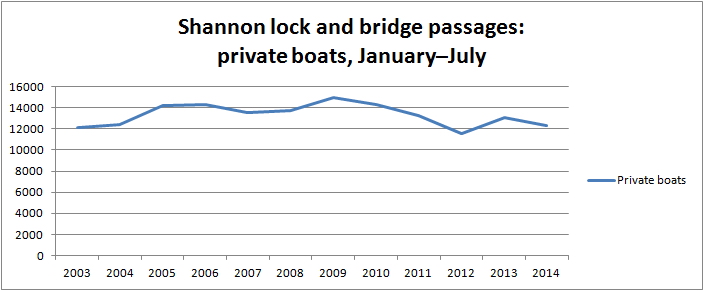
Private traffic is up a bit on 2012 but down on 2013.

Shannon hired boats Jan to Jul 2014

Hire-boat traffic for the first seven months of each year

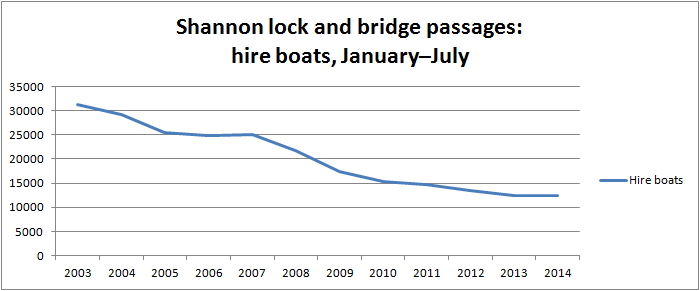
Hire-boat traffic is down on both previous years, but the pace of decline seems to have slowed.

Shannon private and hired -v- 2003 Jan to Jul 2014

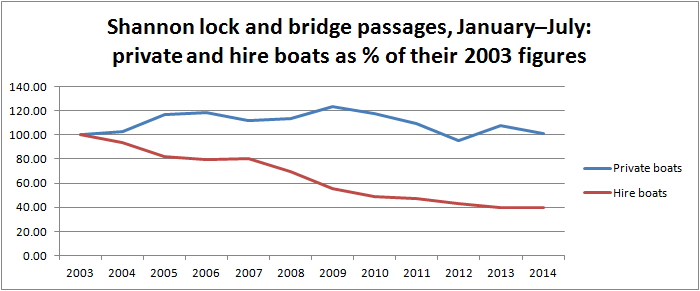
Changes since 2003: private and hired boats

Hire-boat traffic seems to be levelling off at 40% of its 2003 figure: a massive loss of business. I do not know whether anyone is trying to, or could, recover that amount of business. I am not aware of any new Shannon-based tourism business that could compensate for the losses in the cruising (hire-boat) business, but I would be glad to hear from anyone who knows of such projects. Something with high growth potential is required.

Private traffic is wobbling either side of its 2003 figure: the increases during the Celtic Tiger years have been lost.

Shannon private -v- hired boats Jan to Jul 2014

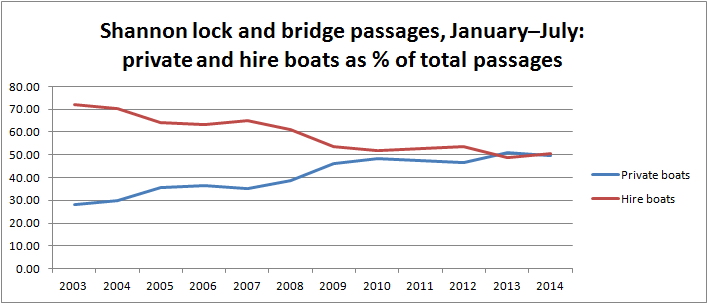
Still roughly 50/50

In the year to July 2014, hire-boat traffic was just above private traffic, but there is very little in it. Private traffic is now comparatively more important to Waterways Ireland [which may be why it is now trying to establish its economic importance] but it does not bring in much money from outside the two jurisdictions, so the case for public spending on waterways becomes much weaker.

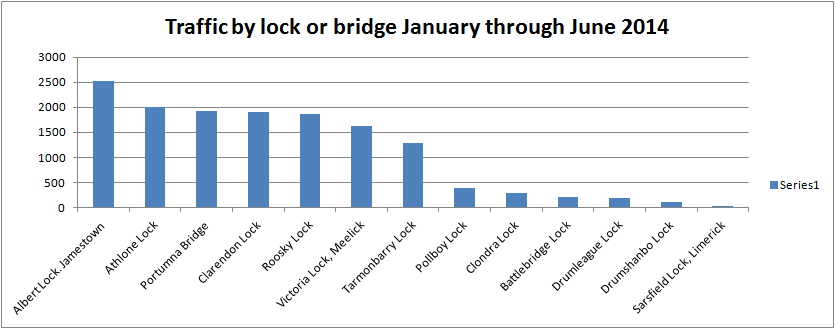
And, quite clearly, opening more waterways doesn’t work: as this chart showed last month, the branches off the main lines of the Shannon, Erne and SEW are little used. The Lough Allen Canal, the Suck and the navigation to Limerick are very little used and I see no sign that the reopened Royal Canal has attracted many visitors to Ireland. What is needed is more intensive usage of the main waterways, not further dilution by the opening of more branches [to Clones or anywhere else].

SnnNav JanJun 6

High and low usage

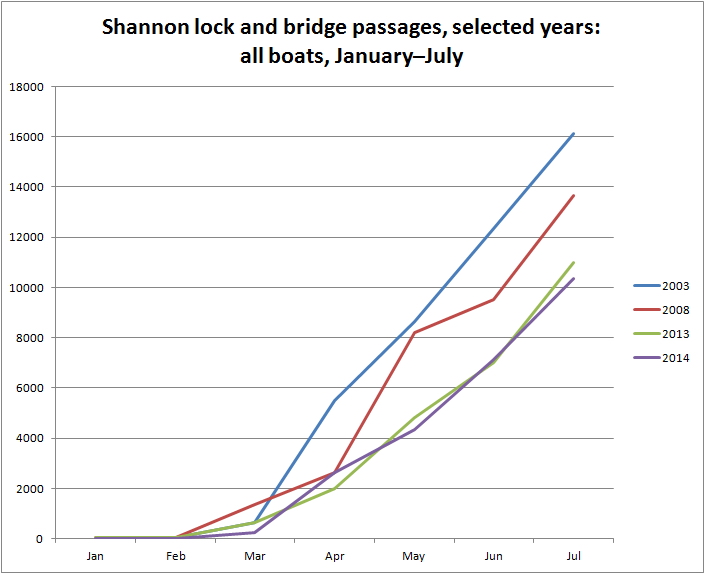
Finally, I thought it might be interesting to see whether the monthly pattern of usage has changed since 2003. To avoid an over-cluttered chart, I included only four years: 2003, 2003 +5, 2003 + 10 and 2014. The chart is for all boats, private and hired.

Shannon all boats by month selected years Jan to Jul 2014

Monthly traffic, selected years

The season seems to have got going earlier in 2003 and even in 2008. Was the weather better in those years?


Where do correct ideas come from?

Where do correct ideas come from? Do they drop from the skies? No. Are they innate in the mind? No. They come from social practice, and from it alone; they come from three kinds of social practice, the struggle for production, the class struggle and scientific experiment.

Readers will not, I am sure, need to be reminded that those are the words of the late Comrade Mao Tse-tung [or Mao Zedong, as the younger comrades say] in the Draft Decision of the Central Committee of the Chinese Communist Party on Certain Problems in Our Present Rural Work of May 1963.

Maurice Semple, in By the Corribside [self-published, 1981], lists writers who, from 1868 onwards, agreed with the view of the Cong Canal expressed by Sir William Wilde:

[…] for it was discovered, that like many other undertakings, the great canal at Cong “would not hold water.”

Those writers’ view is echoed by local people, and even by engineers, to the present day. Their case is, in effect, that the Board of Works engineers did not know what they were doing or did not properly survey the ground and were therefore surprised to find, on admitting water to the bed of the canal, that it vanished into sinkholes or swallow-holes in the karst.

One oddity about that belief is that the Cong Canal does actually hold water: it is full in winter, as the photos on this page, taken in February 2013, clearly show. It is empty in summer, but that is because water is unable to get in at the upper end, not (I suggest) because it flows out through the bottom.

What interests me at the moment is that I can find no evidence to support Wilde’s contention. Samuel Roberts, the engineer in charge of the work, knew that the work would be difficult but there is no hint in any of his annual reports that he feared that the difficulties might be insuperable. Furthermore, it is clear from his own reports and from other evidence that he was ordered to cease work on the navigation aspects of the canal before it was finished: there was never a moment when water was admitted to a completed navigation canal.

I have not been able to find any report from the 1850s in the Freeman’s Journal, the Cork Examiner, the Dublin Evening Mail or the Belfast News-Letter, or in any British newspaper, that supports William Wilde’s account of events. What, then, is its basis?

Of course my inability to find evidence does not mean that it doesn’t exist, but I would be grateful if anyone could point me towards it. I should say that I do not regard later accounts, like Wilde’s, as valid unless they include some evidence from 1854, the year of which Roberts wrote

The masonry in the Cong lock was commenced in March, and was progressing rapidly when I received instructions from the Board, in April, to suspend the execution of all navigation works in this division of the district, and complete only such as were necessary for the regulation of the waters of Lough Mask, for drainage purposes.

What I am looking for is an eyewitness, an official or some other reliable account, from 1854, that says “the canal was completed; water was let in; it vanished, to the surprise of the engineers”. If no such account exists, I may be forced to conclude that Wilde’s style of work is opposed to the fundamental spirit of Marxism-Leninism. As the Great Helmsman put it in the Little Red Book:

To behave like “a blindfolded man catching sparrows”, or “a blind man groping for fish”, to be crude and careless, to indulge in verbiage, to rest content with a smattering of knowledge — such is the extremely bad style of work that still exists among many comrades in our Party, a style utterly opposed to the fundamental spirit of Marxism-Leninism. Marx, Engels, Lenin and Stalin have taught us that it is necessary to study conditions conscientiously and to proceed from objective reality and not from subjective wishes; but many of our comrades act in direct violation of this truth.


Archives workshop: a reminder

I mentioned, back in April, that an interesting-looking workshop is scheduled for Belfast on 8 September 2014. It’s being held in the Public Record Office of Northern Ireland [PRONI] in the Titanic Quarter and there’s an optional extra tour and reception on the SS Nomadic afterwards. This post is a reminder.

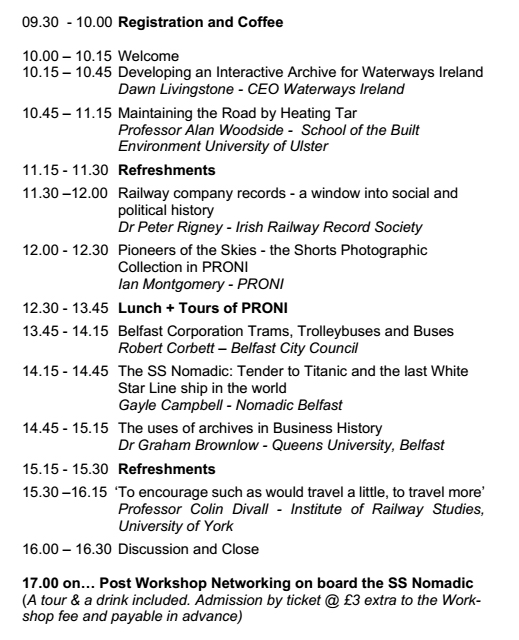
The programme covers waterways, roads, railways and flight. For this site, the opening session is of great interest: Dawn Livingstone, CEO of Waterways Ireland, is to talk about an interactive archive for Waterways Ireland.

By air, sea and land

By air, sea and land

The workshop is being organised for PRONI by A²SN, the Archives and Artefacts Study Network, supported by the Historical Model Railway Society, the Business Archives Council and the Postal History Society.

The [two-page PDF] brochure is downloadable here PRONI transport archives workshop. The workshop fee is £20/€25 with an extra £3/€3.50 for the SS Nomadic visit. Sterling cheques are accepted; there is provision for paying in euro by online banking.