Category Archives: Uncategorized

Who saved Clonmacnoise?

It seems possible that, at some stage in the late eighteenth century, there was a plan that would probably have destroyed Clonmacnoise.

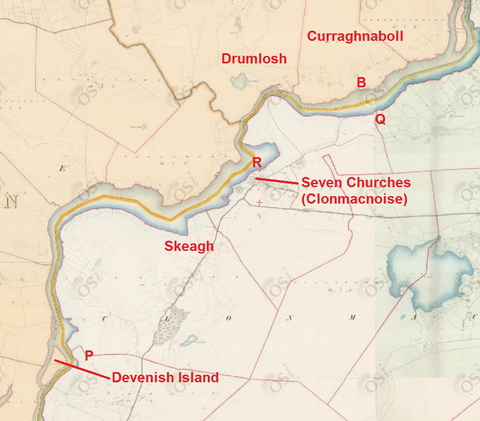
There exists A Map of the River Shannon from Athlone to Killaloe, Surveyed by John Killaly 1795, which contains much of interest. I do not have permission to reproduce it here, but here is the section around Clonmacnoise from the ~1840 OSI 6″ map.

Clonmacnoise OSI ~1840

Clonmacnoise OSI ~1840

I have marked on the map some of the placenames used by Killaly.

The legend reads:

[…]

B. Ford least water 4F 6J [which I take to mean 4′ 6″]

[…]

From Q to P the proposed Canal is ¾ Mile shorter than the River.

From Q to R [the proposed Canal] is ¾ Mile shorter than the River.

It seems therefore that, in 1795, someone was considering shortening the Shannon by digging one of two possible canals to cut off peninsulas along the east bank. Given the narrowness of the stretch between the esker and the river, I suspect it would have been impossible to dig either of them without destroying Clonmacnoise.

I would like to know more about the proposal and about why it was abandoned.

Incidentally, some folk prefer the spelling Clonmacnois but the Placenames Database of Ireland uses Clonmacnoise.

My OSI logo and permit number for website

Underwear and the Ulster Canal

In September 2010 I wrote:

[…] a government department, in a time of economic crisis, is proposing to commit to the spending of at least €35,000,000, without having any certainty of being able to get the money anywhere. Unless Waterways Ireland has surplus assets that I don’t know about, I cannot see how it can raise that amount by selling property in a slump; nor do I see any certainty that the Department of Finance will supply the money.

So the Department of Community, Equality and Gaeltacht Affairs won’t be choosing between two sources of funding. Its only possible source is the Department of Finance, and its only possible argument is that, unless the taxpayer stumps up, the shame will be too great: the neighbours will realise that we’re all fur coat and no knickers.

Since the creation of the Department of Arts, Heritage and the Gaeltacht in 2011, we’ve seen a slow striptease, with the government flicking up the corners of its fur coat and gradually hinting at the nakedness underneath.

The setting up of an inter-agency group of treasure hunters was the most explicit acknowledgement that the Irish government could not afford to build the Clones Sheugh. The group included folk from Fermanagh District Council, the Northern Ireland Tourist Board, the NI Strategic Investment Board and the Department of Culture, Arts and Leisure, so the burden of treasure-hunting was spread north of the border. But if that constituted the fifth veil — highlighting rather than concealing nakedness — the sixth has now been dropped.

On Tuesday 9 July 2013 the Select Sub-Committee on Arts, Heritage and the Gaeltacht was concluding its consideration of the revised 2013 estimates for the Department of Arts, Heritage and the Gaeltacht (and the National Gallery). Sandra McLellan, Sinn Féin TD for Cork East, said:

I have one more question, on subhead D4, Waterways Ireland. There is a promise of stage payments to Waterways Ireland to begin the process of making the opening up of the Ulster Canal a reality. Planning permission to begin the project was sought and is due to be approved at this month’s Fermanagh District Council planning meeting and permission has already been approved in County Monaghan. Once the Government releases the funding, the process should move quickly and whatever land purchases are needed will be made. Does the Government intend on doing this and will Waterways Ireland have the adequate funding to undertake the project in 2013–2014?

The minister, Jimmy Deenihan [FG, Kerry North/West Limerick], began by talking about planning permissions and compulsory purchases:

At this stage, the planning permissions have been granted. That, in itself, was a challenge because of environmental and other reasons. The next process will be the CPOs to get the land. In many cases, hopefully, we can acquire the land by agreement. That will be the next challenge.

He went on to say why the Irish government couldn’t afford the sheugh:

There is an inter-agency group sitting. It is something I established, where the local authorities and the statutory organisations, North and South, have all come together around a table and are looking for alternative sources of funding too rather than merely funding from the Dublin Government. Originally, the agreement was that this would be funded by Dublin and the funding for it was identified with the sale of property at the time. During the Celtic tiger, the property, down in the docklands, etc., was quite valuable. However, with the collapse of the property market, that potential source of funding was not there to the same extent, although, with the property market now recovering, that property could become valuable again. Hopefully, it will and can contribute to the overall costs.

Note that phrase “rather than merely funding from the Dublin Government”. But there is more to come:

The next stage would be the acquisition of the land in order to provide the canal and the inter-agency group is looking at possibilities. Also, my counterpart in Northern Ireland, the Minister for Culture, Arts and Leisure, Carál Ní Chuilín MLA, is looking at possible funding for the small portion that is in the North. Funding may be available for that from the Northern Executive and, maybe, Westminster. That, obviously, would help. Wherever we can get funding for this, certainly we will be striving to get it. It will be incremental. We will have to approach it on a staged basis but the important point is to get it started.

So the idea that the wealthy and munificent southern government would pay the entire cost of the sheugh, as a present to the benighted and miserable inhabitants of Norn Iron, and as a demonstration of the prosperity to be expected from a united Ireland, has been abandoned altogether. If Carál Ní Chuilín [who is, coincidentally, a Sinn Féin MLA] manages to extract money from her colleagues for that portion of the sheugh lying within Norn Iron, it will mean that the construction is being funded in the same way as other Waterways Ireland capital spending: each government pays for the development within its own jurisdiction.

Will Ms Ní Chuilín manage to persuade her colleagues? In September 2010 I wrote:

[…] I see no evidence whatsoever that the Northern Ireland executive, or Her Majesty’s government, has any intention of ever starting the JCBs rolling along the Ulster Canal. They are happy to support the principle of canal restoration; they are even prepared to allow southern taxpayers to spend money (borrowed from the bond markets) crossing northern soil. It is possible that, if the canal to Clones brings wealth and prosperity to Co Monaghan, the northern executive will rethink. But as it stands, the evidence suggests that the southern taxpayer will be permitted to dig to Clones, and perhaps even to Monaghan and Caledon, but that the canal will never get any further.

It is possible that having a Sinn Féin minister running DCAL will change  economic perceptions, and no doubt Simon Hamilton, the [DUP] Minister of Finance and Personnel, will be easily persuaded. Having an Irishman as UK Chancellor of the Exchequer may help the Sinn Féin cause: the last time that happened, HMG wasted half a million pounds on the Shannon.

But back to the minister:

It is a good North-South project. It links North and South. There also could be some possibilities under European funding, for example, there was funding available for the Ballyconnell canal and some of that was derived from European funding. We will be looking at every possible source of funding in order to get the project off the ground and to complete it over a period of time. Besides, Waterways Ireland, from its own capital budget, may have some small amount of funding available to initiate the project as well. I will be looking at identifying funding from different sources and, hopefully, over a period of time, we can provide the canal.

There are two sets of points in that paragraph. One suggests that the inter-agency group has not yet found the pot of gold, indeed that it has no very firm ideas about where to find it. Waterways Ireland is unlikely to be able to spare more than the price of a few shovels, but even if it devoted its entire capital budget to the Clones Sheugh it would take at least ten years to pay for it.

The other set of points is contained in the first two sentences:

It is a good North-South project. It links North and South.

Any minor boreen could be said to link North and South, but without costing €40 million or so. In fact, though, the Clones Sheugh is not a good project: it is a waste of money. It will link a couple of fields in the middle of nowhere to, er, Clones, which is no doubt a vibrant hub of culture. It will not attract significant numbers of foreign tourists, so it will merely displace waterways activity from elsewhere, and it will not generate new business or employment opportunities except perhaps for part-time summer jobs in a couple of pubs.

I have compared the Irish (and especially Sinn Féin) enthusiasm for canals to a cargo cult, but perhaps a more modern comparison, and one in line with this post’s heading, would be to the Underpants Gnomes (a metaphor I used here about the Shannon in 1792). It will be recalled that the Underpants Gnomes had a three-phase business plan:

  1. Collect Underpants
  2. ?
  3. Profit.

The Irish government’s (and perhaps Sinn Féin’s) devotion to the Clones Sheugh might be explained by their adherence to a similar plan:

  1. Build canal
  2. ?
  3. Peace and prosperity.

But, knickerless, they cannot gird their loins. Maybe Little Miss Higgins‘s video might provide useful advice.

Envoi

The minister’s extensive reply did not stop Sandra McLellan from asking pretty much the same question nine days later, causing me to wonder why the shinners want the sheugh:

Is there something in the St Andrew’s Agreement, or some other bit of northsouthery, that promises a sheugh to Sinn Féin, to enable them to claim credit for some high-profile but non-threatening all-Irelandism? Is the Clones Sheugh the price of SF support for the Police Service of Northern Ireland? I don’t know, but there must be some explanation for the failure to kill off the sheugh.

[h/t to the learned AD, who drew my attention to the meeting of the select sub-committee, which I had not myself noticed. AD is not, however, to be blamed for my views — or for my metaphors]

Le bateau monstrueux*

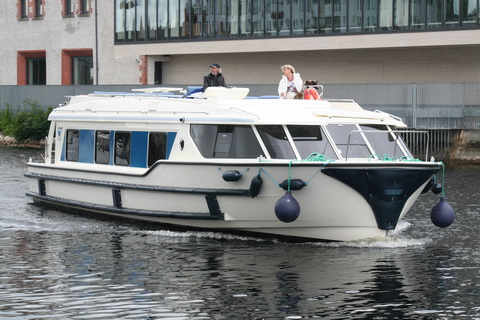
Voila le grand bateau de Monsieur Thibault.*

Enormous Le Boat vessel 01_resize

Le grand bateau a Athlone*

I’ve never been entirely clear why an Anglo-German travel group should have adopted a macaronic Anglo-French name, Le Boat, for its business of providing “self-drive boating holidays on the inland waterways of Europe“, which is one of the activities within the Marine Division of its Specialist & Activity Sector, which is in turn one of its three main sectors.

Somewhere within Le Boat is the Irish operation, Emerald Star; that brand name is used on the leboat.net website but not, as far as I can see, on the leboat.co.uk site. Furthermore, Emerald Star is not listed amongst TUI Travel’s brands. I mention this because M Thibault’s boat carries the Le Boat brand, not the Emerald Star. I have asked the TUI Travel press office whether the Emerald Star brand is being withdrawn.

Enormous Le Boat vessel 02_resize

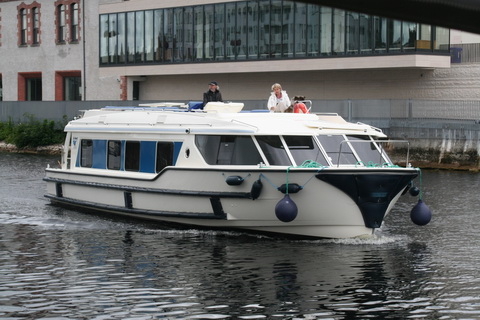
Voila le gros chien sur le grand bateau*

Anyway, the boat itself is interesting. It’s Le Boat’s Vision, made by Beneteau. There are variants: it comes with either three or four bedrooms, diesel or hybrid, SL or not. It is available for sale as well as for hire; a buyer can place it in the Le Boat fleet and earn some money too.

There is a brief description here with a link to Waterways World‘s recent report about the boat. There is more here and here. It is extremely well equipped.

Enormous Le Boat vessel 03_resize

Le Le Boat bateau*

Back in the 1970s, many boat owners had either small or elderly boats; a secondhand cruiser, sold out of one of the hire fleets, was the height of luxury, and on average the hire boats were more luxurious than the private (or that at least was my impression). In recent years that has changed; private boats became luxurious and equipped with more toys than hire boats had.

Le Boat’s Vision may change the balance again, but only a very large company could afford a fleet of such boats: Waterways World gave the price as STG£249000.

[* translations by Google]

Belle of Barley Harbour

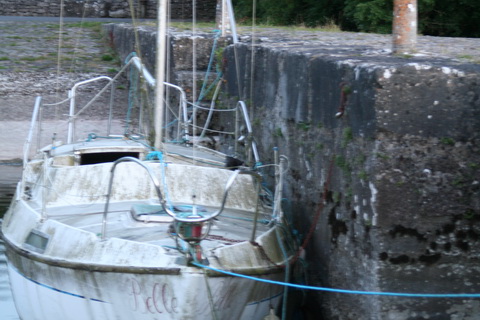
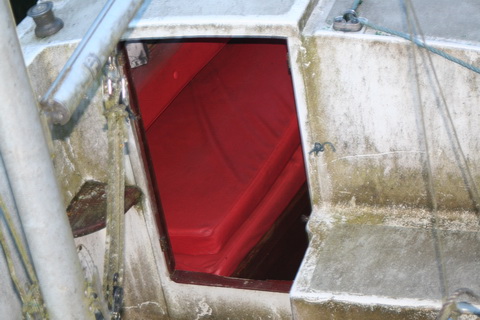
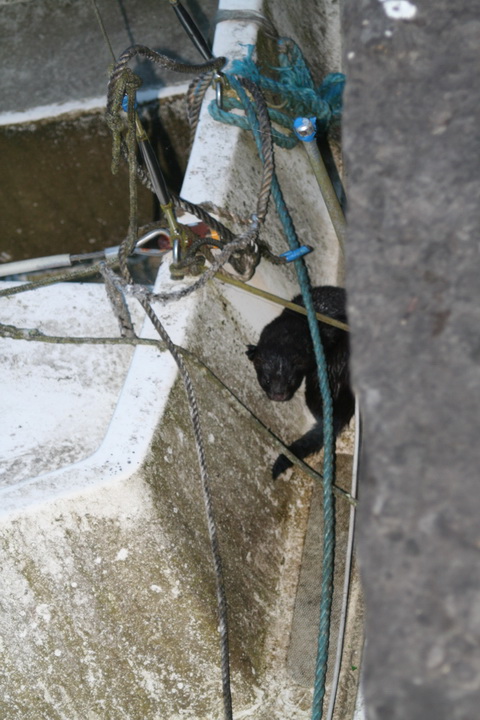
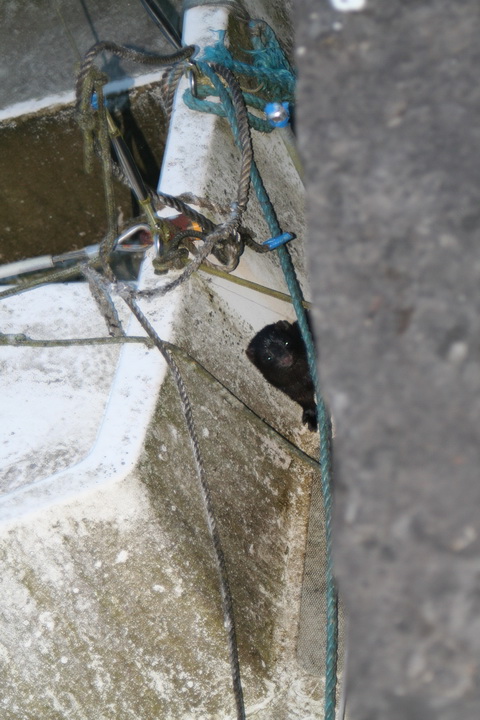
If you own the yacht Belle, which is at Barley Harbour on Lough Ree, you may wish to visit it. Its wooden doors are missing and there is what I think is a mink on board. I’m afraid I don’t know the owner and don’t know how to contact her or him.

Belle at Barley Harbour 01_resize

Belle by night

Belle at Barley Harbour 07_resize

Doors missing

Belle at Barley Harbour 05_resize

Mink 1

Belle at Barley Harbour 06_resize

Mink 2


Canal carrying 1846: the Grand Canal

Isaac Slater’s Directory[i] of 1846 lists those carrying goods on inland waterways. Most of the carriers on the Grand Canal, which runs from Dublin to the River Shannon with various branches, claim to serve a modest number of places, but Thomas Berry & Co have a very lengthy list. So long is their list that it will require two maps to show all the places they served, with a third map for the rest of the carriers.

Note that the maps are from the 25″ Ordnance Survey map of around 1900 rather than the 6″ of around 1840: I used it because it was clearer, but it shows features (eg railway lines) that were not present in 1846.

There may be some cases where I have misidentified a destination; I would be grateful to have my attention drawn to such cases.

Click on a map to get a slightly larger version.

Thomas Berry & Co

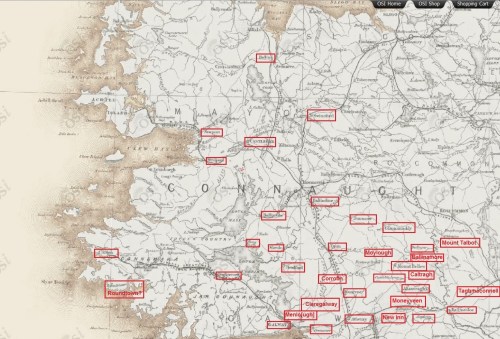
Thomas Berry & Co midland and south routes

Thomas Berry & Co midland and southern destinations (OSI)

The canal runs from Dublin, at the top right, left (roughly west) through Tullamore to Shannon Harbour, where it meets the river; there was an extension to Ballinasloe on the far side of the Shannon. Berrys served places along the canal and several others fairly close to it, but it looks to me as if there were three routes by road beyond that:

  • via Banagher (which has a bridge across the Shannon) to Eyrecourt and Killimor
  • from Ballinasloe to Loughrea and district and then south-west to Ennis in Co Clare
  • perhaps from Tullamore to Birr [Parsonstown], Roscrea (including Shinrone, Cloughjordan and Borrisokane) and Templemore.

There are also two outliers for which I can think of no plausible explanation: Baltinglass and Wexford. Perhaps their inclusion was a mistake. Certainly Berrys, like John M’Cann & Sons on the Royal Canal, seem to have had extensive road networks (perhaps using car-owning subcontractors?) to supplement their water-borne routes, but I don’t see why they would take on a route no part of which could sensibly have been conducted by inland navigation.

The next map shows the north-western destinations served by Berrys.

Thomas Berry & Co western routes

Thomas Berry & Co north-western destinations (OSI)

You can see that their network covered much of County Roscommon and went almost as far west into County Galway as it was possible to go; it also extended northwards into County Mayo.

I have not attempted to check what industries might have made these towns and villages worth serving. Berrys certainly seemed keen to take as much as possible of the traffic from west of the Shannon towards Dublin — excluding such of it as went by the Royal Canal: it is interesting to compare these maps with that for M’Cann on the Royal.

Finally, note that along the canal itself Berrys listed only destinations towards the western (Shannon Harbour) end: it seems likely that the roads took the valuable traffic from the eastern end into Dublin. There were no doubt turf boats taking fuel in from closer to Dublin, but they were not general carriers.

Other carriers

Now for the rest of the carriers.

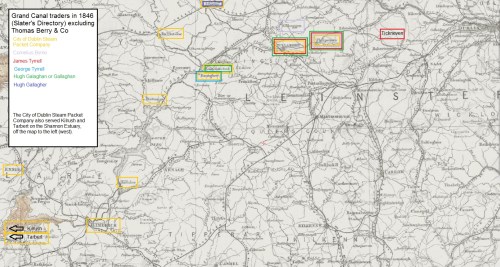
Grand Canal carriers 1846 excl Thomas Berry

Grand Canal carriers 1846 excluding Thomas Berry (OSI)

I have included the Shannon here as well as the Grand Canal; however I have covered the Barrow Line of the Grand Canal, as well as the navigable rivers Barrow, Nore and Suir, in a separate post. Of the carriers listed here, only the City of Dublin Steam Packet Company [CoDSPCo] (which employed horses to pull its boats on canals) ventured on to the Barrow Line, serving Portarlington and Mountmellick.

Berrys and the CoDSPCo were by far the largest firms on the Grand. I don’t know the size of the Berrys fleet, but the CoDSPCo had 52 barges in addition to its Shannon (and Irish Sea) steamers. Note that only on the middle Shannon, around the junction with the Grand Canal, and at Ennis did the two firms serve the same destinations: the CoDSPCo seems to have had the lower Shannon trade to itself.

With one exception, all the carriers, including Berrys, had Dublin depots at Grand Canal Harbour, James St; the Grand Canal Docks at Ringsend, joined to the Liffey, were not mentioned.

The exception is Hugh Gallagher, whose only listed destination was Athlone. It would be interesting to know how he served Athlone: whether by road or by water and, in the latter case, whether he used a steamer. I do wonder whether Hugh Gallagher might be the same person as the Hugh Galaghan (also Gallaghan) who served Philipstown [now Daingean], Tullamore and Shannon Harbour.

George Tyrrell is another who is listed with but a single destination, Banagher, whereas James Tyrrell is listed as serving Tickneven, Philipstown, Tullamore — and Edgeworthstown, which must be a mistake as it is closer to the Royal Canal.

Finally, Cornelius Byrne is shown as serving two destinations: Philipstown and Kilbeggan (which has its own branch off the main line of the canal).

Other information

A little extra information is available from the entries for towns other than Dublin in the Directory:

  • Naas has its own branch from the main line of the canal, but the directory says that “TO DUBLIN, there are Boats, as occasion require, but they have no fixed periods of departure.”
  • Edenderry also has its own branch, short and lock-free, but there is no mention of its being served by trade boats
  • Kilbeggan, with a longer, leakier, lock-free branch, was served by the CoDSPCo’s and Thomas Byrne’s boats travelling to Dublin three times a week. Is this Thomas Byrne related to the Cornelius Byrne mentioned above? It seems that Byrne went only eastward for only the CoDSPCo’s boats went westward (to Shannon Harbour, Ballinasloe and Limerick) two or three times a week
  • at Banagher, Fleetwood Thomas Faulkner of Main Street was the CoDSPCo agent; a downstream steamer left Shannon Harbour after the [passenger] boat from Dublin arrived and called at Banagher’s Bridge Wharf; an upstream steamer from Limerick called every afternoon at 3.00pm and met the night boat travelling to Dublin by the Grand Canal. I presume that this happened on every day except Sunday.

More

As far as I know, little has been written about the carrying companies, especially those of the nineteenth century. I would be glad to hear from anyone who can correct, supplement or comment on this information.

My OSI logo and permit number for website


[i] I Slater’s National Commercial Directory of Ireland: including, in addition to the trades’ lists, alphabetical directories of Dublin, Belfast, Cork and Limerick. To which are added, classified directories of the important English towns of Manchester, Liverpool, Birmingham, Sheffield, Leeds and Bristol; and, in Scotland, those of Glasgow and Paisley. Embellished with a large new map of Ireland, faithfully depicting the lines of railways in operation or in progress, engraved on steel. I Slater, Manchester, 1846

Canal carrying 1846: the Royal Canal

Isaac Slater’s Directory[i] of 1846 lists those carrying goods on inland waterways. There is a long list for Dublin; entries for other towns list those providing local services [there are some conflicts between the lists: see below]. However, the Dublin list shows only two carriers on the Royal Canal:

  • the Royal Canal Company [RCC] itself (Samuel Draper, Secretary) at the Broadstone in Dublin
  • John M’Cann & Sons, Liffey lock, North Wall, where the Royal Canal joins the River Liffey.

I noted here that two published histories of the Royal Canal, and a history of the Midland Great Western Railway [MGWR], suggested that the RCC/MGWR did not commence carrying goods themselves, on their own canal, until the 1870s. However, I had come across an MGWR ad, from 1853, beginning

The Directors will receive Proposals for the Haulage of their Trade Boats to and from Dublin and Longford and the River Shannon […].

The material in Slater’s Directory strengthens the notion that the RCC/MGWR did engage in carrying well before the 1870s, although the nature of the contractual relationships is not clear. Note also that Peter Clarke’s Appendix C[ii] lists “Boat Owners operating on the Royal Canal 1826 to 1847” including four RCC boats as well as four MGWR boats.

Destinations

M’Cann and RCC both provide long lists of the destinations they serve:

  • RCC: Athlone, Ballinafad, Ballymahon, Balnacarig, Balnalack, Boyle, Boyne aqueduct, Carrick on Shannon, Castlerea, Colooney, Coolnahay, Downs Bridge, Dromod, Drumsna, Ferns, Glasson, Hill of Down, Junction [which may be the junction between the main line and the Longford Branch], Kenagh, Kilcock, Lanesborough, Leixlip, Longford, Maynooth, Moyvalley, Mullingar, Newcastle, Newtownforbes, Rathowen, Roscommon, Ruskey, Rye aqueduct, Sligo, Terlicken, Thomastown, Toome Bridge
  • M’Cann: Arvagh, Athlone, Ballaghaderin, Ballina, Ballinamore, Ballyfarnon, Ballymahon, Ballymore, Ballymote, Boyle, Carrick on Shannon, Castlerea, Dromod, Drumkerrin [Drumkeeran?], Drumlish, Drumshambo, Drumsna, Dunmore, Edgeworthstown, Elphin, Fenagh, Granard, Lanesborough, Longford, Mohill, Roscommon, Ruskey, Strokestown, Tenelick Mills, Tulsk.

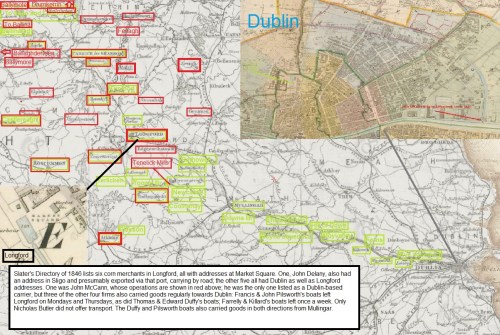
I thought it might be interesting to show these destinations on a map. Note that the map is from the 25″ Ordnance Survey map of around 1900 rather than the 6″ of around 1840: I used it because it was clearer, but it shows features (eg railway lines) that were not present in 1846.

Click on the map to get a slightly larger version.

Royal Canal carriers M'Cann and RCC 1846 (OSI)

Royal Canal carriers M’Cann and RCC 1846 (OSI)

I can’t stand over every location marked on the map (as it were). Spellings of place-names were sometimes not those in use today; some place-names (Ballinamore, Ballymore, Newcastle) are used of two or more places that might have been those intended; I could not identify two places, Dunmore and Junction, although I suspect the latter may be the junction between the main line and the Longford Branch of the canal.

What is interesting, though, is the different emphases in the two firms’ marketing. The Royal Canal Company lists almost every location along its canal; M’Cann offers a wide range of destinations beyond the canal, presumably linked by cars on the roads, into Counties Longford, Cavan, Roscommon, Westmeath, Mayo and Sligo. The RCC serves some such destinations, but a smaller number of them.

Some of the locations listed are small places; my presumption — which I have not yet checked, but for which I have found some supporting examples — is that such places have mills, quarries or other industries that provide cargoes for the canal.

The Shannon and the roads

Both operators offer to serve destinations on the River Shannon, to which the Royal Canal is joined at Clondra/Richmond Harbour:

  • RCC: Athlone, Carrick on Shannon, Dromod, Drumsna, Glasson, Lanesborough, Ruskey
  • M’Cann: Athlone, Carrick on Shannon, Dromod, Drumshambo, Drumsna, Lanesborough, Ruskey.

It is possible that goods to those places were carried by water, although (if steam tugs were not available) that would have been slow and uncertain; given that there were good roads leading from the west to the Shannon and throughout the region, it is, I think, likely that these destinations were served by road. I have no evidence on the matter save that the directory entries for Carrick-on-Shannon, Drumsna and Jamestown do not mention the availability of water transport.

Some of those destinations were served by direct road services from Dublin:

  • Athlone, Ballina, Castlerea, Dunmore, Longford, Roscommon, Sligo, Thomastown.

Competition presumably kept charges down.

Other carriers

Slater’s Directory lists six corn merchants in Longford, all with addresses at Market Square. One, John Delany, also had an address in Sligo and presumably exported via that port, carrying by road; the other five all had Dublin as well as Longford addresses.

One was John McCann, whose operations are shown in red on the map; he was the only one listed as a Dublin-based carrier, but three of the other four firms also carried goods regularly towards Dublin: Francis & John Pilsworth’s boats left Longford on Mondays and Thursdays, as did Thomas & Edward Duffy’s boats; Farrelly & Killard’s boats left once a week. Only Nicholas Butler did not offer transport. The Duffy and Pilsworth boats also carried goods in both directions from Mullingar. My guess is that carrying goods from others helped these merchants to cover the costs of their own fleets.

Peter Clarke’s Appendix C suggests that M’Cann’s fleet was the smallest of those based in Longford. The list is of “Boat Owners operating on the Royal Canal 1826 to 1847” but I am not entirely clear what the list shows. It seems unlikely, for instance, that the Midland Great Western Railway owned four boats throughout the period, as the company did not exist for most of it. Is the number of boats the largest that an owner had, or used, in a peak year, or an average over several years?

I don’t, therefore, know how to interpret the list but, assuming that the same methods were applied to all owners, it seems that the fleet sizes were these:

  • Duffy Bros 12
  • Pilsworths 9
  • M’Cann 5
  • Royal Canal Company 4.

Neither Farrelly nor Killard is listed, but there are many others: Dunne 8, Kelly 6, Murtagh 6, Murphy 5, MGWR 4, Williamson 4, and many others with 1, 2 or 3 boats each. Again, it is not clear in which years those owners had those numbers of boats.

More

As far as I know, little has been written about the carrying companies, especially those of the nineteenth century. I would be glad to hear from anyone who can correct, supplement or comment on this information.


[i] I Slater’s National Commercial Directory of Ireland: including, in addition to the trades’ lists, alphabetical directories of Dublin, Belfast, Cork and Limerick. To which are added, classified directories of the important English towns of Manchester, Liverpool, Birmingham, Sheffield, Leeds and Bristol; and, in Scotland, those of Glasgow and Paisley. Embellished with a large new map of Ireland, faithfully depicting the lines of railways in operation or in progress, engraved on steel. I Slater, Manchester, 1846

[ii] Peter Clarke The Royal Canal: the complete story ELO Publications, Dublin 1992

My OSI logo and permit number for website

Canal carrying 1846: Dublin to Waterford

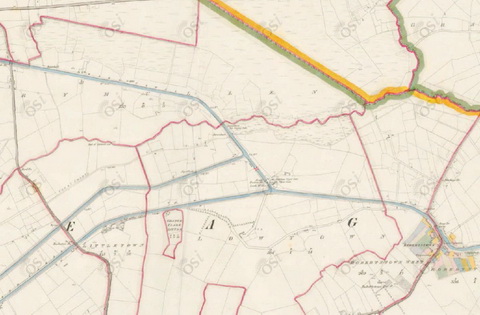
Lowtown is at the western end of the summit level of the Grand Canal; it thus has some claim to be the highest point on the canal. It is close to the village of Robertstown in County Kildare.

Lowtown is also the site of the junction between the main (Dublin to Shannon) line of the Grand Canal and its most important branch, the Barrow Line.

Lowtown (OSI ~1840)

Lowtown (OSI ~1840)

The main line from Dublin comes in from near the bottom right and exits near the top left. The two cuts leaving near the bottom left are the Old and New Barrow Lines, which join together just off the map. The Barrow Line runs to Athy, in south County Kildare, from which the Barrow [river] Navigation runs to the tidal lock at St Mullins, downstream of Graiguenamanagh.

The River Nore joins the Barrow a litle further downstream; the Nore is navigable on the tide upstream to Inistiogue. The combined rivers flow south through the port of New Ross and eventually join the estuary of the River Suir. Turning right at that point takes you up the Suir to Waterford, Carrick-on-Suir and Clonmel. Thus the Barrow Line, from Lowtown, forms an inland waterway link between Dublin and some towns along the Barrow, Nore and Suir.

Isaac Slater’s Directory[i] of 1846 lists those carrying goods on inland waterways. There is a long list for Dublin; entries for other towns list those providing local services. There are some conflicts between the lists (see below).

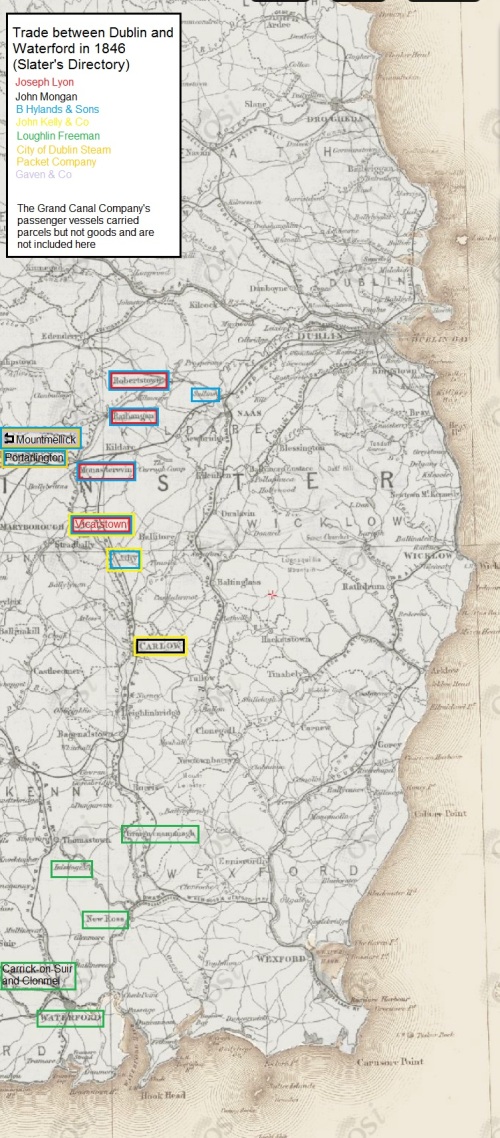
The map below shows those carrying on the Barrow Line of the Grand Canal and on the rivers Barrow, Nore and Suir. Each carrier is assigned a colour, which is used to frame the name of each place served by that carrier. Some towns (Mountmellick, Carrick-on-Suir, Clonmel) are off the map, further to the west. Note that the map is from the 25″ Ordnance Survey map of around 1900 rather than the 6″ of around 1840: I used it because it was clearer, but it shows features (eg railway lines) that were not present in 1846.

Click on the map to get a slightly larger version.

Dublin to Waterford: inland waterway traders 1846 (OSI)

Dublin to Waterford: inland waterway carriers 1846 (OSI)

Notes

All but one of the carriers are shown as having Dublin premises at Grand Canal Harbour, James Street. The exception is Gaven & Co, which is mentioned only in the Mountmellick entry.

I have not included the Grand Canal Company’s passenger-carrying boats, which carried parcels but not goods.

The City of Dublin Steam Packet Company entry for Dublin does not include Portarlington and Mountmellick amongst the towns served but the entry for Mountmellick says that the company’s boats leave for Dublin every Tuesday and Friday (its agent being John White) while that for Portarlington says they leave weekly. Boats from Mountmellick had to pass through Portarlington as well as Monastereven and other towns en route to Dublin.

Similarly, the entry for Mountmellick says that the Hylands boats leave there every other day while that for Portarlington says that they pass through weekly.

There is a page missing from the electronic copy of the directory that I consulted so the entry for Monastereven is incomplete.

The entry for Carlow says

To DUBLIN, and also to [New] ROSS, Boats depart, at uncertain periods, from the Wharfs of Lawrence and James Kelly, the Quay.

It does not say whether Lawrence and James Kelly owned any boats. They may have had boats but used them only for their own goods.

The entry for Mountmellick says “Bryan Hyland” rather than “B Hylands”.

The entry for Mountmellick includes the only mention I have found of Gaven & Co’s boats (James Waldron, agent).

The entry for Rathangan says

There are Boats for the conveyance of Goods, but no fixed period of departure.

Thomas Berry & Co, the most important carrier on the Grand Canal, did not venture south of Lowtown.

More

As far as I know, little has been written about the carrying companies, especially those of the nineteenth century. I would be glad to hear from anyone who can correct, supplement or comment on this information.


[i] I Slater’s National Commercial Directory of Ireland: including, in addition to the trades’ lists, alphabetical directories of Dublin, Belfast, Cork and Limerick. To which are added, classified directories of the important English towns of Manchester, Liverpool, Birmingham, Sheffield, Leeds and Bristol; and, in Scotland, those of Glasgow and Paisley. Embellished with a large new map of Ireland, faithfully depicting the lines of railways in operation or in progress, engraved on steel. I Slater, Manchester, 1846

My OSI logo and permit number for website

Wireless telegraphy

I mentioned here that I thought that, during the major search operation on Lough Derg on 21 June 2013, life would have been easier for everybody if each boat had had a handheld VHF and someone able to operate it. However, I should make it clear that I don’t know what equipment and what sort of organisation and safety procedures the rowing group had, so I’m not going to comment on them. Instead, I’m going to make a general point about what I think are obstacles to the more widespread use of VHF.

Buying a set

Handheld VHF sets can be bought for as little as £50 in the UK or €75 in Ireland. So the technology is now very cheap and, for short range work as on Lough Derg, a handheld VHF should be adequate.

So let’s say you do a bit of searching on tinterweb, say half an hour or so; you find a cheap set from a reliable retailer, give your credit card details and then sit back and wait for the set to be delivered. Elapsed time less than a week, your time say half an hour, the price from say €75 upwards. Getting the hardware is easy and cheap: quite a change from when the Wireless Telegraphy Act 1926 (still applicable) was passed.

But if you want to be legally entitled to use a VHF set, matters are much more complicated.

Hunt the department

Let us suppose that you are a poor benighted foreigner who has decided to hire a boat on the Shannon. You know there is Coast Guard VHF cover there and you think that it would be sensible to bring your handheld set and use it while in Ireland. But, being a poor benighted foreigner, you want to do it all legally.

Your first challenge is to find which Irish government department deals with the matter. Maybe it’s the Department of Communications? You have an old booklet somewhere saying its full name is the Department of Communications, Marine and Natural Resources, which sounds promising. However, you notice that the department seems to have dropped “marine” for “energy” and searching its site for “marine vhf” returns no results.

If, at this point, you were tempted to look at the website of the Commission for Communications Regulation, and thought of looking under Radio Spectrum/Licensing, you would find a link that took you to the right place. But let’s suppose instead that, in reviewing an official list of Irish government departments, you noticed that the word “marine” is now (for some reason) part of the title of the Department of Agriculture, along with “food”.

So you troll on over to the farmers’ friends. The main headings on the site’s front page don’t include marine, though; fisheries is the closest topic. If you use the search facility to find “marine” you get 10800 results, which is rather too many to be useful, but you find that there is a Marine Agencies and Programmes Division, which has a list of Useful Links. Unfortunately none of them are to the department that actually deals with most marine matters: the Department of Transport [and Tourism and Sport], which is at both www.transport.ie and www.dttas.ie.

Things are looking up.

Hunt the unit

Your next challenge is to find the section or unit within the Department of Transport Etc that looks after marine VHF. You could use the department’s search engine, which (at least on my computer) is great for showing the word “Loading” but not for anything else. Or you could click on the word “Maritime”, which takes you to a page whereon you read:

Maritime Safety Directorate (MSD)

The Maritime Safety Directorate (MSD) is comprised of two main sections; the Marine Survey Office (MSO) which includes the Marine Radio Affairs Unit (MRAU) and the Maritime Safety Policy Division (MSPD).

Sure enough, clicking on Maritime Safety Directorate in the left-hand column gives you another page whereon you read:

The Maritime Safety Directorate comprises of two main sections: the Maritime Safety Policy Division (MSPD) and the Marine Survey Office (MSO), which includes the Marine Radio Affairs Unit (MRAU). The Mercantile Marine Office (MMO) also works to the Directorate.

This doesn’t quite correspond to the list of headings in the left-hand column on that page, which makes no mention of a Maritime Safety Policy Division and has lots of other stuff that doesn’t seem to fit in the two (and a half?) main sections, but at least there is a link for the Marine Survey Office (MSO), and on that page there is a link to the Maritime Radio Affairs Unit (MRAU), so you click that and finally you’ve arrived.

Hunt the information

The MRAU has a top-level page and two lower-level pages. The top-level page has an email address, which is good, and a list (dated 6 April 2011) of nine PDFs of Marine Notices relevant to radio. They are identified by numbers rather than by names: there is nothing to indicate what any of them is about,  so the eager seeker after knowledge will have to read all of them. Some are about EPIRBs and suchlike; as far as I can see, the only three relevant to our poor benighted foreigner, wanting to use a handheld VHF, are this one [PDF], that one [PDF] and the other one about fees [PDF].

Selecting the Contact Us page gives you names and phone numbers as well as email addresses. So the page with the detailed information must be the other one headed Forms (and not this one, which seems to be orphaned). Each of the links on the Forms page takes you, for some reason, to another page, from which you can download a document: most are indeed PDFs but two are Word DOC files.

The documents cover three topics:

Thre is also e FAQ [PDF], which outlines the rules. It also suggests that one document is missing from those downloadable: it may be called Ships Radio
Operators Certification and may be an application form.

The FAQ does not explain the different types of licences that are mentioned in Marine Notice 35 of 2010:

An Irish Certificate of Equivalent Competency (CEC) or Irish Certificate of  Competence (COC) issued by the Department of Transport, Ireland, when such
certificate states that the holder has a valid Global Maritime Distress and Safety System (GMDSS), General Operator Certificate (GOC) or Restricted Operator Certificate (ROC) qualification. An Irish CEC or Irish COC must be accompanied by the persons separate valid GMDSS, GOC or ROC qualification.

I have no idea whether I have a CEC, a GOC, a ROC or a … the other thing. And I can’t make out which of them a new applicant (or a poor benighted foreigner) should apply for.

Then Marine Notice 12 of 2004 adds another variant, the SRC:

Radio Operators on board Irish recreational craft, and on board certain other Irish craft  that are required to comply with Merchant Shipping legislation regarding the carriage of maritime radio equipment, must hold as a minimum qualification the Radio Operator’s Short Range Certificate of Competency(SRC) issued by the Commission for Communications Regulation, or an equivalent certificate that is recognised by the Commission as being the equivalent of the Irish SRC.

Is ComReg still involved? I didn’t think so.

But the main point of this marine notice is to say that the only poor benighted foreigners whose short range certificates of competency are recognised in Ireland are the Finns and the Germans; only they can get the Authority to Operate. What should other foreigners do? I don’t know and I can’t see the answer anywhere.

Information

So far, then, it seems to me that (for someone outside the system) it is hard to find the bit of the Irish government web presence that holds the information. (That, of course, is not the fault of the Department of Transport.) Once you’ve got to the relevant part of the Department of Transport website, you have to read far too many documents to find the information you want; it’s not easy to understand and it may be incomplete.

Getting a certificate and a licence

As far as I can see, the process is this:

  • attend a course from one of the approved providers [DOC]. It’s not clear to me which course our poor benighted foreigner [or other would-be operator] would have to do; BIM offers courses ranging from two to ten days, but doesn’t show the costs; I suspect that courses for pleasure-boat operators, especially those from private-sector providers, take rather less time, but I don’t know the cost. The elapsed time could be several months, depending on local supply of and demand for courses
  • take an exam from one of the approved examiners [DOC]. Again, I don’t know the duration (it used to be less than half a day), the cost or the elapsed time (how long you would have to wait until a course is available locally). As far as I can see, the syllabus is not published, so you have no choice but to go to one of the approved providers; that sounds like an anti-competitive practice
  • apply to the department for a certificate. That, it seems, has to be done on paper; the fee [PDF] depends on the certificate you need, which I don’t know, but is either €50 or €60
  • when you’ve got the certificate, you apply for a licence for your, er, ship, using this form [PDF] and paying €100. You give details of the radio operator’s certificate; if it’s a non-Irish certificate you provide a copy, and I guess that you have already applied for an Authority to Operate [PDF].

So your cost is €150 or €160 plus the course fee plus the exam fee; the elapsed time could be several months. All for permission to operate a piece of equipment that is rather less complex than a modern smartphone.

Costs and benefits

Years ago, there was some abuse of VHF channels, which were sometimes used for casual chit-chat. From what I can hear, that is no longer a problem; folk probably send text messages instead. I don’t see any reason to fear an increase in the number of VHF users, and indeed I see many reasons to promote such an increase.

Some of the recent reports of the Marine Casualty Investigation Board on small-boat accidents describe cases in which handheld VHFs could have summoned assistance faster — and would, I think, have been more useful than orange smoke flares. In other cases, folk summoning assistance have relied on mobile phones.

It seems to me that the present system, designed almost ninety years ago for an entirely different context, for large and cumbersome equipment on large vessels, is unsuited to modern leisure boating, with large numbers of small boats that could carry small, cheap, battery-powered handheld VHF sets.

At present, the rational decision for a boat-owner is to buy a cheap VHF without bothering to get either a certificate for the operator or a licence for the vessel. This is the rational decision because the official channels for getting certificates and licences are slow, expensive and cumbersome. It may therefore be — who knows? — that the populace has already decided to ignore the regulations.

For leisure boating within some sensible distance of the shore, I suggest that the current regulations be either drastically simplified or, perhaps better, scrapped altogether. That might mean giving the International Telecommunication Union a kick up the transom, but the present system is counterproductive: it seems to limit the use of handheld VHFs in cases where they could be very useful, if only to allow search and rescue volunteers to stand down earlier.

 

Searching Lough Derg

Last Friday evening, 21 June 2013, was not a good time to be out on Lough Derg. We were heading north, with the waves behind us, and had little difficulty until entering port, but we could hear on the VHF what must have been one of the biggest search and rescue operations on the Shannon in recent years.

We had switched on at what seemed like a fairly early point in the proceedings, and kept listening until the Coast Guard were assured that everybody was accounted for. We weren’t able to attend to the whole thing, as manoeuvres during and after berthing occupied our attention for some time, but we got a pretty clear picture. The Irish Times report (which will probably disappear behind a paywall at some stage) is here; I think it has some minor details wrong but the gist of it is correct; its later report is here. The Clare Herald has a very detailed account here, the Clare Champion account is here and the Limerick Post adds some information here.

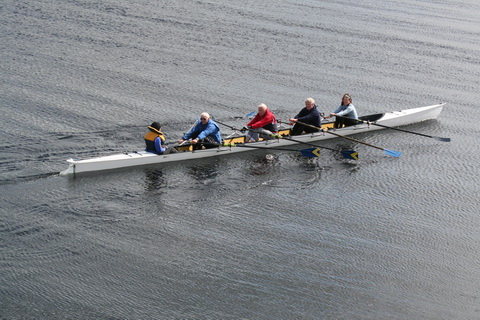
The event was said by the Irish Times to be “hosted for FISA in Ireland by St Michael’s Rowing Club of Limerick” but I can’t see anything about it on either organisation’s website. I presume that the boats were something like this one.

Quad at Clonlara in 2011

It’s a quad, with each rower using two oars; it carries a cox and it’s used for touring rowing, so it’s not as slim as a standard racing shell.

By the way, just to be clear, none of the photos on this page were taken during last Friday’s operation.

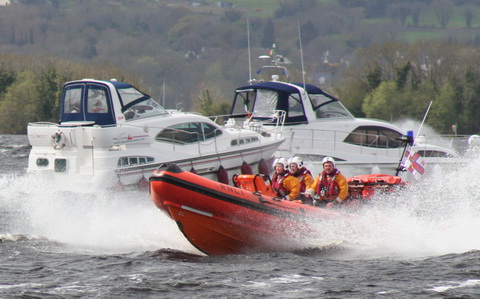
RNLI Lough Derg lifeboat

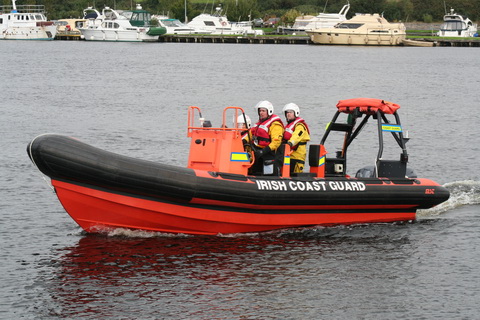
From what we could hear, the operation involved volunteers from Killaloe Coast Guard, the RNLI at Dromineer, the Community Rescue Boats from Mountshannon and Limerick and at least one yacht, which (I think) took one of the rowing boats in tow; that yacht’s participation and careful provision of information to the Coast Guard was admirable.

Killaloe Coast Guard RIB

Killaloe Coast Guard RIB

We heard discussion of proposals to ask the Civil Defence to participate as well, and the Clare Herald confirms they did turn out. It seems that the University of Limerick Activity Centre boat was out too, as was Peter Hooker of RNLI in his own boat.

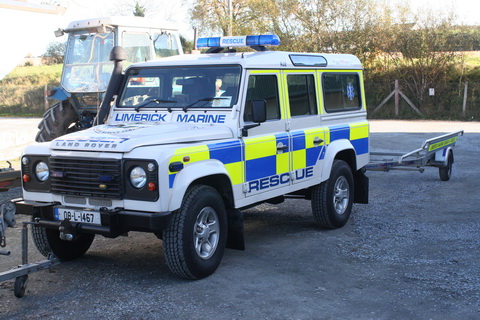
Limerick Marine SAR Land Rover

Limerick Marine SAR Land Rover

That’s just the volunteers, and if I’ve left anybody out I’m sorry; let me know and I’ll amend this.

Then there were the professionals: the Coast Guard staff on VHF, the Gardaí on shore, the helicopter crew. And, again, the Clare Herald makes it clear that lots of other people were involved too: fire brigade and ambulance units, paramedics and a hospital consultant.

All in all, this was a major operation and a lot of people put in a lot of effort that night, in bloody awful weather.

Communications

I formed the impression that communication amongst the members of the rowing fleet, and between them and the rescue services, was poor. It was difficult to establish what rowers were where and how many were unaccounted for. The Clare Herald story seems to support that conclusion: it says that Gardaí had to travel to the rowers’ hotel to make sure that everybody had turned up and that the search was not formally stood down until 11.30pm.

I don’t know what communications equipment and what sort of organisation and safety procedures the rowing group had, so I’m not going to comment on them. Instead, I want to go off at a tangent. It struck me that life would have been easier for everybody if each boat had had a handheld VHF and someone able to operate it. Such sets can be bought for as little as £50 in the UK or €75 in Ireland.

So the technology is now very cheap and, for short range work as on Lough Derg, a handheld VHF should be adequate. But if you want to be legally entitled to use a VHF set, matters are much more complicated. I’ll discuss that in another post.

FF -v- SF on C18 economic development

More from the splendid KildareStreet.com, this time an actual Dáil debate, with real people speaking, on 30 May 2013. The debate was initiated by Micheál Martin [head honcho in FF, Cork South Central], who asked the minister …

… his plans for capital investment in Waterways Ireland in the coming year; and if he will make a statement on the matter.

There are three odd aspects to that question.

The first is that Micheál Martin should already know that the capital expenditure allocation for WI within RoI for 2013 is €4 071 000: I can understand that he wouldn’t have wanted to plough through the vast wodges of budgetary bumpf, but I’m sure he would have read the highlights on this site.

The second oddity is that Micheál Martin must have known that the minister would not himself have any plans for capital expenditure: they would be WI’s plans.

The third oddity is that FF didn’t seem to have any particular reason for asking this question: the rest of the debate (see below) seems rather desultory. Could it be that it’s trying to reclaim the waterways limelight from the Shinners, who’ve been keeping an eye on WI dredging as well as on thon sheugh?

To be honest, it all seems a bit pointless: waterways may be interesting to me, and presumably to readers of this site, but they’re hardly of great national importance. A serious debate, by informed participants, might be useful, but (with all due respect to the contributors) there was little sign of that here.

Jimmy Deenihan did actually give some interesting, albeit minor, details about WI’s plans for this year. I omit the first two paras and the last, which are boring boilerplate bumpf that will be familiar to regular readers.

Jimmy Deenihan [FG, Kerry North/West Limerick]: While the Waterways Ireland 2013 business plan and budget is the subject of ongoing discussions with the co-sponsoring Department of Culture, Arts and Leisure in Northern Ireland and will require formal approval by the North-South Ministerial Council, I have provided an indicative funding allocation of €4.071 million to Waterways Ireland for capital projects in this jurisdiction in the coming year. This will facilitate capital works by Waterways Ireland in developing, restoring and improving infrastructure for water based and activity recreation and tourism, consolidating facilitates and improving access to the waterways across the navigations.

I am advised that the Waterways Ireland draft 2013 business plan has a development schedule providing for 1354 m of additional moorings across the navigations. Works planned within this jurisdiction include a range of major projects such as upgrading Bagenalstown Lock on the Barrow; provision of a slipway and stabilisation of the dock walls at Grand Canal Dock, dredging the Grand Canal; development of houseboat facilities at Lowtown and Sallins; lifting the bridge at Tullamore depot; bridge upgrades, works on weirs and locks on the Shannon; and commencement of work on the Belturbet Service Block on the Shannon Erne and purchase of plant and machinery.

I said that I would welcome information about what “lifting the bridge at Tullamore depot” means. The answer was provided in the Comments below; here is a photo of the bridge in question.

The (currently non-lifting) lifting bridge at Tullamore

The (currently non-lifting) lifting bridge at Tullamore


Most of the rest is unsurprising.

The FF follow-up came from Seán Ó Fearghaíl [FF, Kildare South], who said:

I welcome the many positive developments to which the Minister referred but one of our concerns is that since 2011 the funding available for Waterways Ireland has been cut from €35 million to approximately €32 million.

Studies over the years have shown that waterways tourism is one of the activities that is most likely to generate return visits. As a regular user of places like the Shannon Navigation, one never ceases to be amazed at the number of non-nationals one meets on that waterway who have been coming back to Ireland year in, year out. I wonder to what extent the funding the Minister has available to him should be augmented by the Department of Transport, Tourism and Sport. These waterways are of immense value to the local populations privileged to live in the catchment area of each amenity, along with their huge tourism importance. What sort of interaction does the Minister have with tourism bodies north of the Border and the Department of Transport, Tourism and Sport? Is anything planned for the waterways under the auspices of The Gathering?

What has happened in Kildare this week? We had Bernard Durkan [FG, Kildare North] the other day and Clare Daly [Socialist Party, Dublin North, but originally from Newbridge, Co Kildare] a moment ago; now we have a new chap from Kildare South.

Anyway, it can’t have come as any surprise to Mr Ó Fearghaíl that WI’s budget has been cut: so has everybody else’s, and the budgets were announced last December. I note that he didn’t ask how the Clones Sheugh was to be funded, never mind the Cavan Sheugh to Lough Oughter. But his question is the sort that a journalist might ask: vague, unfocused, couched in generalities, lacking in evidence of research into the subject. I would like to know more about his “Studies over the years”, with particular reference to the balance between and the allocation of the costs and benefits of investment in waterways; generating return visits is not in itself terribly useful (I really do not want Great Aunt Maud here again).

Not that the minister offered many hard facts in his reply:

I have seen for myself the provision of moorings at Killaloe and Ballina. Those have made a major difference to both towns in different counties on either side of the Shannon. The result of that investment is obvious and local people would accept that.

As regards involvement from Fáilte Ireland, Waterways Ireland is augmenting Fáilte Ireland’s promotion of the waterways. Waterways Ireland is providing funding on an annual basis for the promotion of tourism on its waterways. It is a North-South body, which is also very important, because Tourism Ireland promotes the entire island and the waterways network of more than 1,000 navigable kilometres can really be pushed on an all-island basis and we are doing that. I have tried to minimise the reduction in funding for Waterways Ireland because of its North-South significance and its potential and considerable work has been done. We have improved facilities for tourists so we are now ready to proactively promote this great facility.

Any, like, figures? Statistics? References to analyses? How much of WI’s budget is being diverted to the tourism bods and what is the benefit?

Next (and last) up was Peadar Tóibín [SF, Meath West], with “now for something completely different“:

A number of groups are actively trying to create a green way along the Boyne from the estuary to its source. The Boyne is littered with internationally recognised heritage monuments and would be a fantastic tourist attraction that would bring people into the region. People who holiday in the region visit Trim Castle and Newgrange on coach trips and as ar result Meath does not get the full value of their tourism. The Boyne Canal runs from Navan to Drogheda. It is not covered by the Waterways Ireland network. Would the Minister agree that such a canal should be brought within the ambit of Waterways Ireland, along with other canals, and would he consider the funds that might be available to help with the development of such a green way along the River Boyne?

The minister’s reply is interesting:

We have no plans to extend the present 1,000 kilometres of navigable waterways. The focus of our investment in capital development will be from Clones to Lough Erne to the value of €35 million.

What? No Cavan Sheugh? No Kilbeggan, Longford or Mountmellick Branch?

Oh, and note that the figure of €35 million is being quoted for the Clones Sheugh, although the last estimate I had form WI was higher than that.

The minister continued:

As regards the green way, I do not have direct responsibility but any way I can help through Waterways Ireland, I will do so. As a keen cyclist and walker, I am all for encouraging green ways wherever possible. If the Deputy has a proposal I can forward to Waterways Ireland for discussion, I will gladly take it.

Well, well. A Monaghan greenway is being developed; why not a Clones greenway too, instead of an expensive canal?