Category Archives: Uncategorized

A sense of proportion

Waterways Ireland’s funding comes from Ireland [RoI] and Northern Ireland [NI] in the ratio 85:15. I understand that the ratio reflects the length of WI-run waterway in each jurisdiction, although I am not sure how length is measured on lakes.

The proportions of boats in the two jurisdictions are not 85:15. As of December 2013 there were 5570 boats on the Erne Register and 8816 on the Shannon Register. These numbers may or may not reflect the numbers of boats on the waterways as (a) there may be unregistered boats and (b) folk may not always deregister boats that have moved off the navigation. I do not know how many boats there are on the Lower Bann; boats on the Shannon–Erne Waterway should be on either the Erne or the Shannon Register.

Waterways Ireland reckoned that there were 520 boats on the Grand, Royal and Barrow at the end of 2013. Adding them to the Shannon number gives us

  • RoI 9336
  • NI (excl Lr Bann) 5570.

The ratio is RoI 63, NI 37.

On programme costs, though, matters are otherwise. Granted that the 2011 figures, the most recent available, may not be representative of long-term average costs: the Royal has not been reopened long enough for us to get such a long-term average, and the 2011 figure may be unusually high.

The other difficulty is with the allocation of the costs of the Shannon–Erne Waterway. I have arbitrarily divided it 50/50 between the two jurisdictions, although they probably exaggerates the proportion attributable to NI.

Shannon + Royal + Grand + Barrow + ½ SEW = €7275000

Erne + Lower Bann + ½ SEW = €807000

The ratio is RoI 90%, NI 10%.

So:

  • funding: NI 15%
  • number of boats: NI 37%
  • spending: NI 10%.

All subject to caveats.

No particular point: I just thought it was interesting.

Comments closing

Very large numbers of new readers have visited this site in recent days and have read my posts about the draft WI canals byelaws. I am grateful to them and even more grateful to those who took the trouble to comment.

I have spent pretty well the whole week on this, between reading the legislation and draft byelaws, writing up posts and responding to comments. I have fallen behind with other work, and accordingly I need to turn my attention to other issues.

I have invited one person to write a guest post on an aspect of the byelaws issue that I think is important, but that apart I won’t be adding new material on the subject for some time. Furthermore, later this evening I will close the existing posts to comments. Those posts, latest first, are:

Draft canals byelaws: comments on what I sent to WI as my contribution to the consultation process

Bang em’ up? Alas, no more on the enforcement mechanisms

Pull the plug: drain the canals on WI’s financial situation. I hope it is clear that I don’t really want to see them drained, but that I do think action is needed

Asleep at the wheel on why the production of new draft byelaws should not have come as a surprise.

The posts themselves and the existing comments will remain visible.

I hope that readers have found the discussion and information useful — even those who didn’t agree with my views.

My next substantial post will be on the Dublin & Kingstown Canal.

If you are interested in the mix of contemporary and historical waterways matters, you are welcome to subscribe to the site’s RSS feeds or by email. Note that the site is non-commercial and does not carry advertisements.

How to become a FAMOUS photojournalist

So there you are, with a large collection of photos on your favourite subject, and you’re wondering how you can capitalise on that to become a FAMOUS photojournalist, with your work published in NEWSPAPERS. Well, now I can tell you the secret road to success:

  • take photos
  • put some of them on tinterweb then just …
  • SIT BACK and wait!

Yes: that’s all it takes. Because after a while, the Limerick Post may come along, help itself to your photo and publish it in its newspaper.

Judge of my surprise, gentle reader, when I found, on page 62 of its issue of 25 January 2014, one of my photos (from 2009) illustrating a story about driving in floods. I had no record of any request from Messrs Limerick Post for permission to use the photo. I sent this email:

Greetings.

On page 62 of your issue dated 25 January 2014, in an article on safety headed “Driving in hazardous conditions, storm and flood”, you publish one of my photographs, captioned “Irish Waterways’ photograph
of Castleconnell being cleared after floods”.

I do not recall giving you permission to use that (or any other) photo and I would be glad to know how you came to use it.

I got this reply from the Commercial Features Editor:

Good morning. I wanted to use a photo that was representative of tough conditions re floods locally and saw the Castleconnell one online. I did credit Irish Waterways in the shot. Is there a problem?

I responded:

Giving a credit is not the same as seeking, much less paying for, a licence to use someone else’s photo — but I’m sure I don’t have to explain copyright law to a professional. So, yes, I see this as a problem and I would welcome your proposals for its resolution.

I have now left it for a week to give Messrs Limerick Post time to compose a suitably grovelling apology but it has not, alas, arrived. Accordingly, I beg to inform Messrs Limerick Post that if, in future, I find them using one of my photos without permission, they will be hearing from my solicitors.


Pull the plug: drain the canals

The worst aspect of the piece published by the Indo last Sunday is that information is presented entirely without context. Persecuted boatowners are, it seems, to be forced to pay money, and the economy of the canals (such as it is) is to be damaged, for no reason whatsoever. The assertions of the boatowners go unchallenged.

Happily, this site provides a bilge-cleaning service. Here is the news.

1. Waterways Ireland is in dire financial straits

I have written extensively here about Waterways Ireland’s finances. I pointed out that there is a continuing dispute between the NI minister responsible for waterways and her southern counterpart, but that if the RoI government gets its way WI’s income will be cut by one third between 2010 and 2016. I showed that WI’s operating income is negligible and that most categories of expenditure have already been cut; I also showed that retirements will increase the cost of pensions benefits from just under €1000000 in 2011 to just under €2400000 in 2016, which will account for 10% of the total real staffing budget.

The combined effect is that Waterways Ireland needs to make further cuts in its spending, but that its scope for doing so is extremely limited: further cuts are bound to affect the staffing budget. WI’s only other option is to increase its (pathetically small) operating income.

2. canals and Barrow are disproportionately expensive

Here, I gave WI’s programme costs for 2011, taken from the annual report for that year (the most recent available). Here they are again, rearranged:

Royal Canal €2908k
Grand Canal €1556k
Barrow €600k

Total Canals + Barrow €5064k

Shannon €1882k
Erne & Lower Bann €478k
Shannon–Erne Waterway €658k

Total other waterways €3018k

There are all sorts of caveats to be entered about these figures: for instance, as I observed here, WI has different levels of non-navigational responsibilities on different waterways, and programme costs do not include staffing costs; nor do they include overheads like IT, marketing, personnel and so on.

But the Canal-and-Barrow costs clearly offer more scope for cutting than those for other waterways, as WI’s Corporate Plan 2011–2013 recognised. I showed here that it proposed these cuts for the period:

  • Grand Canal €910,000
  • Royal Canal €503,000
  • Barrow Navigation €387,000
  • Shannon Navigation €662,000
  • Shannon–Erne Waterway €232,000
  • Erne System €70,000
  • Lower Bann €69,000.

That’s €1800ooo in reductions from Canals + Barrow, €1033000 from the rest. However, budget developments since that plan was drawn up are likely to have increased the amounts required to be cut.

3. Canals and Barrow boaters get huge subsidies

I do not have up-to-date figures for the numbers of boats on the waterways, but suppose for the sake of argument that there are 500 on the Canals + Barrow and 8000 on the rest. I am confident that those figures are of the right order of magnitude.

In that case, counting only WI’s programme costs for the waterways in question and excluding staffing and central overheads, the costs to the taxpayer are:

  • Shannon, Erne, Shannon–Erne, Bann: €377.25 per boat
  • Grand, Royal, Barrow: €10128 per boat.

I hope to be able to provide better figures later, but the exact figures don’t matter very much: the point is that every boat on the canals and Barrow is benefiting to an enormous extent from taxpayer support. The poor persecuted boaters are seeking the continuation of a very, very privileged position: owners of camper vans, for instance, get no comparable benefit.

4. Canals and Barrow boaters contribute very little

I have figures for the numbers of boats on the canals and Barrow that held permits in September 2013. I have sought those for December, but I suspect that the number did not greatly increase by the end of the year.

By September:

  • 254 boats had Combined Mooring and Passage Permits
  • 134 boats had Extended Mooring and Passage Permits.

So the total contribution by boaters to the cost of the canals and Barrow was (254 X €126) + (134 X €152) = €52372, about 1% of the programme costs for the three waterways, which means it was considerably less than 1% of the total costs including salaries and overheads.

Let me dwell on that for a moment. The poor persecuted boaters, some of them members of organisations that claim to value the canals, themselves think that the canals are worth only €50000 a year, because that’s all they’re prepared to pay. It is not clear to me why anybody else, like the taxpayer, should pay more.

The poor persecuted boaters are now being asked to pay more than 1% of the total cost of the waterways they use (and, presumably, support). I would have thought that they would welcome an opportunity to contribute.

These figures also suggest that the level of compliance on these waterways is low, although I accept that my figures are inadequate and I will try to obtain more comprehensive information.

5. canals and Barrow are a poor use of public money

It is not clear how the taxpayer benefits by keeping the canals and Barrow open to navigation. Suppose Waterways Ireland were to open all the racks, drill holes in the bottoms of aqueducts and run off all the water. What then?

I suspect that it wouldn’t be that simple: that there are engineering-type reasons why some structures would need to be maintained and some water flow kept up. Perhaps the Morrell Feeder would suffice to keep the Grand Canal in Dublin looking nice; the flow from the Milltown Feeder, the canal’s main supply, could be sold off to Irish Water to relieve the Dublin drought. The Royal could simply be abandoned altogether; the Barrow would continue to be navigable by canoes and small craft. Shannon Harbour and Richmond Harbour could be kept in water (by pumping if necessary) and operated as commercial marinas, charging commercial rates.

Staffing could be reduced: even if there were no immediate redundancies (or transfers to Irish Water), the need for any new recruitment would be avoided for some time. Overtime would never be required and Irish Rail wouldn’t have to lift Effin Bridge.

So who would lose? The Irish tourist trade would hardly notice: as far as I can see, very few tourists go boating on canals or Barrow. There are two small hire firms on the Barrow Line, but apart from them there are (as far as I know: correct me if I’m wrong) only individual boats for hire here and there. Unless a large, well-capitalised firm, with a large marketing budget, moves in here, I can’t see there being any significant tourism activity that relies on there being water in the canals. Walking and cycling routes could be improved along the towing-paths, while the Barrow could also cater for canoeing and kayaking.

Who else benefits from having the canals and Barrow navigable? A publican or two in rural areas will sell an extra pint or two to passing boaters whose money might otherwise have been spent in Dublin; a takeaway in Tullamore will have a tiny increase in turnover … but that’s about it. This vast expenditure moves the spending of a few quid from Dublin to Daingean, but I doubt if the total is enough to create even one job in any location. I cannot see that there is any multiplier effect worth talking about.

Furthermore, such business as there is is highly seasonal, with very few boats moving any considerable distance other than in short periods in spring and autumn. Traffic is low in winter and summer.

Over the last ten years canal businesses have closed down. There were four hire fleets on the Barrow: they’ve all gone. Various trip boats have gone. Lowtown Marina is for sale. All of that during a period when capital expenditure on the canals was rising, facilities were being improved and charges to users ranged from low to non-existent.

I suggest therefore that spending on the canals and Barrow is not of any benefit to the tourist industry and is of minimal benefit to commercial service providers along the waterways. Instead the benefits go largely to two groups: the employees, who work for what they get, and the boat-owners.

6. Waterways Ireland should share the benefits

The cost of a year-round berth for a 60′ barge at a marina in a small village on the east (Dublin) side of Lough Derg is €3000. Lower rates are available on the west side.

The cost of a year-round berth for a 60′ (or any other size) barge in Shannon Harbour, a small village on the east (Dublin) side of the Shannon is currently that of an Extended Mooring and Passage Permit, €152. Thus Waterways Ireland is providing a benefit worth over €2800 to someone keeping a barge at Shannon Harbour.

I can see no good reason why Waterways Ireland should allow the Shannon Harbour owner the whole of that benefit: it would seem reasonable that Waterways Ireland should claw back at least half of it. Most marinas charge by the foot (or metre) of length, so rates for other boats could be worked out in proportion.

A berth at Shannon Harbour enjoys easy access to the Shannon; a berth in (say) Pollagh is less favourably situated and might thus be charged for at a lower rate. But berths closer to Dublin – say at Sallins or Hazelhatch or at the Leinster Mills on the Naas Branch — should attract a premium. And folk who are saving money by living in boats should be happy to share part of their savings with Waterways Ireland. (I don’t know what the premiums should be but, in another post, I’ll discuss pricing.)

The point here, the point ignored by the Indo, is that Waterways Ireland needs to narrow the gap between income and expenditure on the canals and Barrow. It is entirely fair that it should charge for the services it provides and that the burden should be borne by those who benefit.

However, it should be noted that WI’s charges are not inescapable: anyone who does not want to pay them is at liberty to remove his or her boat from the canal or Barrow and place it elsewhere, or to sell it and buy a camper van.

That being so, I see no more ground for objecting to any level of charge that WI might bring in than there is for objecting to the prices in, say, Brown Thomas.

Envoi

If (as seems to be the case) boaters’ organisations are incapable of engaging in rational discussion of the funding and management of the waterways, I suggest that Waterways Ireland should ignore them. Just pull the plug, shut down the canals and spend the savings elsewhere.

WI and the state should not continue to spend ridiculously large amounts of public money subsidising the leisure activities of a small number of people, who don’t themselves value what they’re getting, when there is little benefit to the economy as a whole. There has to be some better balance between income and expenditure on the canals and Barrow.

Waterways Ireland’s pensions burden

Let us suppose that you are an Irish civil service department, whose staff are employed on standard Irish civil service terms.

And let us suppose that your Secretary General’s 65th birthday was on 31 December 2013, by which time she had 40 years’ pensionable service. Her salary was €250,000 a year, so that’s the amount you (the department) paid to her in y/e 31 December 2013. Because of cutbacks, she is replaced, from 1 January 2014, by someone earning half that amount. So what is the cost of SecGens in 2014? Keep it simple: ignore employer’s PRSI and allowances and travel expenses and anything else.

Civil service pensions

In 2014, you will pay the new SecGen €125,000, half the old rate, but you will pay the retired SecGen €500,000, so your total expenditure on SecGens will rise from €250,000 to €625,000. [The timing may not be quite thus, but never mind.]

In 2015, the new SecGen will continue to get €125,000, but so will the old SecGen. So, even though your new SecGen gets half what the old one earned, the total cost to you remains the same.

And so on until the old SecGen dies. But if the new SecGen retires before that, you will have two retired SecGens drawing pensions and one even newer SecGen getting a salary ….

Under ordinary Irish civil service terms, someone who retires is entitled to a pension of one eightieth of final salary for every year of service, up to a maximum of forty years. So a SecGen who started, say, as a graduate entrant at the age of 25, stayed in the civil service and retired at age 65, would be entitled to a pension, for life, of half her final salary.

She would also be entitled to a lump sum of one and a half times her final salary. That’s why, on retiring, she gets an amount equal to twice her final salary: 1.5 times salary as a once-off lump sum plus 0.5 times as pension.

You could argue that that is an absurdly generous arrangement, but that’s not my point here: someone who started work 40 years ago under those conditions can’t be criticised for taking the money they’re entitled to, and it will be a long time before any revisions could take effect.

These pensions are defined benefit, non-contributory and unfunded: no money is put aside by either employees or the employer to meet pension payments in future years. It is assumed that the taxpayer will continue to meet the increasing costs.

Now, that’s all very well for the main-line civil service: it has been in existence for a long time; it’s very large, with a large pay bill; it has had SecGens retiring before and another retirement or two won’t greatly affect the overall cost.

But if you’re a relatively small organisation, dependent on the exchequer for most of your income but without any of getting extra money to pay for pensions, the retirement of one or two senior officials, or of larger numbers of lower-paid employees, could significantly increase your costs while doing nothing to improve your income or the amount of work you do.

That is happening to Waterways Ireland at the moment. I’ll give some details shortly, but first I want to get the pension scheme out of the way.

The woodchuck pension fund

Here is Wikipedia’s version of the tongue-twister about the woodchuck:

How much wood would a woodchuck chuck
if a woodchuck could chuck wood?
A woodchuck would chuck all the wood he could
if a woodchuck could chuck wood!

Coverage of the Waterways Ireland pension scheme in its annual reports reminds me of the woodchuck. I should say immediately that that is not a criticism of WI: it’s down to an accounting standard called FRS 17.

As far as I can make out, this standard requires WI to show in its accounts the entries that it would make for its pension fund, if it had a pension fund, even though it doesn’t have one. It does have a pension scheme, which I imagine sets out the rules about who is entitled to get what, but there is no pot of money put away, guarded by fierce trustees, to ensure that the pensioners of the future will get their money. Here is how I understand it; if I’m wrong (which wouldn’t be surprising), do please correct me in a Comment below.

WI’s balance sheet shows (for 2011) a liability of €66,432,000 and a balancing asset of the same amount; both of them are imaginary figures. Similarly, the income and expenditure account shows the amount that WI (in theory) should have paid in 2011 for the pension benefits that its staff accumulated in that year, along with an imaginary interest charge on its total liability. Those are then balanced by a figure called “Net deferred funding for pensions” which, at €4385000, is by far the largest component of WI’s “Other operating income”.

Obviously that lot would look better if it had corroborative detail to provide artistic verisimilitude, so the accountants or the pensions bods or someone did other calculations of currency translation charges and transfers in and out of the scheme and service costs and so on, all on a non-existent pension fund.

Now, as far as I can see, we can ignore all that. But there are two cash figures that are real and important:

  • one is that WI staff paid (was it under the public service pension levy? or something else?) €230,000 in contributions in 2011, for which they will receive benefits of €2,744,000, ie twelve times what they put in
  • the other is that in 2011 WI paid out €934,000 in actual pension
    benefits to people who had retired by then. That presumably includes
    any retirement lump sums.

Incidentally, WI’s 2011 accounts (the most recent available) make no mention of the North South Pension Scheme (see below), of which WI is a member. Perhaps the stuff in WI’s accounts is about its imaginary portion of a combined but equally imaginary fund under the North South Pension Scheme. The meetings of the NSPS CEO Pension Committee, which “exercises trustee-like functions” [seriously: see below], must be fun.

Not being an accountant (I feel I lack the necessary creativity), I am interested in the actual cost to WI of the benefits it pays out to folk who retire.

Retirements

I asked WI how many people retired in 2012 and 2013 and how many were expeected to retire in the next three years.

WI retirements 2012–2016

Figures for 2012 and 2013 are actual; those for later years are expected. Source: Waterways Ireland

Those who retired were:

  • 2012: 3 lockkeepers, 1 boatperson, 1 director of marketing, 1 mechanical fitter, 1 general operative [GO] plant operator B, 1 preserved pensioner
  • 2013: 1 chief executive, 1 clerical officer, 1 GO, 2 GO chargehands, 3 GO plant operator As, 1 GO plant operator B, 1 boatperson, 1 boatperson/skipper, 1 lockkeeper.

WI could not say what grades were expected to retire in 2014, 2015 and 2016. If they did, of course, I’d be able to guess which senior managers were about to retire; as it is, I have to rely on rumours. WI was able to predict the lump sum and pension payouts for 2014–2016, so I suspect it has a good idea who intends to retire.

The total number retiring in those five years is 81, which is about a quarter of the entire WI staff (currently 325). That’s a big proportion of the staff. No doubt it reflects the age profile of staff who transferred into the organisation but the figure may be boosted by the Hutton Push [see below].

Lump sums

Here is what WI expects to pay out in retirement lump sums in 2014, 2015 and 2016, and what it actually paid out in 2012 and 2013. Note the big increase in 2014. These sums are paid on retirement and are not recurring: in other words, they are made only to those who retire in the year in question.

Actual amounts for 2012–2013; predicted amounts for 2014–2016. Source: Waterways Ireland

Actual amounts for 2012–2013; predicted amounts for 2014–2016. Source: Waterways Ireland

If all lump sums are 1.5 times final salary [something of which I can’t be certain], then we can work out the total of the final salaries of the retiring employees.
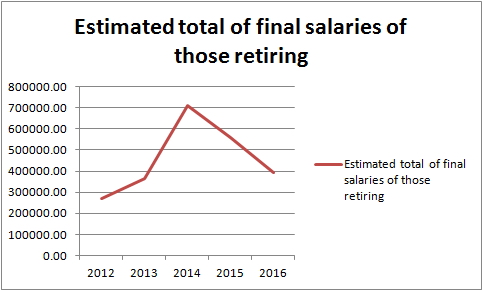
Source: actual and forecast lump sum payments divided by 1.5

Source: actual and predicted lump sum payments divided by 1.5

And, as we know the number of people expected to retire in each year, we can work out the average final salary for each year.
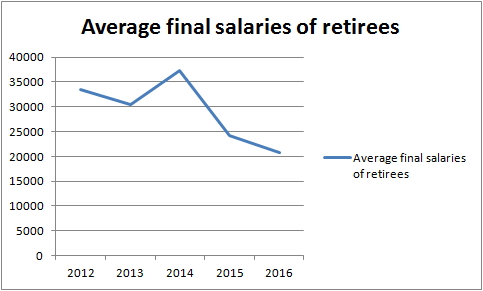
Source:  estimated total final salaries divided by expected numbers of retirees

Source: actual and predicted total final salaries divided by numbers of retirees

It looks as if some senior staff may be expected to retire in 2014.

Annual pension payments

The lump sum amounts are paid only to those retiring in the year in question, whereas the annual pension payments include those to people who started drawing pensions in 2011 and earlier years. But the lump sums are once-off, whereas the annual payments will continue to increase as more people retire.

Source: Waterways Ireland figures for total pension pay-outs less lump sums

Source: Waterways Ireland figures for actual and predicted total pension pay-outs less lump sums

The effect on WI’s finances

The totals of the lump sums and annual pension payments show how much WI has to pay out in each of the five years.
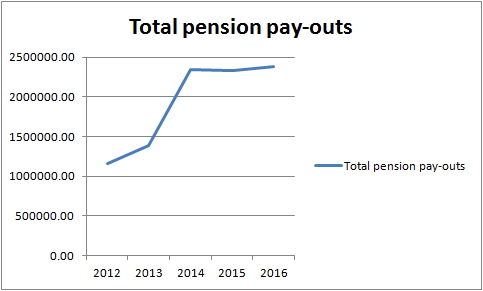
WI totals of actual and predicted pension pay-outs

Totals of actual and predicted pension pay-outs. Source: Waterways Ireland

The figure shown in the 2011 accounts was €934000. By 2016, the total will be two and a half times that: €2377000.

Remember that this is an unfunded pension scheme, so the increase comes out of WI’s ordinary allocation of money from its sponsor departments. And that allocation will not be increased: both governments want to cut WI’s income, although one government wants to cut more than the other does. If the RoI government has its way, by 2016 WI’s income will be just under 66% of the 2010 figure: a cut of one third in six years.

According to the last available accounts, WI’s main cost is staff: €21,903,000 in 2011. But that figure includes €5769000 in pension costs, €934000 of which was benefits paid out while the rest was special magical imaginary payments to the pension fund; the real staff cost (excluding agency staff and employer PRSI/NIC contributions) was €14411000.

Between 2011 and 2016, the increase in pension costs means that an extra €1443000 has to be found and, as staff costs form the main element of WI’s expenditure, it is likely that the staff budget will bear much of the burden.

The Hutton push

One factor that may be prompting some WI staff to retire as soon as they can, thus pushing up the lump sum payments in 2014, is the possibility that some changes, recommended by the UK’s Independent Public Services Pensions Commission [the Hutton Commission], might be applied to the North South Pension Scheme that covers Waterways Ireland. On 30 April 2013 Martin McGuinness [SF, Mid-Ulster, Deputy First Minister] reported to the Northern Ireland Assembly on the North/South Ministerial Council [NSMC] institutional meeting held on the previous day.

Jim Allister [Traditional Unionist Voice, Antrim North] asked him about the pension scheme:

The pension scheme for those bodies entails lavish employer contributions. In one case, over 31% of salary is contributed by the employer and a mere 1·5% is contributed by the employee. When will that lavish squander be addressed by bringing the scheme into line with what exists in the Civil Service scheme? Is it good enough for it simply to be pushed back for another six months? Why not address it now instead of looking at it further down the road?

The ever-patient Martin McGuinness responded:

At the NSMC meeting on 28 March 2013, we noted that the NSMC approved an amendment to the North/South pension scheme, which means that increases to the scheme for benefits paid in the northern currency will be in line with the consumer price index. Prior to that, they were increased in line with the retail price index. The amendment ensures that the North/South pension scheme follows public sector pension policy, as agreed by the Executive.

We also noted that the two Finance Departments are in discussion about how to further amend the scheme. These amendments will ensure that northern members are not immune from pension reform. The first amendment will increase employee contributions on average from 1·5% by 3·2 percentage points. That will align with the employee rates payable from April 2014 in the principal Civil Service pension scheme here in the North. The second amendment will introduce, by April 2015, the wider Hutton reforms, such as the introduction of a career average revalued earnings scheme and a linkage between the North/South pension scheme age and the state pension age.

The scheme was raised in the Dáil on 17 December 2013 in a written question to the Department of Public Expenditure and Reform.

Dara Calleary [FF, Mayo] asked the minister:

[…] the discussions he has had in relation to the North/South pension scheme; if the proposed amendment rules as notified from officials in the Department of Finance and Personnel and his Department will apply to southern based employees of Waterways Ireland; and if he will make a statement on the matter.

The minister, Brendan Howlin [Labour, Wexford] replied:

Five of the six North/South Implementation Bodies, including Waterways Ireland, along with Tourism Ireland, operate the North/South Pension Scheme (NSPS). The Scheme is unique in covering public sector staff employed on both sides of the border; staff of the affiliated employers in this jurisdiction are automatically members of the Scheme. The Chief Executive Officers of the relevant NSPS bodies and Tourism Ireland meet as the NSPS CEO Pension Committee, which exercises trustee-like functions in relation to the Scheme.

As Minister for Public Expenditure and Reform, I am jointly responsible, along with the Northern Ireland Minister for Finance and Personnel, currently Mr Simon Hamilton, for the rules of the North/South Pension Scheme, and in particular for approving amendments which may be proposed to those rules. In exercise of my responsibilities in relation to the Scheme, I and my officials have engaged in correspondence and discussion about reforms to the NSPS rules with my counterpart Northern Ireland Minister and his officials.

Review and reform of existing pension arrangements, including public sector pension arrangements, has been an ongoing feature of the pensions landscape in Ireland and the UK over recent times. In this context it is natural that reforms to the North/South Pension Scheme would arise for consideration, and proposals in this regard have been discussed with the NSPS CEO Pension Committee.

Pending further development of these proposed reforms, and mindful that there is ongoing discussion with trade union interests on the proposed changes, I do not intend to elaborate at this juncture on the possible final specific content of the rule amendments which may arise. I can however confirm to the Deputy my intention that the changes will, to the extent that is consistent with legal norms in each jurisdiction, apply to southern and northern NSPS members alike, including staff of Waterways Ireland in this jurisdiction. This uniformity of application would reflect the fundamental all-Ireland character of the Scheme, to which successive Governments have been committed.

That doesn’t tell us much about the likely effects on the take-home pay of WI staff, or the pensions and lump sums of retired staff, and I have no inside information about what is proposed or likely. But you can see why WI staff who are near retirement age might be tempted to get out before their conditions are worsened.

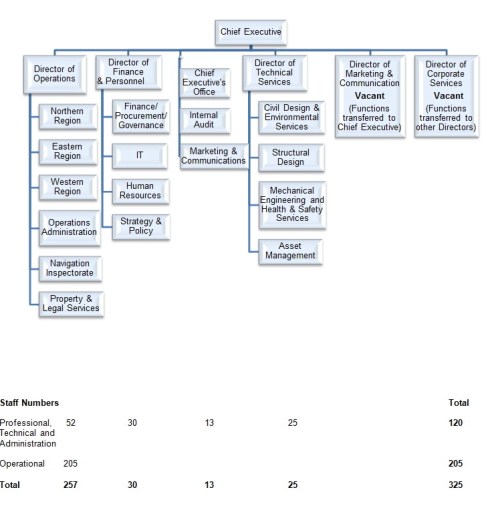
 

Waterways Ireland organisation chart

Here, courtesy of Waterways Ireland, is an organisation chart, revised on 13 November 2013, showing the numbers of employees in each division. Click on the chart to expand it.

Waterways Ireland organisation chart November 2013

Waterways Ireland organisation chart November 2013

Où est la plume de ma tante?

21 February 2018: voici une mise à jour.

Post originally written in January 2014 follows

Où sont les neiges d’antan? [That’s French for “Where is Anto’s stash of heroin?”] Où est l’étoile d’émeraude?

I remarked in August, on sighting le grand bateau de Monsieur Thibault in Athlone, that it carried the Le Boat brand, not that of Emerald Star. Emerald Star is now one speck within Le Boat, which is one of the activities within the Marine Division of the Specialist & Activity Sector of TUI Travel, which employs 54000 people.

Le le Boat bateau

Le le Boat bateau

I wrote to Messrs TUI Travel’s “corporate communications” department at the time to ask whether the Emerald Star name was being phased out, but answer came there none: no doubt all 54000 employees were busy at the time. But I noticed today that a hapless seeker after truth, searching for “emerald star”, ended up here, so I had a look myself. There is no emeraldstar.ie website (and emeraldstar.com is unrelated) but the UK Le Boat site has a little badge on the top left of the page saying “Emerald Star from le Boat”. I wonder whether that appears if the site detects that you’re accessing it from outside Ireland. I could find no other mention of Emerald Star, so I suspect the brand is doing a Cheshire Cat.

I was glad to find that Messrs Le Boat have found Google Translate useful. At least, I assume that’s how they produced this paragraph under their “Useful info” tab:

Useful Info for the Ireland

The Irish coast rises tallish from the sea, and yet the terrain drops farther inland, creating a sort of cup where the water gathers. One fifth of the water drains inward to the Shannon River, Ireland’s largest at 360 kilometres (224 miles). The fall on the navigable middle section of the river is slight at only 9 metres (29 feet), which means the water moves slowly. A Shannon River map also reveals the large number of lakes in the Shannon system, a real plus for canal boat cruising!

No, I’ve checked: it’s not Ulster Scots.

Then there’s this:

Feel the irresistible lure of the Shannon-Erne

The Shannon River gives Ireland’s central reaches their character. It’s an obvious feature if you study a Shannon River map. At a glance, it’s clear that the waters influence the land. The fishing is superb and golf is extremely popular! The towpath is level, so you’re in cycling heaven! […]

You learn something every day: I never knew that the Shannon had a towpath. I wonder where it is.

But that’s not the only puzzle. Messrs Le Boat list some suggested cruises, eg:

The Celtic Cruise Ireland
Oneway: Portumna to Carrick-on-Shannon

[…]

The golf course calls! The fishing itch must be scratched! Castles loom tall! Feel the warm embrace of Celtic charm!

Who writes this rubbish? But this is the puzzling one:

The Northern Shannon Cruise Ireland
Return Trip: Carrick-on-Shannon, via Belturbet

[…]

Travelling in the thousand lakes area takes you from the Lake Niegocin to the Lake Sztynorckie, with plenty to see on the way!

Well, I admit I don’t know the north Shannon as well as I do Lough Derg [“Lough Derg, an angler’s paradise, casts an Irish spell of contentment to keep you fishing and having too much fun!”], but I can’t find either of those lakes on any Shannon or Erne map. Où sont les mille lacs de M. Thibault? Où sont les Niegocins, Antoin? Ils sont dans le jardin avec la plume de ma tante.

The amazing success of Harbour Flights

I have written before about Harbour Flights, which operated a seaplane (floatplane) at Mountshannon on Lough Derg and conducted trial flights hither and yon. I was a little confused about whether Harbour Flights was “fully operational” but its redesigned web page (there were once several pages) carries the impressive news that the company has been so successful that it has ceased operations, at least temporarily.

But it will be back, and instead of operating a single aircraft, which was actually owned by somebody else, it will have a veritable fleet “operating from [sic] destinations nationwide” and will be “fully operational again”, which suggests that it was fully operational before. I wonder how many of the “50 new Irish jobs” were created when it reached that point.


Ballylongford (and Inishmurray/Cahircon)

SHANNON-RIVER. This is by far the most considerable river in Ireland, or perhaps in any known island, not only on account of its rolling 200 miles, but also of its great depth in most places, and the gentleness of its current, by which it might be made exceedingly serviceable to the improvement of the country, the communication of its inhabitants, and consequently the promoting inland trade, through the greater part of its long course, being navigable to a considerable distance, with a few interruptions only of rocks and shallows, to avoid which there are in general small canals cut, to preserve and continue the navigation.

Thus Wm Wenman Seward, Esq [correspondent of Thomas Jefferson], in his Topographica Hibernica; or the topography of Ireland, antient and modern. Giving a complete view of the civil and ecclesiastical state of that kingdom, with its antiquities, natural curiosities, trade, manufactures, extent and population. Its counties, baronies, cities, boroughs, parliamentary representation and patronage; antient districts and their original proprietors. Post, market, and fair towns; bishopricks, ecclesiastical benefices, abbies, monasteries, castles, ruins, private-seats, and remarkable buildings. Mountains, rivers, lakes, mineral-springs, bays and harbours, with the latitude and longitude of the principal places, and their distances from the metropolis, and from each other. Historical anecdotes, and remarkable events. The whole alphabetically arranged and carefully collected. With an appendix, containing some additional places and remarks, and several useful tables printed by Alex Stewart, Dublin, 1795. [Google it if you want a copy.]

Seward was one of many people who saw the Shannon as a valuable resource, even if they were vague on how it was to yield a return. I was reminded of that on reading the Strategic Integrated Framework Plan for the Shannon Estuary 2013–2020: an inter-jurisdictional land and marine based framework to guide the future development and management of the Shannon Estuary. The Introduction includes this:

The Shannon Estuary is an immensely important asset and one of the most valuable natural resources in Ireland and the Mid-West Region in particular — the fringe lands and the marine area both provide space and location for development, activities and opportunities to progress economic, social and environmental growth within the Region.

This report is an attempt to show how the estuary could deliver a return. The core point seems to be that a small number of areas are designated as “Strategic Development Locations for marine related industry and large scale industrial development”, thus protecting them from the attentions of the environmentalists: the whole of the estuary is a Special Area of Conservation and a Special Protection Area.

Almost all the Strategic Development Locations are already industrialied in some way:

  • Limerick Docks (in Limerick city)
  • Ballylongford (of which more below)
  • Tarbert (power station)
  • Aughinish Island (alumina)
  • Askeaton (Nestlé)
  • Foynes Island and land to the rear of Foynes (main port on the estuary)
  • Moneypoint (power station).

There is one more, Inishmurry/Cahircon (which is not boring), which is even more interesting because there is no industry there at present. It was used as a resting place for certain vessels, but it was also proposed as the site for an explosives factory. Perhaps the designation as a Strategic Development Location suggests that that proposal is not dead but merely sleeping.

Ballylongford is equally lacking in industry, despite activity at Saleen in the early nineteenth century. However, Shannon Development assembled a large landbank nearby; the report’s Executive Summary says:

The Ballylongford Landbank benefits from a significant deepwater asset and extant permission for a major LNG bank.

Here is the area in question. Note that the red oval is just to indicate the rough location; it does not show the boundaries of the landbank.

Ballylongford (OSI ~1840)

Ballylongford (OSI ~1840)

You can see a proper map and a marked-up aerial photo in Volume 1 of the report [PDF] on page 73 (77/174).

Shannon Development agreed to give a purchase option on a little uder half of the site to Shannon LNG Ltd, which proposed to build a liquefied natural gas terminal there, to be supplied by ship; much information is available here.

The Commission for Energy Regulation decided to introduce charges that would have increased Shannon LNG’s costs; the company took the matter to court but, yesterday, lost its case. The Irish Times report here will probably disappear behind a paywall at some stage; the Irish Independent report is here and the Limerick Leader‘s here (its photo shows Tarbert and Moneypoint; the Ballylongford site is off to the left).

If the Ballylongford development does not proceed, plans for economic growth on the Shannon estuary may prove to be for the birds.

My OSI logo and permit number for website

Another tour-Limerick-by-water idea …

… but this one, unlike the rest, might actually make financial sense: it uses existing infrastructure, it probably has a low capital requirement (as the firm presumably already owns the kayaks) and it seems to offer the prospect of extra income, without much extra cost, in the off-season, with low fixed costs. Furthermore, it covers the more scenic parts of the city: the Park Canal is not, alas, one of them when seen from water level, because the banks are so high you can see nothing else.

The Limerick Post covered the venture here.