Category Archives: Weather

Holiday tours in Ireland VII

On Lough Derg

There are two Lough Dergs in Ireland. One is in the County of Donegal, within four and a half miles of Pettigoe, and is celebrated for its St Patrick’s Purgatory. The lake is but six miles long and four miles broad, and can hardly vie for scenery with its namesake in the south.

In order to reach this, probably one of the most exquisitely beautiful loughs in Ireland, it is necessary to make for the town of Killaloe. This can be done by leaving Euston at a quarter-past ten at night, when Killaloe is reached by 3.10 the following afternoon; or should the tourist prefer the Irish mail, he can leave at a quarter to nine in the evening and arrive at Killaloe at half-past eleven the following morning.

Few Irish towns contain so many antiquarian relics, combined with such beautiful scenery, for Killaloe stands on a hillside tufted with wood and surrounded by mountains. The old cathedral occupies the site of a church founded by St Dalua, in the sixth century. The present building dates from the twelfth century, with a central square tower whose effect is somewhat spoiled by a  modern crown. Its gem is a Hiberno-Romanesque doorway, which has, unfortunately, been blocked into the south wall of the nave. The precincts also contain a small stone-roofed church, said to date as far back as the sixth century.

The fishing is generally extremely good, though many prefer Castleconnell, some five miles to the south on the road to Limerick. In any case few portions of the United Kingdom furnish better salmon fishing than that reach of the river Shannon that lies between Killaloe and Castleconnell.

Lough Derg must, however, remain the greatest attraction of the district. It is twenty-three miles in length, and varies in breadth from two to six miles. Nothing can surpass the loveliness of the scene, especially on a fine summer’s day. On the one side the well-wooded and smiling hills of Limerick and Tipperary, where Thomthimia, with its slate quarries, slopes down to the water’s edge; while on the other the darker and more rugged mountains of Slieve Bernagh, Ballycuggeren, and the Crag form the most effective contrast.

Kincora was once the residence of Brian Boroimbh, King of Munster, and its magnificence was long the main theme of the ancient bards. But little now remains of the ancient palace beyond a long circular earthen fort, with a single vallum some twenty feet in height.

Inishcaltra or the Holy Island is, however, well worth a visit, and for this purpose it would be better to utilize the local service from either Scariff or Killaloe to Mountshannon, which faces the island. It possesses a round tower some eighty feet high, and seven churches, or cells, and oratories, the most remarkable of which is that of St Caimin, originally erected by him in the seventh, but subsequently rebuilt by Brian Borombh in the tenth century.

Scariff may this year be approached by steamer, and is a very prettily situated village, within access by road of Woodford, in County Galway, and Ennis in County Clare. The steamer then crosses the lake to Dromineer, at the mouth of the Nenagh river, where the ruins of the castle stand out with such picturesque effect. The bay is one of the most popular resorts, both of the angler and of the yachtsman; for to the latter it has earned a well-deserved reputation for its annual regatta.

The steamer then stops at Williamstown while a boat from Kilgarvan occasionally lands passengers and conveys them to the steamer. As soon as the new jetty has been constructed by the Board of Works, Woodford will be equally accessible; but there is no doubt that the approach to Portumna pier at the head of the Lough, lying as it does between the well-wooded demesnes of Portumna Castle on the one side and Belleisle and Slevoir on the other, presents one of the finest pictures that the lake discloses, for there we see the most striking contrast between the tame verdure of the river Shannon and the bold mountain scenery of Lough Derg.

It would be tedious to dwell on the varied beauties of those innumerable seats that dot the shores of the lake on all sides; suffice it to say that few parts of the United Kingdom present as many diverse attractions as this wide expanse of water. Much as one may appreciate Loch Lomond, Loch Maree, or the Caledonian Canal, this Irish lough certainly surpasses them; and much gratitude is due to the Shannon Development Company for bringing within such easy access of the average tourist a wealth of scenery that certainly equals, if it is not finer, the finest spots that either Scotland, Norway, or Switzerland can offer.

This is, however, but half the trip from Killaloe to Athlone. Portumna is chiefly remarkable for the ruins of a Dominican priory founded in the thirteenth century, as well as for the Castle, the property of Lord Clanricarde, in which he has not resided since his succession to the estate. The village of Lorrha, three miles further up, also contains the ruins of a Dominican abbey, an oblong pile 120 ft long, as well as a castle and two old ecclesiastical buildings called by the peasantry the English churches, owing to their having been built by Norman settlers.

The river now assumes a totally novel character, winding by graceful curves through low-lying but rich meadow lands. Their luxuriant appearance is largely due to the fact that they are usually submerged under the waters of the river during the winter months.

Meelick Abbey is next passed. It was founded by the Franciscans in the twelfth century, and was at one time a sumptuous structure, but is now a roofless and mouldering ruin; and a beautiful pillar which formerly supported the arches on the south side has been torn away with ruthless vandalism, in order to make headstones for the graves in the cemetery.

Banagher can boast of a fine stone bridge, opened some fifty years ago to replace the preceding structure, which displayed no less than twenty-three arches of various forms, with massive piers between, and was so narrow that only one carriage could pass at a time.

Shannon Harbour is best known from the description of its hotel in Lever’s Jack Hinton, but that building is now let in tenements. Shannon Bridge is one of the three fortified passes built to guard the Shannon, and is but four miles from Clonfert, whose cathedral, now being restored, contains one of the finest Hiberno-Romanesque doorways to be found in the three kingdoms.

Few spots, however, offer greater attractions to the antiquary than do the celebrated seven churches of Clonmacnoise. The most remarkable of these are the Diamhliag Mhor or Great Church, which dates from the fourteenth, and Fineens Church, built in the thirteenth century. The former was originally the work of Flann, King of Ireland, in 909, and contains several bits, more especially the sandstone capitals of the west doorway, that may be traced to the earlier period. Besides these churches, there is much to be seen at Clonmacnoise, which includes among its ruins the episcopal palace and castle of the O’Melaghlins, a nunnery, two round towers, Celtic crosses, and inscribed stones. The grand cross, formed of a single stone 15 ft high and elaborately carved, surpasses every other in beauty of execution and elaborate detail.

Though the tourist may gaze upon Clonmacnoise as he approaches and leaves it and enjoys a particularly fine view of its beauties as he passes by the curve of the river on whose banks it is situated, no provision has yet been made to enable him either to land or to make a closer acquaintance of its many beauties as he passes by. This is due to the refusal on the part of its proprietor to meet the proposals of the company. It is, however, to be hoped that more favourable terms may be made in the future, as the traveller must now proceed straight to Athlone and visit the ruins from there either by road or by water.

Much more might be said of Lough Derg as well as of the Shannon from Killaloe to Athlone. Fair hotel accommodation may be obtained at Killaloe, Dromineer, Portumna, and Athlone at from eight to nine shillings a day. Lodgings can also be procured at Killaloe, where the proprietors have learned to cater for the requirements of those anglers who frequent this highly-favoured spot.

Return tickets may be obtained from Euston to Killaloe by the North Wall at
£4 13s 6d first, £2 16s second, and £2 third class. Lough Derg may also be visited from Athlone by the Midland Great Western Railway from Broadstone. The fares by Kingstown and the mail are somewhat dearer.

Pall Mall Gazette 1 August 1898

From the British Newspaper Archive run by Findmypast Newspaper Archive Limited, in partnership with the British Library.
Drowning at Doonass

Melancholy and distressing accident

By a Letter received at our Office, from Doonas, County Limerick, we regret to announce a melancholy accident having happened on Sunday the 9th inst in that neighbourhood. Mrs Massey, the wife of the Hon William Massy accompanied by her butler and two boatmen were attempting to cross the Shannon to Sir Hugh Masseys, where Mrs Massey was to dine. The evening was dark, accompanied by a dense fog, the boatmen lost their way, the boat was carried down by the current, and precipitated over the Leap, and melancholy to relate the entire party in the boat were drowned. During the entire of yesterday, the boatmen at Castleconnell were dragging for the bodies, but without success.

So dense was the fog that on the road between Kilmastulla, and Sallymount, the guard of the Coach was obliged to walk for upwards of 3 miles of the road, at the heads of the leading horses, and the coach agent was obliged to send a man on horseback with a lantern in his hand before the coach as far as Newcastle.

Dublin Mercantile Advertiser, and Weekly Price Current 17 January 1831

From the British Newspaper Archive run by Findmypast Newspaper Archive Limited, in partnership with the British Library.

Limerick floods 1814

Limerick, Dec 1

On Thursday night, or at a very early hour on Friday morning, the most awful and terrific tempest from the south and west, that ever was remembered arose, and continued without intermission until between 11 and 12 o’clock yesterday — the river Shannon swelled to an unprecedented height, with a surf which caused it to overflow the country to an extent never before witnessed; there was no trace of the highest banks upon the river, and they are broken and prostrate every where we have as yet heard of — at the quays in this harbour, the several vessels drove from their moorings, and a large Norway ship, the Pax, a brig, the Caroline, and a sloop, the Elizabeth, were forced beyond Curragour Mills, near Thomond bridge, and with much exertion were saved from injury, by Mess Mallock and Graham, ship builders, with their men — the Messery, of Liverpool, at O’Neil’s quay, laden with rock salt, is thrown on her beam ends.

The falling of chimnies has caused several houses to be unroofed; Mr Bodkin’s family, in Bridge Street, were providentially saved, as the next chimney fell on the roof, which was blown in, destroyed the different rooms, and though a child slept in the attic story, and went through the two under floors, it was unhurt. Several trees have been torn up, garden walls blown down, and the whole of the parapet, from the House of Industry to the Revenue Building overturned. A new house in Glentworth Street was completely levelled with the ground. Thomond-bridge miraculously withstood the flood; the whole bridge was covered at one time, and the parapet presented the appearance of a wall built across the river.

We really fear that the accounts from the coast will be dreadful. Yesterday morning, between eight and nine o’clock, two sail boats were lost between Foynes Island and Ahanish, one was loaded with butter, and had nine passengers, all of whom were drowned; the other a turf-boat, the property of Mr O’Keefe, with three men on board, one of whom (Hurley) perished, and the other two were driven on shore by the violence of the waves, and were saved.

On Tuesday evening a large boat belonging to Denis Malcahy of this town, was driven on the rocks, off the shore of Kilkeran battery, the tide at the same time setting in with such rapidity that the boat filled with water, and one of the crew threw himself overboard and swam ashore, leaving two men and a boy on the wreck; when in this awful moment, one of the workmen belonging to Messrs Mackey and Ryan, plunged into the water and swam to the boat — made a raft of her oars and spars, to which he fastened a rope, and swam off to the length of it — the remaining crew clung round the raft, and in the presence of a number off shore, were towed in, and thus saved from a watery grave. Thomas Gleeson, a mason, was the person who so humanely ventured his life to save that of others, which Providence enabled him to effect.

Caledonian Mercury 24 December 1814. From the British Newspaper Archive run by Findmypast Newspaper Archive Limited, in partnership with the British Library.

The wind today

From the Met Éireann National Forecast for today, made at 28 January 2016 05:09:

Temperatures will reach 10 or 11 degrees today and southwest winds will be fresh to strong and from the southwest.

Well I never.


Mr Mullins’s steamer

Here is a little information about the steamer Cupid, which was owned or used by the contractor Bernard Mullins on the Shannon in the 1840s.

Athlone 1889

To the Editor of the Athlone Times 24/8/1889

Dear Sir

I understand that the Athlone Board of Guardians passed a resolution at a recent meeting in favour of the drainage of the Shannon. May I ask, is it the object of these enlightened gentlemen to destroy the navigation of 240 miles passing through our country, which no law can ever restore; or can it be possible they so far despair of the future traffic of the country under the management of their Parliament, in College Green, as to feel warranted in doing away with such a natural and beautiful highway for trade.

I happen, myself, to be in a position to judge the agricultural part of the question, and after the experience of 25 years of the lands which are subject to the Shannon flooding, I have no hesitation in saying that the meadows are greatly improved, and I may mention that in no way could these lands be more profitably farmed than by meadowing.

To the Athlone people, it seems to me a matter of the greatest importance, or do they realise that their beautiful river is about to be turned into a mere cesspool, their traffic to be left at the mercy of the railway companies, and their boating excursions on their fine lake to be made almost impossible, as this drainage will create such a current at the opening of the lake that it will require their strongest efforts to force a boat against it, and even after overcoming this difficulty, they would have little to look at but white shores and barren rocks.

I remain, Mr Editor, Faithfully yours… R D Levinge, Carnagh

Thanks to Vincent P Delany for this.

Thon Sheugh and WI’s budget

A Sinn Féin MLA, whose party colleague is one of two ministers responsible for Waterways Ireland, has expressed concern about WI’s financial position:

Phil Flanagan: Is the [North South Ministerial] Council aware of the stark financial difficulties facing Waterways Ireland as a result of not only sustained budget cuts but the currency fluctuation because of the weakened euro? Let me point out some of the figures: compared with 2013, the 2014 budget was down by €290,000; and, in 2015, it was down by €875,000, solely because of the weak euro. Was that matter discussed? What potential solutions may ensure that Waterways Ireland is returned to a sustainable financial footing?

I had not realised the extent of the problems caused by the euro.

Replying, Martin McGuinness — also Sinn Féin — said

The fluctuation of the euro was not discussed at the meeting.

Obviously, it does represent a serious challenge, given the fact that the euro has been very weak over recent times. I note that it has strengthened over recent days. Certainly, on foot of the Member highlighting this, we can give it further consideration.

Mr McGuinness went on to provide some information about Saunderson’s Sheugh (which we’re pretending is the Ulster Canal):

It is important to point out that the work of Waterways Ireland is nearing completion, including the dredging of the River Finn between Upper Lough Erne — that will be of interest to the Member — and Castle Saunderson as part of phase 1 of the restoration of the Ulster canal.

Design plans for the new bridge at Derrykerrib are also at an advanced stage. I understand that there are some contractual issues with the site that, combined with high water levels, have led to delays.

However, Waterways Ireland is working with local councils and other interested parties to secure EU funding under the INTERREG sustainable transport programme. The proposed greenway would run from Smithborough village to the Monaghan town greenway and on to Armagh. The point that the Member raised is important and will be considered by the Council.

Given that that was irrelevant to the question, I presume that Mr McG wanted to get this information on the record.

I would like to know more about the “contractual issues with the site”. I do hope they won’t mean that we miss getting photos of the northern and southern ministers, wearing yellow hard hats and lifejackets, claiming credit for the work. After all, there is an election coming up.


Lacustrine expansions

SHANNON (THE) , the largest river of Ireland, and probably the largest in any equal extent of insular ground in the world. […]

The lower third of its course is tidal or estuarial; and the other two-thirds are, in a comparative sense, so straight, so deep, so free from current, and so much aided by lacustrine expansions, that the river can be navigated by barges, and made an aqueous highway for commerce, to within a few miles of its source.

Were all its facilities to trade and communication as fully recognised and used as those of the rivers of England, it could not fail to relieve and enrich the condition of a very large proportion of the Irish population, and would be burdened with a much greater annual aggregate of freightage than any other river of equal length in the world; yet, in spite of its voluminousness, its highly navigable capacities, and its intimate connection with many of the most populous inland and central districts of Ireland, it was, till a few years ago, very little cared for, and continues to the present day to be comparatively little known.

It effects, from Lough Allen near its source, to the sea at the level of low-water, an aggregate descent of 159 feet in summer, or 163 feet in winter; or, to speak popularly, and with reference merely to high-water level, it makes an aggregate descent of 147 feet; but it achieves no less than 97 feet of the 147 in the brief distance between Killaloe and Limerick; and it also effects, within its entire course, no fewer than 17 different falls or rapids; so that, in its entire current, except at these few particular localities, it is necessarily sluggish and silent almost to stagnation.

Much of its strictly fluviatile extent consists of very large and long lacustrine expanses; much also consists of dull, dead reaches of river, stagnating amid callows, meadows, bogs, and morasses, rankly overgrown upon the sides by aquatic vegetation, and periodically spreading out in cold and shallow floods; and surprisingly little consists of the merry and brilliant combinations of limpid and rippling current with clean well-defined and picturesque banks which so generally constitutes the river-scenery of Scotland.

The Parliamentary Gazetteer of Ireland, adapted to the new poor-law, franchise, municipal and ecclesiastical arrangements, and compiled with a special reference to the lines of railroad and canal communication, as existing in 1844–45; illustrated by a series of maps, and other plates; and presenting the results, in detail, of the census of 1841, compared with that of 1831 Volume III N–Z A Fullarton and Co, Dublin, London and Edinburgh 1846

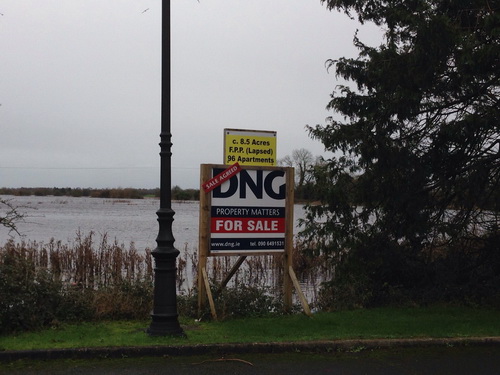
FPP (lapsed)

I mentioned flooded fields, zoned for housing, here. Michael Geraghty has very kindly sent on this photo, taken recently in Athlone.

Athlone Michael Geraghty 01_resize

FPP (lapsed)

How nice to have a waterfront apartment. Though it may be a bit much to have it waterback, waterside, watertop and waterbottom as well.

If there is an award for sales skills amongst auctioneers, I wish to nominate Messrs DNG.

For certain values …

In the Irish Times of 5 January 2016 Fintan O’Toole has an article headed “Genuine local democracy part of the solution to flooding“. He points out that

  • in 2004 the Irish Times property supplement showed a photograph [we are not told whether it was part of an ad or advertorial or of a critique of property development] showing a sign advertising for sale a flooded field that had been zoned for residential use
  • in 1997 a resident of Clonmel detailed how the town’s natural flood defences had been destroyed
  • in 1999 a man in Ennis blamed the flooding of his house on the granting of too many planning permissions
  • in 2000 3500 Clonmel residents objected to building on flood plains
  • nitwitted local councillors didn’t care.

He concludes that

As flooding gets worse, we will have to spend enormous amounts of money on engineering solutions. But in fact one part of the solution doesn’t cost any money at all. It’s called listening. Or, to give it its political title, it’s called genuine local democracy. Top-down, very expensive technocratic measures may have to be part of the response. But they will only work in a political culture that has eyes to look at the land and ears to listen to what people know about it.

Well, up to a point, Lord Copper. The article provides no evidence that a majority of the citizens — in any local authority area, Dáil constituency or other political unit — shares the erudite and enlightened views of those who write letters to, or columns in, the Irish Times. In fact, given that the citizens have, over more than one hundred years, continued to elect large numbers of nitwits to the local authorities and, for almost a century, to the Dáil, it seems unlikely that democracy — genuine, local or otherwise — will ever produce the right answers.

Which may explain why so much power now resides elsewhere, in the hands of experts and courtiers, and why elected representatives are reduced to throwing the occasional tantrum, providing tea and sympathy and making empty promises that then come back to haunt them.