Tag Archives: Ireland

Closing the Shannon in winter

I pointed out some time ago that, in the Dáil on 16 October 2013, Jimmy Deenihan said:

The [budgetary] provision will enable Waterways Ireland to deliver on its core activities and targets, which include keeping the waterways open for navigation during the main boating season and promoting increased use of the waterways resource for recreational purposes.

That was the first time I noticed the suggestion that, in effect, boating in winter might be de-emphasised, as it were; the idea is followed up in the current draft of the Waterways Ireland Corporate Plan 2014–6. The proposal receives some support from the figures for Shannon traffic in the first three months of 2014.

I realise that, as the numbers are small, they can be affected by the high water levels, bad weather or the date of Easter, but those for 2014 are remarkably low. The totals for the first three months [Jan–Mar] since 2003 are:

2003  689
2004  536
2005 2229
2006  683
2007  825
2008 1449
2009  687
2010  567
2011  626
2012  736
2013  753
2014  260

All the usual caveats apply, notably that the figures do not capture boating that is confined to the lakes. Still, the 2014 figure is less than half the next lowest, and it’s the first time since 2003 that the figure has been below 500, 400 or 300.


Eels

An update here and, from across the water, here.

Important topics in Ireland 1845–1850

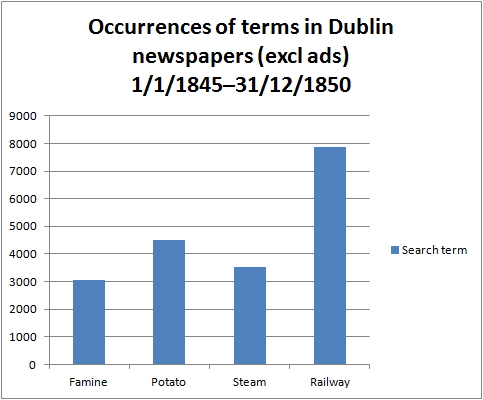
I thought it would be interesting to ask the British Newspaper Archive what people were reading about in newspapers published in Dublin between 1 January 1845 and 31 December 1850. The BNA has scans of two Dublin newspapers for that period, the Freeman’s Journal and the Dublin Evening Mail. I used the archive to search for four different words in those newspapers in that period; I then counted the numbers of results.

On the first round, I included ads and family notices.

Newspaper terms incl ads 1845–1850

Terms in Dublin newspapers (incl ads) 1845–1850

I guessed that the numbers for steam and railway might be exaggerated by their inclusion in ads so, on the second round, I excluded both ads and family notices. The result was as expected.

Newspaper terms excl ads 1845–1850

Terms in Dublin newspapers (excl ads) 1845–1850

I then asked Google’s Ngram machine to count the numbers of occurrences of four pairs of words between 1845 and 1850. I asked it to do a case-insentitive search, but it can’t do that for “compositions” (combinations of words), so it counted:

Ireland+potato
Ireland+steam
Ireland+famine
Ireland+railway.

Here is what it came up with, but whence I know not, other than that it searched the corpus English. The embedding process doesn’t seem to be working, so I’ve left the code here but also cut and pasted the output.

Google Ngram

Google Ngram

I suspect that, in recent times, the amount written about steam and railways of the period 1845–1850 in Ireland has been rather less than that about potatoes and the famine.


Splendid chaps, these arty types

I take it all back: I’ll never say another rude word about art gallery folk.

Well, not many, anyway.

The splendid folk at the National Gallery of Ireland have an online searchable archive that allows you to look at pics, download small watermarked versions and buy larger versions if you would like to do so. And “searchable” doesn’t just mean searchable by artist or type of paint or whatever it is: you can put in important terms like “steamer” and “shannon” and “canal”.

Admittedly you don’t get much back: two steamers, none of interest on this site, nothing about the Shannon and twelve canal scenes, only two of which are in Ireland. One of them, though, is very interesting indeed, and you can see it if you use

P4457

as your search term.

You should get an 1809 pic by one John Henry Campbell entitled “Ringsend and Irishtown from the Grand Canal, Dublin”, showing three wooden canal-boats, not particularly well moored, with their crews settling in (it appears) for the evening with fires lit and some with shelters rigged.

I can’t work out where they are, though. To get Ringsend lined up with Howth in quite that way, you’d have to be pretty close to the Grand Canal Docks, I’d have thought. Any guesses or deductions?


Carrick-on-Suir to Clonmel towing-path

Messrs RPS, consulting engineers, have been asked by South Tipperary County Council

… to design a minimal impact walking & cycling greenway route along the towpath of the River Suir between the towns of Clonmel and Carrick-on-Suir.

I have written about this stretch of the river here, so I was pleased to be asked to submit some comments and I welcomed the proposal. I made three suggestions, commenting more on principles than on details, which local people would know more about than I do.

First, I said that the heritage artefacts along the route should be protected and, if possible, explained. That might be done unobtrusively by making online information available to those equipped with smartphones. Such systems are used by the Canal & River Trust in Britain (here’s an example) and I understand that there have been experiments in using them on the Royal Canal here.

Second, I said that use by walkers requires more than a good trail: walkers also need safe parking places for their cars and information about public transport services that will return them to their starting-points. Car parks themselves need not be along the greenway but the information has to be provided there.

Third, there is scope for more use of the waterway itself, especially by canoes, kayaks and rafts, as well as by anglers. While such uses are (I imagine) outside RPS’s brief, I thought that it would be better to take account now of the needs of such users, and to ensure that the engineering would be able to cater for them in the future (I was not proposing that facilities necessarily be provided now), rather than to have to re-engineer the greenway later. My main concern was provision for enhanced access by rescue services, and Carrick-on-Suir River Rescue would probably be the best people to comment on that. I also suggested that a certain amount of unobtrusive hard edging along the towing-path might be of assisstance to boaters.

If you’ve looked at my page on this section of the Suir, you’ll know that it’s very scenic. Up to now, not all of the route has been accessible and making it so is a Good Thing — and at relatively low cost.


The Mahmoudié Canal

There is a possible link between the Mahmoudié Canal, which ran from Alexandria to the Nile, and Irish waterways. I have not managed to establish a definite link to this Irish canal-boat but it is not ruled out either, and a few other Irish connections came up along the way: Oscar Wilde’s father, for instance, who wrote about the Boyne and the Corrib, and sent his most famous son to school on the Erne, travelled on the Mahmoudié Canal.

And did you know that, in the early 1840s, you could buy bottled Guinness and Bass in Cairo? Or that, to transport 50 people (including 12 ladies and 3 female servants) and 3 bags and 62 chests of mail across 84 miles of desert, you would have needed, in 1841,

  • 130 camel men, donkey men and servants
  • an escort of 17 Arab horsemen
  • 145 camels
  • 60 donkeys
  • 12 saddle horses
  • 12 carriage horses
  • 7 carriage camels
  • 12 donkey chairs: “for invalids, or ladies, the donkey-chair forms as easy a conveyance as a palanquin or sedan”
  • 3 two-wheeled carriages
  • 1 four-wheeled carriage?

Or that, to reduce the number of rats and insects on a cangia (sailing boat) on the Nile, you should sink it for two or three days before boarding?

You can read about all of that and more in this PDF. However, it’s not for the faint-hearted: it’s 51 pages, with over 300 endnotes (which you don’t have to read) and lots of links for those who are really interested. There are illustrations in some of the linked materials.

The Mahmoudié mystery v04 iwh [PDF]

Marty Whelan, St Saran, Colonel l’Estrange and the Tessauren Ferry

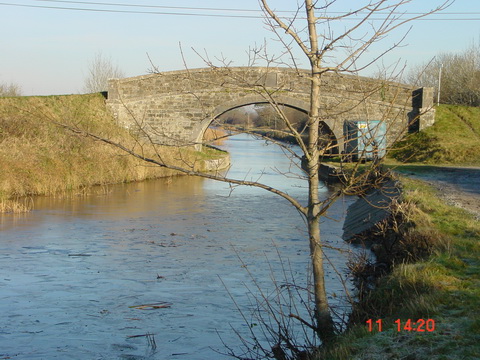
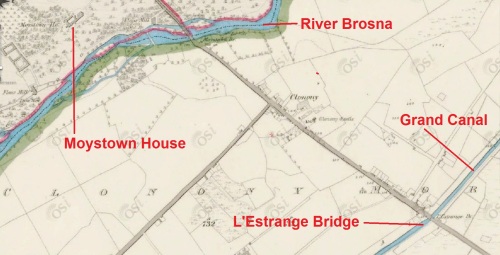
Marty Whelan, a youthful disk-jockey chap with an insignificant amount of facial hair, presents a morning programme on the wireless. One day last week, discussing traffic problems with a chap from AA Roadwatch, he considered the origin of the name of L’Estrange Bridge, whose location neither he nor his collocutor knew.
L'Estrange Bridge (2003)

L’Estrange Bridge (2003)

It had been mentioned on this site as the location of a fatal motoring accident in December 2011 and it is, of course, a useful stopping place for those who, driving to Athlone, like to stop to consume the coffee (and any comestibles) they may have purchased in the award-winning Spar shop in Cloghan.

I emailed Mr Whelan, with a link to the location on the OSI map.
Tessauren 1

L’Estrange Bridge and Moystown House

I speculated that, as the nearby Moystown House was owned by the l’Estrange family (as was Huntston or Hunstanton, across the road), the Grand Canal Company might have had to buy land from them and, with the aim of keeping the cost down, have agreed to name the bridge after the landowner (a tactic that the National Roads Authority might adopt).

I should make it clear that I have not researched the land purchases of the Grand Canal Company in the area, so this should not be taken as definitive. I note, from Fred Hamond’s Bridges of Offaly County: an industrial heritage review (for Offaly County Council, November 2005), that the date on the bridge is 1800, although the canal was not opened until 1804; as Fred says:

Most [bridges] were built before their respective stretches of canal opened […].

The Parliamentary Gazetteer of 1846 says:

The principal artificial features are the mutually adjacent demesnes of Moystown and Hunstanton, the residences of the Messrs L’Estrange, situated on the Brosna. “Though Moystown,” remarks Mr Fraser, “has not extensively diversified park scenery to boast of, and is environed by deep brown bog, there is, in the style of the house, in the arrangement of the plantations, and in the beautiful evergreen oaks and other ornamental trees which adorn the lawn, a character which carries us back to the gentlemen’s seats of the olden times. This demesne is watered by the Brosna, which pays its ample tribute to the Shannon at thetermination of the grounds, and where also the Grand Canal crosses the river in its progress to Ballinasloe.”

Lewis’s Topographical Dictionary of 1837 says that Colonel l’Estrange was living at Moystown at the time, William l’Estrange was living at Kilcummin, a little distance north of Huntston, and Major Carlton (a relative, I think) at Huntston.

A quick search suggests that the l’Estranges did occupy land there in 1800, but I cannot claim to have carried out a thorough investigation.

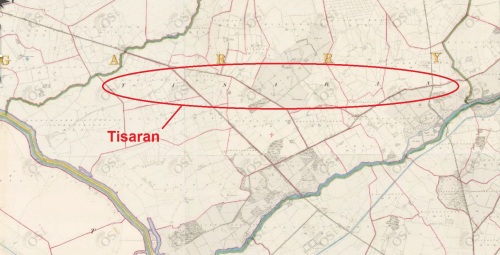
What was of more interest to me was that the Parliamentary Gazetteer extract was from an item headed Tessauran, Tiseran or Kilcally:
Tessauren 2

The parish of Tisaran

TESSAURAN, TISERAN, or KILCALLY, a parish in the barony of Garrycastle, 2¼ miles north-west by west of Cloghan, King’s co., Leinster. Length, south-westward, 3¾ miles; extreme breadth, 2½; area, 7,316 acres, 2 roods, 12 perches, — of which 106 acres, 3 roods, 38 perches are in the river Shannon. Pop., in 1831, 2,032; in 1841, 2,029. Houses 346. The north-western boundary is traced by the Blackwater; the south-western boundary, by the Shannon; and the south-eastern boundary, by the Brosna. All the northern district, part of the eastern, and most of that along the Blackwater, are bog; much of that along the Shannon is lowland meadow; and most of the remainder is dry limestone land, pleasant in appearance, and possessing a considerable aggregate of embellishment.

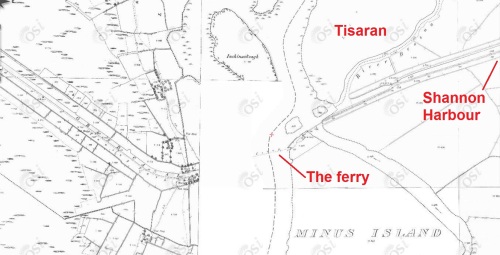
Some time ago, I asked here about Tessauren Ferry, but had no response. I found the term in F E Prothero and W A Clark eds Cruising Club Manual: A New Oarsman’s Guide to the Rivers and Canals of Great Britain and Ireland George Philip & Son, London 1896. His entry for the Grand Canal included this at 79¼ miles from Dublin:

Entrance into the Shannon at Tessauren Ferry.

I have not seen the term used anywhere else. The ferry is of course that provided by the Shannon Commissioners to enable horse-drawn boats to cross the Shannon to the Ballinasloe Line of the Grand Canal. It would be nice to find other instances of the use of Prothero’s term.

Tessauran, Tisaran, Tiseran, Tessauren (and perhaps there are other variants) is the name of the parish north-east of the junction between the Brosna and the Shannon. It is odd that the ferry’s eastern departure point was actually outside the parish, because the Brosna was the boundary and the ferry started from the south side of the canal and the Brosna.
Tessauren 3

Tisaran parish and the ferry

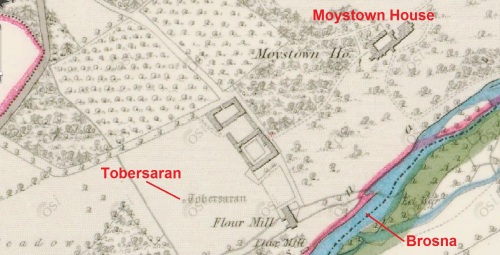
The other link I had not made was that between Tessauren and St Saran, whose well I photographed some years ago, which means that I was on the grounds of Moystown House.
Tessauren 4

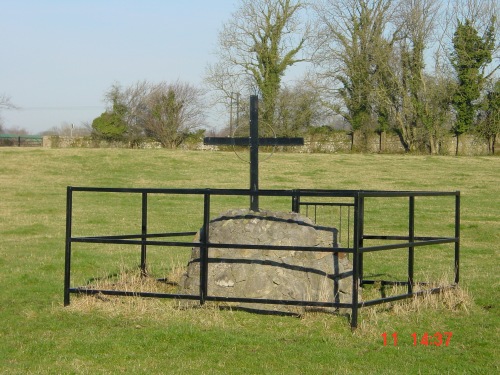
St Saran’s well (Tobersaran)


St Sarans Well near Shannonbridge 03_resize

St Saran’s well

St Sarans Well near Shannonbridge 04_resize

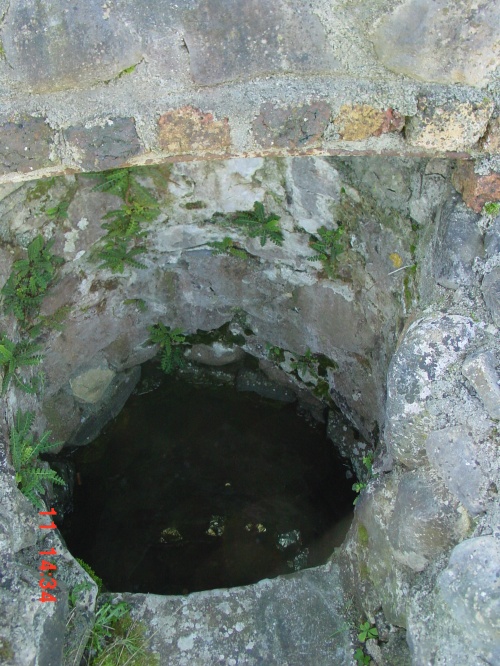
Looking into the well


So one mystery solved, as an accidental result of a remark on the wireless, but more information about the use of the term Tessauren Ferry would be welcome.

My OSI logo and permit number for website

Brosna

The River Brosna has the distinction of supplying water to two Irish waterways: the Shannon, which it joins at Shannon Harbour, and, further up, the Royal, which is to get a supply of water pumped from Lough Ennell, outside Mullingar.

The Old River Shannon Research Group promises to give special attention to the Brosna this year, so we may expect to learn more about this interesting river — without having to get our own feet wet.

The Shannon in winter

Waterways Ireland has kindly supplied me with the Shannon traffic figures for January and February 2014. The usual caveats apply. I have not made any charts because the traffic levels were so low:

  • in January, nineteen boats were recorded; of them, ten went through Portumna Bridge. Thirteen boats were private and six hired
  • in February, thirteen boats were recorded, five of them at Portumna; nine were private and four hired.

The total of 32 boats in the two months is extremely low. Since 2003, the Jan–Feb totals have been:

2003   45
2004 112
2005  67
2006  92
2007 127
2008  72
2009 124
2010  72
2011 114
2012  94
2013  97
2014  32

As Waterways Ireland intends to “prioritise navigation opening times to the times of greatest use, in order to achieve maximum use of resources available”, we may expect the Shannon to be closed in winter.


Bernard Durkan TD

I have sent this email to Bernard Durkan, a Fine Gael TD for Kildare North:

Greetings.

It is reported that, in the Dáil on 6 March 2014, you said:

“The canal restoration that has taken place over the past 50 years was largely done through voluntary effort. While Waterways Ireland has an involvement in upgrading the canals, and it has a responsibility that we all respect, cognisance should be taken of the huge voluntary effort in the restoration of the canals.”

I would be grateful if you could tell me the evidence for your assertion. How did you measure restoration and the respective contributions of volunteers and of Waterways Ireland and its predecessor bodies?

Best wishes
bjg

I may confess that I think he’s talking through his hat, but I will read his evidence with interest.