
The National Inventory of Architectural Heritage on the Black Bridge at Plass[e]y and on Baal’s Bridge in Limerick.
It would be nice if the NIAH provided reliable historical information.
I thought it would be interesting to ask the British Newspaper Archive what people were reading about in newspapers published in Dublin between 1 January 1845 and 31 December 1850. The BNA has scans of two Dublin newspapers for that period, the Freeman’s Journal and the Dublin Evening Mail. I used the archive to search for four different words in those newspapers in that period; I then counted the numbers of results.
On the first round, I included ads and family notices.

Terms in Dublin newspapers (incl ads) 1845–1850
I guessed that the numbers for steam and railway might be exaggerated by their inclusion in ads so, on the second round, I excluded both ads and family notices. The result was as expected.
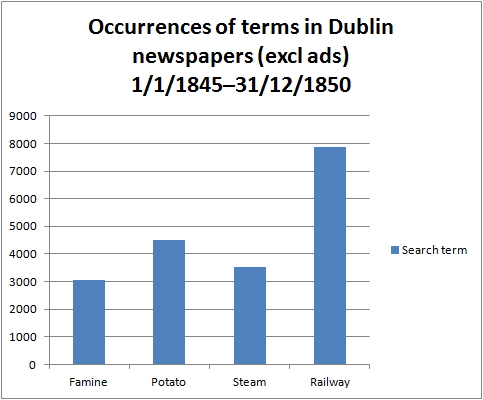
Terms in Dublin newspapers (excl ads) 1845–1850
I then asked Google’s Ngram machine to count the numbers of occurrences of four pairs of words between 1845 and 1850. I asked it to do a case-insentitive search, but it can’t do that for “compositions” (combinations of words), so it counted:
Ireland+potato
Ireland+steam
Ireland+famine
Ireland+railway.
Here is what it came up with, but whence I know not, other than that it searched the corpus English. The embedding process doesn’t seem to be working, so I’ve left the code here but also cut and pasted the output.

Google Ngram
I suspect that, in recent times, the amount written about steam and railways of the period 1845–1850 in Ireland has been rather less than that about potatoes and the famine.
Posted in Built heritage, Canals, Charles Wye Williams, Economic activities, Engineering and construction, Extant waterways, Foreign parts, Industrial heritage, Ireland, Irish inland waterways vessels, Operations, People, Rail, Sea, Shannon, Sources, Steamers, waterways
Tagged boats, bridge, canal, Dublin, famine, Ireland, Killaloe, Limerick, Lough Derg, Operations, potato, railway, Royal Canal, sea, Shannon, steam, steamer, waterways, Waterways Ireland
… not.
If you’re feeling the need of something to depress you, troll on over to the website of the Northern Ireland Community Relations Council and download the six PDF sections of the third Peace Monitoring Report. Written by Dr Paul Nolan, it is an extremely impressive piece of work — and a welcome counter to the witterings of the peaceprocess feelgoodistas who are so prominent on 2RN these days.
If you would prefer a summary, here is Liam Clarke’s account in the Belfast Telegraph, and here is his commentary; Tomboktu and others pointed to some problems with the headline on the first piece, but I’m more concerned that the focus on education in the headline on Clarke’s account may distort perceptions of what the report and, indeed, the rest of Clarke’s article are really about.
The report uses indicators grouped into four domains:
I didn’t find much that was cheering in any of them. Nolan lists ten key points:
Only the fifth and ninth offer any good news. But, from a waterways perspective, I was struck by the complete irrelevance of the proposed reconstruction of the Ulster Canal, the Clones Sheugh, to solving any of these problems. Yet Waterways Ireland, around whose neck this dead albatross has been hung, is the largest of the cross-border bodies and the sheugh is the largest capital project proposed to be undertaken by any of them. If the Irish government wants to do something to solve the real and continuing problems of Northern Ireland, as outlined in the Peace Monitoring Report, couldn’t it find something more useful to do?
Incidentally, I have not been able to find coverage of the report on the websites of the Irish Times, Irish Independent or Irish Examiner, although that may reflect poor searching on my part rather than any lack of interest on theirs.
Posted in Ashore, Built heritage, Canals, Economic activities, Engineering and construction, Foreign parts, Industrial heritage, Ireland, Non-waterway, People, Politics, Restoration and rebuilding, Sources, Tourism, Ulster Canal, waterways
Tagged Belfast Telegraph, boats, canal, Clones, Community relations Council, department of arts heritage and the gaeltacht, Erne, Liam Clarke, Limerick, lock, lost, Lough Neagh, Northern Ireland, Paul Nolan, Peace Monitoring Report, sheugh, Ulster Canal, Waterways Ireland
Some weeks ago Waterways Ireland kindly supplied me with the Shannon traffic figures for the final three months of 2013 and I have just now had a chance to add them to my spreadsheets and produce some graphs.
The usual caveats apply: the underlying figures do not record total waterways usage (even for the Shannon) as, for instance, sailing, fishing or waterskiing on lakes or river stretches, which did not involve a passage through a lock or Portumna Bridge, would not be recorded. The passage records are our only consistent long-term indicator of usage of the Shannon but they would not show, for instance, a change in the balance of types of activities from those in larger cruising boats to those in smaller (sailing, fishing, waterskiing) boats. On the other hand, they do include the Shannon’s most significant tourism activity, the cruiser hire business.
It is good to note, incidentally, that, in its draft Corporate Plan 2014–2016, Waterways Ireland says that it intends to
Develop and implement a research programme to measure waterway usage and inform planning and development.
It won’t be easy to do, but we need much better measures of all types of activities on all seven of the waterways managed by WI.
The final outcome for 2013 won’t greatly surprise anyone who has read earlier bulletins on this subject, like this covering the figures to end-September 2013. All the illustrations are based on information supplied by Waterways Ireland, with some minor adjustments by me to eliminate anomalies, but the interpretation and comments are mine own.

Total Shannon traffic 2003–2013, private and hired
The decline in traffic since 2003 seems to have been halted …

Total Shannon traffic as a percentage of 2003 traffic
… but it is 40% below what it was in 2003.
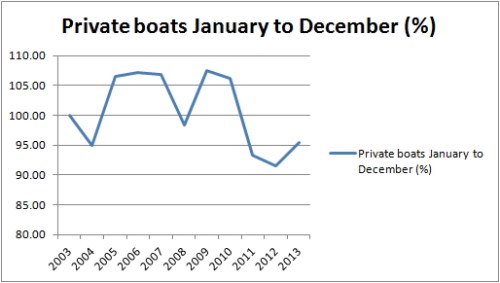
Private-boat traffic 2003–2013 as a percentage of 2003 traffic
Traffic in private boats seems to be recovering, but what is perhaps more significant is that it never went more than 10% above or below the 2003 figure. It has been remarkably stable over the period, despite the economic crash and despite the anecdotal evidence of boats being sold to overseas owners and trucked out of the country. Perhaps larger boats were replaced by smaller? Perhaps only boats bought in the boom were sold in the bust? Unfortunately the deficiencies of the registration system make it very difficult to determine what has been happening.

Hire-boat traffic 2003–2013 as a percentage of 2003 traffic
But if private-boat traffic has been remarkably stable since 2003, the same cannot be said of hire-boat traffic. The best that can be said of 2013 is that the figures didn’t get [much] worse, but a 60% decline since 2003 is really, really dreadful.
WI’s draft Corporate Plan, which does not explicitly mention the hire industry, talks of
… unlocking opportunities to achieve recreational growth, and economic and social development.
I don’t know whether that omission means that WI sees little prospect of a rejuvenated hire-boat industry. And I note that, other than in the titles of organisations, the draft plan rarely mentions tourism or tourists. Are the waterways only for natives? If so, is that a deliberate policy decision? Or is there something that could be done, cheaply, to help to revive waterways tourism?
Emma Kennedy, writing in the Sunday Business Post on 23 February 2014, wrote about Fáilte Ireland’s latest brainwave, which is to “target” three groups:
No families with kids, I see, although “Families & Loved Ones” (the latter term, by the way, nowadays seems to mean either dead people or their relicts) were one of the two “primary target customer segments” identified in Fáilte Ireland’s Inland Cruising Market Development Strategy. (Fat lot of good that strategy did, but we mustn’t be bitter.)
Anyway, without having done any market studies (though WI has funded lots of them), it seems to me that there is scope for more tourism on the waterways, but it might not be on traditional cruisers. It might involve outdoor activities like cycling and walking along the canals and Barrow: WI’s plan discusses them, but without adverting to an overseas market. And it might involve small-boat activities — canoeing, touring rowing, small-boat sailing, camping — on Shannon, Erne and SEW: WI says it will support micro-enterprises, and those providing outdoor activity holidays may need expertise and assistance rather than hard cash.
I admit to having little evidence on this, but it seems to me to be too early to give up on the tourism potential of the waterways. And the decline of the cruiser hire business does not necessarily mean that all waterway tourism is doomed.
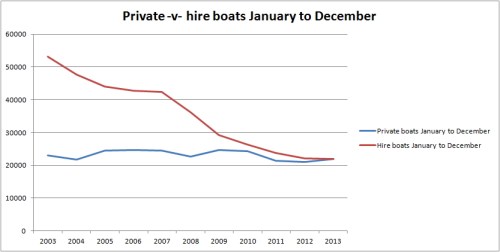
Private boats overtake hire boats
That said, 2013 was the year when, for the first time since Noah was an Able Seaman, the number of passages by private boats exceeded that by hire boats.
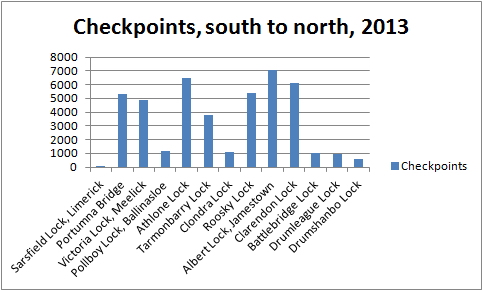
The points at which numbers were recorded
Finally, this chart suggests that any structures that were not built by the Shannon Commissioners in the 1840s will not attract many visitors. The extensions off the main stem of the Shannon — south to Limerick, west to Ballinasloe, east through Clondra, north to Lough Allen — are much less used than the main line from Lough Derg to Lough Key. It seems unlikely that any further extensions, especially to small towns that it would take three hours (at canal speed) to get to, are likely to be any more successful in attracting traffic.
Posted in Built heritage, Canals, Charles Wye Williams, Economic activities, Engineering and construction, Extant waterways, Foreign parts, Forgotten navigations, Industrial heritage, Ireland, Irish inland waterways vessels, Natural heritage, Operations, Politics, Restoration and rebuilding, Shannon, Sources, Tourism, Ulster Canal, Water sports activities, waterways, Waterways management, Weather
Tagged Albert Lock, Athlone, Ballinasloe. Lough Ree, barge, Barrow, Battlebridge, boats, Boyle Waters, bridge, canal, Clarendon lock, Clondra, Clones, department of arts heritage and the gaeltacht, Drumleague, Drumshanbo, Erne, Fáilte Ireland, Grand Canal, Ireland, Jamestown, Killaloe, Limerick, lock, Lough Allen, Lough Derg, Lough Key, Lough Neagh, Meelick, Operations, Pollboy, Portumna, Rooskey, Roosky, Royal Canal, Sarsfield Lock, Shannon, Shannon-Erne Waterway, strategy, Tarmonbarry, traffic, Ulster Canal, Victoria Lock, waterways, Waterways Ireland
Gillogue, in Co Clare, is the site of a former Burlington factory and of a Clare entrance to the University of Limerick. It is also the site of a lock on the Plassey–Errina Canal, a section of the old Limerick Navigation, and of quarries, gravel pits and lime kilns.
And, according to the 6″ Ordnance Survey map, of around 1840, Gillogue also had a railroad.

The Gillogue rail road (click to enlarge)
The railroad was almost certainly not for carrying passengers; it may have been a light railway, with small wagons pushed by men or pulled by horses, and designed to be taken up and moved elsewhere fairly easily. However, I have no hard information about who owned it, who built it or what it was for. I can make guesses, based on its closeness to the canal and to the quarries, but it would be nice to have evidence.
If, Gentle Reader, you know anything about it, do please leave a Comment below.

Posted in Ashore, Built heritage, Canals, Charles Wye Williams, Drainage, Economic activities, Engineering and construction, Forgotten navigations, Industrial heritage, Ireland, Non-waterway, Operations, Rail, Shannon, Sources, The cattle trade, The fishing trade, The turf trade, waterways, Waterways management
Tagged barge, boats, bridge, Burlington, canal, Clare, Gillogue, Ireland, Killaloe, Lame Duck, Limerick, lock, lost, O'Briensbridge, Operations, Plassey, Plassey-Errina Canal, quarry, quay, rail road, railroad, Shannon, steamer, University of Limerick, vessels, water level, waterways
Video. NB I have no information on this myself and have no intention of going to inspect the site: it’s windy and wet in Limerick.
Parteen Villa Weir is sending large amounts of water down the original channel of the Shannon, and over the Falls of Doonass, to draw water off from the upper reaches of the river.
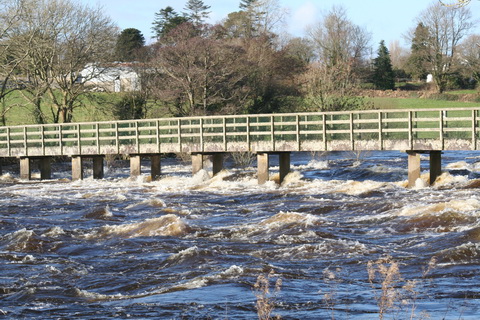
The footbridge at Castleconnell
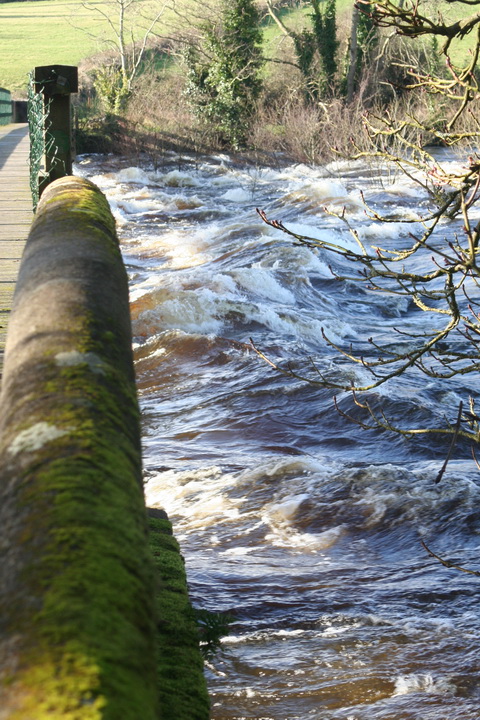
Above the bridge
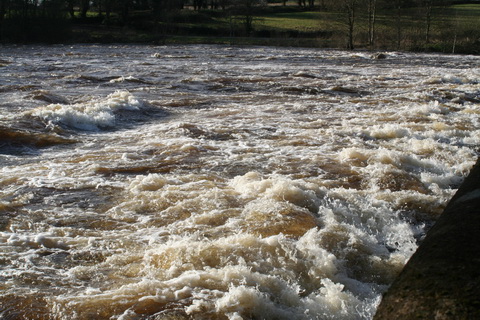
The downstream side of the bridge
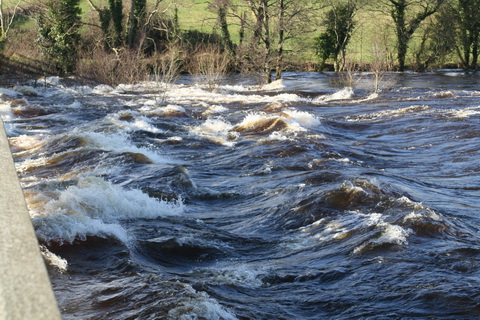
A bumpy ride
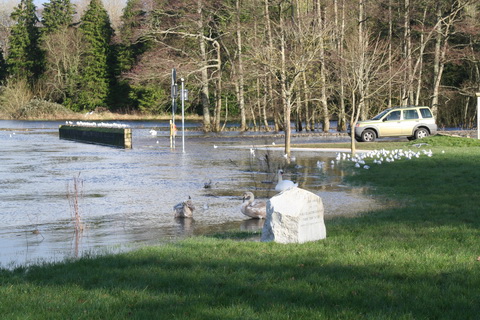
At normal levels the bottom of the wall is several feet above the water
Levels below Parteen Villa have not yet reached those of 2009 and the channel can probably take more before folk get flooded.
The Old River Shannon site has some photos taken at Parteen Villa Weir.
Posted in Built heritage, Canals, Charles Wye Williams, Drainage, Economic activities, Engineering and construction, Extant waterways, Industrial heritage, Ireland, Natural heritage, Operations, Safety, Shannon, Sources, Tourism, Water sports activities, waterways, Waterways management, Weather
Tagged boats, bridge, canal, Castleconnell, Clare, ESB, floods, flow, Ireland, Killaloe, Limerick, lost, O'Briensbridge, Operations, Parteen Villa Weir, quay, Shannon, turf, vessels, water level, waterways, Waterways Ireland, weir

 Irish waterways history