Category Archives: Operations

Tories on the Barrow and the Shannon

I read here that Olivia O’Leary, who chairs a Save the Barrow Line committee, says that the Barrow Line (trackway or towing-path)

[…] is a natural amenity and should be maintained as it is.

It isn’t. It is an entirely artificial creation, built to enable the use of horses to tow boats. Any geraniums, beetles, butterflies or tweetie-birds using it are interlopers, squatters and trespassers and should be paying rent; at the very least they should take second place to humans.

The Grand Canal Company often complained about the poor quality of the Barrow trackway: the surface was not up to the job. If it is to cater for more users, it may well need to be improved. That is an engineering decision on which I am not competent to pronounce but, as the Barrow is pretty well a dead loss for long-distance cruising by larger boats, it needs to be redesigned for walkers, cyclists and canoeists.

But at least the Barrow NIMBYs are prepared to accept more boats. Dr William O’Connor of the Old River Shannon Research Group writes about the Shannon here, complaining about the small number of “garish canoes” that occasionally travel downstream from Castleconnell to Clareville. Dr O’Connor asks

[…] why has it become a free-for-all for canoeists?

The answer is that there is a right to navigate, as I pointed out here (with an addendum here): I have had no response from the ESB so, while being open to correction, I maintain my position. Anglers may believe that their interests are paramount on that stretch of the Shannon: I disagree. Of course I would be all in favour of discussions between anglers, kayakers, dog-walkers and other users (even environmentalists), but such discussions cannot be based on a presumption that one group has all the rights, or that one activity is of supreme importance, and that the rest are secondary.

For some reason, canoes operated by commercial providers are particularly to be condemned, although it is not clear how salmon and lampreys can distinguish between public-sector, private-sector and voluntary-sector canoes — or whether they would be bothered anyway: Dr William O’Connor says

It is noted that there has been little scientific research on the ecological impact of canoeing.

In other words, there is no reason to believe that there is any basis for the concerns expressed by Dr O’Connor or by various anglers.

More broadly, though, the common factor on the Shannon and the Barrow is that existing users of public facilities are resisting new or expanded uses and seeking to protect their privileges. Irish Toryism is alive and well.

Addendum: this is probably the solution to the salmon problem.
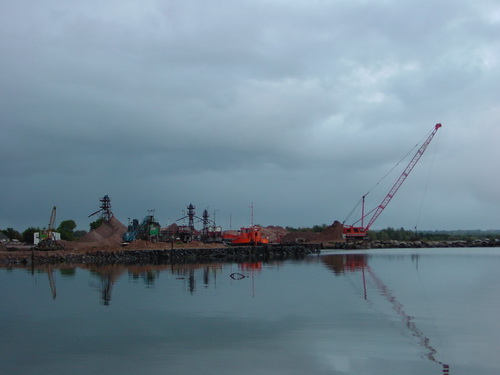
Boarding in Limerick

On the morning of the day on which I left Limerick, a truly melancholy and fatal accident occurred. Just as the steamer which starts every morning for Kilrush and Kilkee, was in the act of leaving the quay, a car was seen to approach very rapidly to the station, from which the vessel had just begun to move. Planks are not used at these quays, the water being sufficiently deep to admit of the steamer lying so close as to enable the passengers to step off from the quay on board the vessel.

A fine young man jumped off the car, and took a female who was on the opposite side in his arms, and ran with her to the packet, and had just succeeded in placing her feet in the side of the boat. In order to get her safely aboard he had to push her forward, and by this means accomplished the object he had in view. But alas! in achieving so much for her, he lost himself; for at this moment the packet moved off, and it became impossible for him to reach her; while the efforts he had previously made to get the lady on board occasioned him to stretch so far forward that it was equally impossible for him to recover his upright position on the quay. The consequence was that he fell between the quay and the steamer, and, as it was supposed, was struck by a revolution of the paddle, for he never rose.

What must have been the feelings of the poor female in witnessing the sudden and melancholy death of her gallant preserver? She was in delicate health, and was about to proceed to Kilkee for the benefit of sea-bathing, when this awfully heartrending event took place, which deprived her of him who was her darling and her pride; for alas! he was her son.

Thomas Lacy Home Sketches, on both sides of the channel, being a diary Hamilton, Adams, & Co, London; W H Smith & Co, London; McGlashan, Dublin, 1852

Date of event (deduced) Wednesday 28 August 1850

Alice is at it again

Learned readers are no doubt familiar with Dame Felicity Lott‘s interpretation of the song Alice is at it again, wherein the nature of what Alice was actually at is left to the imagination of the listeners.

Aengus Ó Snodaigh [SF, Dublin South Central] and the Minister for Fairytales [FG, Drumlins/Stony Fields] have been performing a duet to something the same effect:

[AOS] To ask the Minister for Arts, Heritage and the Gaeltacht the steps she is taking in conjunction with Waterways Ireland to bring to an end an issue that is occurring with increasing frequency (details supplied).

[MfF] I have been informed that Waterways Ireland technical staff recently visited the location in question to assess the situation referred to by the Deputy and to determine the options available to try to make the location referred to by the Deputy less attractive to such activities. Waterways Ireland is currently assessing these options and, subject to available funding, hope to be in a position to implement measures to improve matters, while ensuring that any changes do not negatively impact on the general public.

With regard to an immediate response to dealing with the specific issue raised by the Deputy, Waterways Ireland staff do not have enforcement powers to restrict this activity.

I and Waterways Ireland would encourage anyone who witnesses such activity to report the matter to An Garda Siochána.

So unspecified persons have been engaging in unspecified activities at an unspecified location.

And if we see them at it we should tell the police.


Limerick gammon

Thanks to AOD for alerting me to an article by Morgan McCloskey “O’Maras of Limerick and their overseas business” [PDF] from the Old Limerick Journal summer 2001. O’Maras were bacon and ham curers: according to Frank Prendergast “The Decline of Traditional Limerick Industries” in David Lee & Debbie Jacobs, eds Made in Limerick: History of industries, trade and commerce Volume 1 [Limerick Civic Trust, Limerick 2003]

James O’Mara of Toomevara in County Tipperary had established the business in a small house on Mungret Street in 1839. He started bacon curing in the basement but it became so successful that he had to move shortly afterwards to the premises in Roches Street, which they occupied until its closure in 1987.

The waterways interest arises from McCloskey’s having drawn on Patricia Lavelle James O’Mara: a staunch Sinn Féiner Dublin 1961, republished in 2011 under a slightly different title. Lavelle’s O’Mara, her father, was also covered here and was the grandson of the original James who set up the business in 1839. We are concerned with neither of the Jameses: Stephen, son of the first and father of the second, is the man of the moment. McCloskey says that Lavelle says that Stephen preferred to go to Dublin by boat rather than by rail and that she gives this description of one such trip:

Then the boat went through the heart of Ireland; and the country, with its hills and green fields, was spread before him in all its changing beauty for the best part of a couple of days. The steamer left Limerick and made its way up the Shannon, avoiding the rapids by various canals and locks.

After Killaloe it reached the wide waters of Lough Derg. The passengers had the run of the boat and could get a snack meal if they wished. Once, when grandfather was travelling this way, terrible squalls sprang up and the lake was very rough, but usually they could stop for a moment at Holy Island and see the ancient ruins there, and pass on by the wooded heights of the Tipperary shore, past Dromineer to Portumna, crossing and re-crossing the lake until they found anchorage in Shannon Harbour, as far north as Offaly.

There was a big hotel there owned by the Grand Canal Company, where they all stayed for the night and got to know one another; and feasted on chicken and bacon and cabbage followed by apple pie, and then sat round huge turf fires swopping stories or playing cards.

Next morning the canal boat awaited them, gay with its overhead canopy to protect passengers from the heat of the sun or from inclement weather. The passengers sat in two long rows, back to back, and gazed out across the fields as the paddle lazily churned up the turbid waters and the boat made leisurely progress along the canal. The monotony was broken once in a while by the excitement of passing through a lock.

The problem with this romantic account is that, as presented, it’s rubbish.

Stephen O’Mara was born in 1844 and began work in the family business in 1860. The passenger boat service between Limerick and Killaloe ceased in 1848, when the railway reached Limerick (though there were occasional special excursions after that).

The service was by horse-drawn boat, not by steamer; though there had been some attempts at running steamers, the Limerick boats did not go beyond Killaloe, whence larger steamers ran to Portumna or, later, to Shannon Harbour and places further north.

Scheduled passenger services did not “stop for a moment” at Holy Island, which was off the main route to Portumna.

The canal hotel at Shannon Harbour effectively ceased operating as such in 1847, according to Ruth Delany The Grand Canal of Ireland David and Charles, Newton Abbot 1973.

The canal passage boats did not have canopies, the passengers sat facing each other rather than back to back and the boats were horse-drawn rather than paddle-driven. Furthermore, the service ceased in 1852.

I cannot explain the extent of the inaccuracies, but perhaps Lavelle’s account should have been attributed to the elder James rather than to his son Stephen. I would be glad to hear from anyone who can cast light on this; please leave a Comment below.


Lough Neagh sand trade

The sand trade on Lough Neagh

The sand trade on Lough Neagh

Paul Whittle has spent much time researching and writing a history of the UK marine aggregate dredging industry. He is now publishing it online in blog format. It includes a chapter on the Lough Neagh sand trade, which is the most comprehensive account I’ve seen and well worth a read.

Clonsilla again

I have added a thought to my post about stonework at Clonsilla. To save readers from having to open that page, here is the text.

Peter Clarke, in The Royal Canal: the complete story Elo Publications, Dublin 1992, points out that, in 1807, there was a passenger service from Dublin to Clonsilla: the six miles cost 1/7½ in first and 1/1 in second class.

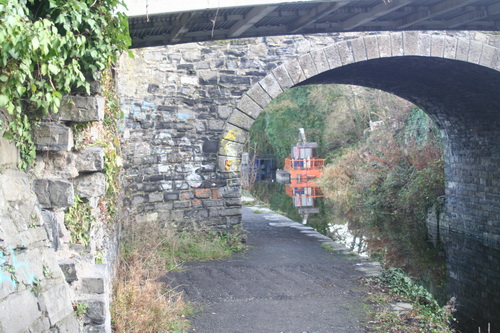
Could it be that the passenger station was under the bridge, with access controlled by gates at either end? Horses could have been changed too, with the ramp providing access for horses to the road. Passengers too could use the ramps, but horses could not use steps. And, as modern canal users will attest, it is always easier to embark and disembark passengers under bridges, where there is deep water at the edge and where the boat does not have to go off its course.

If that is so, there might be similar stonework at the other passenger stations that were located at bridges rather than at harbours. There would be traces of gate pillars at either side of a bridge. Ramps would be required only where the canal bank’s level was significantly above or below that of the road.


McCanns and the Royal Canal

I mentioned McCanns, important Royal Canal carriers, here. The Dublin Mercantile Advertiser, and Weekly Price Current of 13 June 1845 mentioned the firm in another context. On 11 June 1845 the parliamentary committee on the Dublin and Mullingar railway examined H M Tuite, MP for Westmeath, on the subject. A Mr Callaghan appeared for Messrs McCann, “extensive carriers of the Royal Canal”, who opposed the proposed railway. He cross-examined Tuite who, in response to a Callaghan query, said

Since the canal has been under the management of Messrs McCann it has much improved in every respect; the goods are now punctually delivered at their destination.

It’s not clear what that means. Were McCanns managing the canal itself? Or were they effectively managing the general transport business thereon? Slater’s listing may imply that the Royal Canal Company carried (small) parcels pretty well everywhere but that McCanns dominated the general freight trade. At any rate, I would like to know more about McCanns.

From the BNA

Fish from inland waterways

On 19 August 1862 the Irish Times markets report included this:

Athlone Market, August 16th. The following are the rates: oats 14s to 14s 6d per barrel; hay per ton 26s to 33s; straw 1s 7d to 1s 9d per cwt; potatoes 4d to 5d per stone; beef 7d to 8d per lb; mutton 6d to 8d; veal 5d to 7d do; lamb 6s 0d to 8s per qr; geese each 1s 6d to 2s 0d per pair [no, I don’t understand it either]; ducks 1s 2d to 1s 6d; fowls 1s 0d to 1s 6d; butter 8d to 9d per lb; eggs 6d to 7d per dozen; bacon (Irish) 7d to 9d per lb; American 5d to 6d.

Fish rather scarce: trout 6d per lb; pike 2d per lb; bream 1s per dozen; perch 1s per doz; eels 2s to 4s per dozen.

The weather during the past week has been, on the whole, favourable to the growing crops which look very well in this neighbourhood. Potatoes, especially, are an excellent and abundant crop.

From a Correspondent

Being anxious to increase the economic benefits of inland waterways, I determined to make a fish stew, using only freshwater fish. Accordingly, I emailed Inland Fisheries Ireland [IFI] to ask where I could buy a selection of freshwater fish. Answer came there none, which made me wonder why the state paid IFI almost €28.5 million in 2014 (the latest year for which accounts are available). If fishing isn’t producing food, then the maggots are being drowned for entertainment, as foxes are hunted for sport, and I don’t see why the state should subsidise it (or, of course, other recreational activities like football, small farming or Irish Rail).

Anyway, thanks to the virtues of private enterprise and the wonders of free trade, I was able to produce a stew using trout, pike, carp, zander, smoked eel and crayfish. But what a pity that it would have been so much easier a hundred and fifty years ago.

By the way, if you’re wondering why American bacon was on sale in Athlone, and cheaper than Irish bacon, Andy Bielenberg explains in Ireland and the Industrial Revolution: the impact of the industrial revolution on Irish industry 1801–1922 Routledge, London 2009 that

While most Irish bacon was exported to Great Britain, to sustain this trade Ireland increasingly consumed cheaper American bacon in the second half of the nineteenth century.

From the BNA


The Patowmack Canal Company …

… and George Washington. And wars. And wealth.

Royal towpath Clonsilla

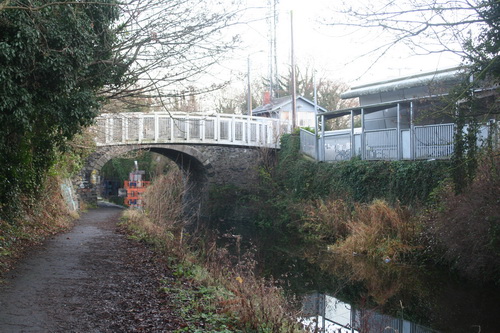
Visiting the Royal Canal at Clonsilla recently, I noted some interesting features of the canal’s stonework. I do not know how old they are or what they were for; I would welcome information from readers.

img_7796_resize

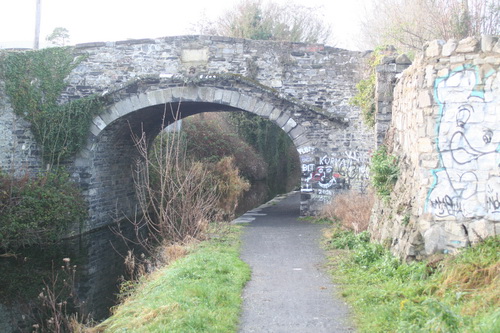
Clonsilla (Callaghan) canal bridge in the foreground; a railway signal box behind it

The towpath crossed from the south to the north bank at Porterstown (Kennan) Bridge, just east of this one. The passage boat Longford sank in 1845 between these two bridges; fifteen people died.

img_7792_resize

Looking west from the bridge

Clonsilla (Callaghan) Bridge (OSI ~1900)

Clonsilla (Callaghan) Bridge (OSI ~1900)

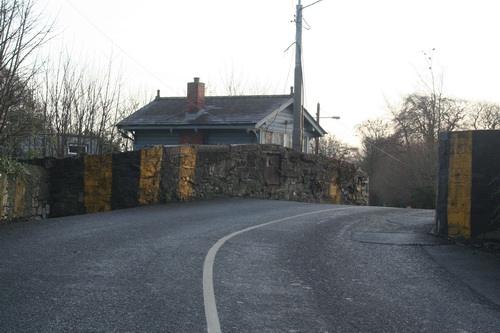
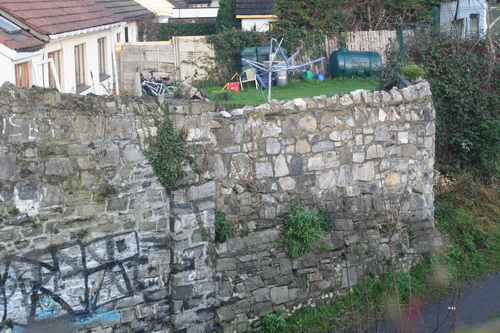
The Ordnance Survey of Ireland 25″ map of around 1900 shows what looks like a ramp leading up from the towpath, on the east side, to the level of the bridge and the road; the earlier 6″ map (late 1820s to 1840s) is less clear and I cannot tell whether the ramp existed then. However, the recent photograph, taken from the bridge, does suggest that the wing wall of the ramp has been built up, with newer stone, and that much of the area of the ramp has been taken in to the gardens above. This, of course, is speculation on my part and I would welcome clarification (leave a Comment below).

img_7797_resize

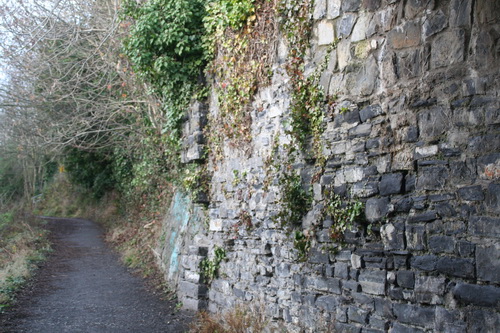
Built-up wall

Note what looks like a very tall gate pillar half way along. I don’t know much about architecture or construction, but the fact that the canal side is vertical makes it look to me more like a gate pillar than a supporting buttress for the wall of the ramp.

img_7800_resize

The eastern pillar from the towpath

Here’s a close-up. You can also see what looks like the dividing line between the older stone of the ramp, which slopes away from the towpath, and what I assume to be newer stone, built vertically, integrating part of the ramp (presumably with infill) with the garden above.

img_7801_resize

The eastern pillar from the towpath (close-up)

Here it is looking eastward (away from the bridge).

img_7803_resize

Looking eastward

There is a similar structure on the west side of the bridge.

img_7798_resize

The west side of the bridge with a pedestrian bridge beside it; the railway station is on the right

Here is what looks like the remains of a similar gate pillar.

img_7805_resize

Western pillar (looking west)

Note the vertical face of the pillar against the slope of stones on the embankment,

img_7808_resize

Vertical face (with missing stones)

These pillars may have some engineering significance in holding up the embankment, but I wonder whether they might have been used to hang gates closing off access to the towpath for some reason. I don’t know whether other bridges have similar arrangements.

Waterways Ireland commissioned a Heritage Survey of the Royal Canal, which is available here [PDF], but that document does not contain any of the details and, judging by WI’s Heritage Surveys page, it does not seem that the “detailed database report” on the Royal will be made available on the WI website. Accordingly, I do not know what the survey says about these pillars.

All information welcome.

Addendum December 2016

Peter Clarke, in The Royal Canal: the complete story Elo Publications, Dublin 1992, points out that, in 1807, there was a passenger service from Dublin to Clonsilla: the six miles cost 1/7½ in first and 1/1 in second class.

Could it be that the passenger station was under the bridge, with access controlled by gates at either end? Horses could have been changed too, with the ramp providing access for horses to the road. Passengers too could use the ramps, but horses could not use steps. And, as modern canal users will attest, it is always easier to embark and disembark passengers under bridges, where there is deep water at the edge and where the boat does not have to go off its course.

If that is so, there might be similar stonework at the other passenger stations that were located at bridges rather than at harbours. There would be traces of gate pillars at either side of a bridge. Ramps would be required only where the canal bank’s level was significantly above or below that of the road.

My OSI logo and permit number for website