
Category Archives: The turf trade

Another turf canal system

Here is a short page about a canal system I had not heard of before today. It was a network of turf canals, with a sea lock, on the estate of Scotts of Willsborough, near Eglinton, on Lough Foyle; the Scotts supplied [London]Derry with turf and, like James Macnab at Portcrusha, reclaimed the land from the bog.
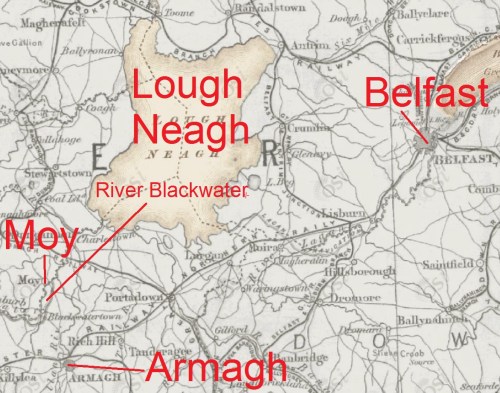
The Armagh Canal

Another unbuilt canal mentioned by the indefatigable Mr Atkinson.

A proposal for making a canal from the city of Armagh to the river Blackwater, near the town of Moy

In order to shew, that carrying into effect the annexed sketch of a line [alas not annexed to the Google scan of Atkinson’s book], for opening a navigable communication from Armagh to the river Blackwater, would be a work of public utility, the following reasons are most respectfully submitted to the Right Honourable and Honourable the Committee of the House of Commons.

From Armagh, being the most considerable market in the kingdom for the sale of brown linens, the manufacture of that staple article is carried on to a very great extent in its neighbourhood; but this manufacture is in danger of being most materially injured, from the great scarcity of fuel, which is such as to oblige the opulent inhabitants to use English coal, at a great expense of land carriage; and they have latterly, at inclement seasons, been under the necessity of subscribing large sums, to procure that article at a low price for the poor, to prevent them from perishing.

Should a navigation be opened from Lough Neagh it would give the means of a supply of turf from the extensive bogs in the neighbourhood of the lake, would open a communication with the collieries at Coal island, in the county of Tyrone, and bring English or Scotch coal at considerably under the prices at which they can now be procured.

An extensive trade in general articles of merchandise being carried on from Armagh, not only to its own neighbourhood, but to a considerable part of the counties of Monaghan and Tyrone, by opening a navigation through Lough Neagh to the ports of Belfast and Newry, this trade would be very considerably extended, to the great advantage of Armagh, and all those places to which its trade extends, and would tend much to improve the public revenue.

To the great number of bleach-greens and flour mills in the neighbourhood of Armagh, water carriage would be of the highest importance, as well for the conveyance of bleaching stuffs, coals, grain, and flour, as of timber, slates, and other heavy articles, used in erecting and repairing the necessary buildings, machinery, &c.

In a large tract of country, from Blackwater town to Lough Neagh, and from thence up the river Bann, and along the canal to Newry (an extent of nearly 30 miles), there is no limestone whatever; so that lime can only be procured by land carriage from a distance of several miles, which prevents its being at all used in that important national object — agriculture.

Was a canal opened from Armagh, it must necessarily go through the lands in that vicinity, containing inexhaustible quantities of limestone, which could be conveyed by boats returning from Armagh, at a very inconsiderable expense, to all that part of the county above mentioned.

The cut, as laid down in the plan, would extend about five and a half miles; and according to the estimate, would, when completed, cost from £18,000 to £20,000, about one-third of which could be raised by subscription.

To keep the works in repair, and pay interest to the subscribers, would require a toll of about sixpence per ton on all boats carrying coals, or any other species of merchandise; but boats laden merely with turf or limestone might be charged only twopence per ton.

The number of horses constantly employed in bringing coals, turf, and other necessaries, to Armagh, amount to some hundreds; two-thirds of these would, from a canal, become unnecessary, and consequently make a saving to the country of their keeping, attendance, &c to a very large amount.

Should the Armagh navigation be carried into execution, it would be necessary to give the commissioners of it a power of laying on a very small toll on vessels coming into the Blackwater from Lough Neagh, to enable them to clear, and keep in order, a cut which was made many years ago (as marked in the plan), to avoid a sand bank in the mouth of the river Blackwater.


Armagh, Moy and Lough Neagh

Armagh, Moy and Lough Neagh

A Atkinson Esq (late of Dublin) Ireland exhibited to England, in a political and moral survey of her population, and in a statistical and scenographic tour of certain districts; comprehending specimens of her colonisation, natural history and antiquities, arts, sciences, and commerce, customs, character, and manners, seats, scenes and sea views. Violent inequalities in her political and social system, the true source of her disorders. Plan for softening down those inequalities, and for uniting all classes of the people in one civil association for the improvement of their country. With a letter to the members of His Majesty’s Government on the state of Ireland Vol II Baldwin, Cradock, and Joy, London 1823.

The Armagh canal document, bearing a date of June 20th 1800, is also included in Rev John Dubourdieu Statistical Survey of the County of Antrim, with observations on the means of improvement; drawn up for the consideration, and by direction of The Dublin Society Dublin 1812 [Google scan, again sketchless] but is not, oddly, mentioned in Sir Charles Coote Bart Statistical survey of the County of Armagh: with observations on the means of improvement; drawn up in the years 1802, and 1803, for the consideration, and under the direction of the Dublin Society Dublin 1804 [at archive.org here], although Coote does say of Newry

A canal has been in contemplation, to be cut from this town to Armagh, and an iron road is also talked of, but there has been no decision in either cases.

My OSI logo and permit number for website

The Gillogue railroad

Gillogue, in Co Clare, is the site of a former Burlington factory and of a Clare entrance to the University of Limerick. It is also the site of a lock on the Plassey–Errina Canal, a section of the old Limerick Navigation, and of quarries, gravel pits and lime kilns.

And, according to the 6″ Ordnance Survey map, of around 1840, Gillogue also had a railroad.

The Gillogue rail road

The Gillogue rail road (click to enlarge)

The railroad was almost certainly not for carrying passengers; it may have been a light railway, with small wagons pushed by men or pulled by horses, and designed to be taken up and moved elsewhere fairly easily. However, I have no hard information about who owned it, who built it or what it was for. I can make guesses, based on its closeness to the canal and to the quarries, but it would be nice to have evidence.

If, Gentle Reader, you know anything about it, do please leave a Comment below.

My OSI logo and permit number for website

G boats, Biffs, armoured cars and the Lagan

On the Grand Canal, M boats (boats with the letter M added to their numbers) were motor barges owned by the Grand Canal Company itself; E boats were engineering boats, used for canal maintenance and B boats (whether motor or horse-drawn) were bye-traders’ or hack boats, boats owned by traders other than the Grand Canal Company itself.

G boats were wooden horse-drawn boats, built to carry turf (peat) during The Emergency, which to the rest of the world was the second world war. Some of them [PDF] were built by Thompsons of Carlow, whose archives are now in the National Archives of Ireland; you can read about them in the Summer 2012 newsletter [PDF] of the Archives & Records Assocation.

The same organisation’s Autumn 2013 newsletter had an interesting article about Lagan Navigation archives in the Public Record Office of Northern Ireland. Unfortunately something has gone wrong with the links on its newsletter web page so the relevant PDF is not available at the moment.

h/t CO’M

Doonbeg

It seems that this chap has bought the glof course near the (proposed) Doonbeg Ship Canal. I’m sure that any further development will be in the best possible taste.

More Pathé

A train ferry, claimed to be in service on the Liffey

Fishing at Ringsend the hard way

Turf by canal

Launching the Irish Elm in Cork

A Boyne regatta

Making and using a Boyne currach in 1921 (you can learn the art yourself here)

A non-watery film: Irish Aviation Day 1936


Scrap the damn thing

The Irish Times reports today, in an article that will probably disappear behind a paywall sooner or later, that some folk don’t want the Naomh Éanna, a decrepit former ferry cluttering up the Grand Canal Dock, to be scrapped.

There seems to be a reluctance to accept that things, like people, have a lifespan. Keeping them alive indefinitely costs a lot of money. And none of those quoted in the article has put forward any good reason for keeping the damn thing, never mind any reason that would justify the spending of very large amounts of money on it.

Yes, it had some interesting (if minor) historical associations, but the best way of recording them would be to write a book, or create a website, or even make a movie, about the ship’s history. Money spent that way would be a far better investment than money spent on keeping the Naomh Éanna afloat. Its heritage or historical value lies in the associated information, not in the steel.

As it is, the vessel has been hanging around for about twenty-five years, since it failed a survey in 1986 or 1988 (I have found different dates). I don’t know how much it has done since then to advance appreciation of industrial or cultural history, or whatever it is that the complainants think is being vandalised, but I would have thought that anyone who wanted to gaze on an elderly vessel has had plenty of opportunity to do so.

Addendum: it seems some folk want to draw up an investment plan.

Horace Kitchener and the peat briquette

I commented recently on the posthumous honour awarded to Kerryman Horace Kitchener, born at Ballylongford near Saleen Quay on the Shannon estuary. Part of the cost of building Saleen was paid by the College of the Holy and Undivided Trinity of Queen Elizabeth neare Dublin (whose present gaffer wants to change its name to something more snappy and brand-like, probably with an exclamation mark or a number in it (maybe he would like something modern: L33T or D00dz!, perhaps). The College of the Holy and Undivided Trinity of Queen Elizabeth neare Dublin owned large bogs in the area and sent turf to Limerick by boat.

Another turf connection has just come to my notice. Donal Clarke, in Brown Gold: a history of Bord na Móna and the Irish peat industry (Gill and Macmillan, Dublin 2010, but it is no longer on their website), says that in the 1850s Horace’s father experimented at Ballycarbery [which seems to be a long way from Ballylongford] “with the production of peat charcoal for se in the manufacture of gunpowder” and, in the process, discovered a way of making peat briquettes.

Not a lot of people (apart from Donal Clarke’s readers) know that.

Incidentally, Kitchener appears in this trip around the world with Irish waterways.

Reading list

Waterways Ireland has been putting out more and more stuff on its website.

If you haven’t already seen them, you can get the full set of Product Development Studies, in PDF format, here.

Even more interesting, to this site, are the waterway heritage surveys. Those for all waterways other than the Shannon are available here. The Shannon study was done some years ago (I remember making some comments on it at the time) and will be uploaded “in due course”.

I was in a WI office yesterday and had a quick look at the Lower Bann survey, which was done by Fred Hamond (so we know it will be good), and I’m looking forward to learning more about the waterway I know least about. It is done thematically and has lots of illustrations: Fred is able to see and present the bigger picture, but a full database, with all the supporting information, is available on request.

A threat to an existing navigation

I have a page here about the River Maigue, one of Ireland’s oldest improved navigations. Incidentally, the river’s name is locally pronounced Mag, to rhyme with bag.

In 2009 I wrote to the Powers That Be to suggest that the (much to be desired) bypass of Adare, a major bottleneck on the N21 Limerick–Tralee/Killarney road, should pass to the south of the town, thus avoiding the interference with the navigation that would undoubtedly have resulted from a northern bypass. It was no doubt the strength of my case, and a recognition of the importance of the navigation, that caused the Powers to opt for a southern bypass. A proposed link to a proposed M20 Limerick–Cork motorway may have been a minor factor in their decision: as nobody was going to build a motorway to Kerry, Adare would piggyback on the motorway to Cork.

However, An Bord Pleanála overturned the decision [PDFs available here] because the M20 proposal was withdrawn. The Irish Cattle and Sheep Farmers’ Association is pleased because it wanted a northern bypass of Adare, to be linked to a new road from Limerick to the port of Foynes; its submission on the matter is here [PDF]. A Limerick ICSA chap has a letter to the editor about the Foynes link in the current issue of the Limerick Leader, although it’s not yet available online.

Now, this proposal has the drawback that it might actually be slightly sensible: a better road to Foynes might stop people agitating for a restoration of the railway line and enable a speedy ending of port activities in Limerick, thus removing large piles of scrap from the riverside. But have the ICSA not considered the damage to the turf-boat traffic to Adare if a road bridge is added to the railway bridge downstream of Adare?