Tag Archives: lock

Mr Roberts and his basin

To complement my page on the Eglinton Canal in Galway, here is one about the Claddagh Basin.
Crossing the Barrow

The trackway [towing-path] on the River Barrow changes from the east {left) bank to the west at Leighlinbridge and back again at Graiguecullen/Carlow.

It seems to me that there may have been some difficulties in getting horse-drawn boats from one side of the river to the other and I have found no evidence on how it was done, so here is some speculation instead.

The Liffey link lottery

In The Grand Canal of Ireland [David & Charles, Newton Abbot 1973], Ruth Delany says

In 1784 the construction of a link with the River Liffey had been discussed.

John Brownrigg had suggested a link from the Grand Canal Company’s harbour at James’s Street, but the plan eventually adopted was that of the Circular Line, the four-mile canal we have today, joining the Liffey via the Grand Canal Docks at Ringsend.

However, I have found a piece of evidence showing that the company considered the Liffey link ten years earlier, in 1774. Delany says that there are no board minutes for two years between 1773 and 1775, which would explain why this earlier plan has not hitherto been noticed. The evidence is from the Hibernian Journal; or, Chronicle of Liberty 19 October 1774.

The Trustees for executing the Canal of Communication between the Canal and the Harbour of Dublin, Toll free, confiding in the Favour of the Public for the Support of a Work of so great national Utility, have unanimously resolved upon the following Scheme, grafted upon the State Lottery for this present Year, for raising a Fund for that Purpose.

The Necessity of this Application to the Public at present, will appear from a Report of the Committee of Works of the Canal Company, certifying that the Works contracted for by Mr Traill between the Liffey at or near Sallins and the City Bason, are in such Forwardness as to render it absolutely necessary to proceed in making the above mentioned Communication early in the next Year; the said Report is in the Hands of the Secretary to the Canal Company.

2 prizes of                      £2000          is £4000
4 prizes of                         £750          is £3000
5 prizes of                         £150          is   £750
10 prizes of                          £50          is   £500
20 prizes of                          £40         is   £400 *
40 prizes of                             £5        is   £200
180 prizes of                            £1/10   is   £270
600 prizes of                           £1         is   £600
19150 prizes of                          £0/6     is £5740 *
First drawn first three days £40          is   £120
Last drawn                          £200          is   £200
£15780

NB Not quite two Blanks to a Prize; and the Publick will take notice, that £35 is accounted for more than the Tickets will amount to.

Ten per Cent to be deducted from the Prizes for the Use of the Scheme.

15000 Tickets, 4 Numbers each, at £1 1s each to Subscribers for a Lot not less than 50 Tickets.

Price to Non-subscribers, one Guinea each Ticket.

Subscriptions are now receiving, and Tickets delivering out at the Navagation-house [sic] in Grafton-street, where the Prizes will be paid immediately after the Arrival of the Numerical Book from London. The Securities required from the Subscribers, viz Bankers Notes, Government and Fire-office Insurance Debentures, and City of Dublin Bonds, are to be lodged in the Bank of Thomas Finlay, Esq, and Company.

The Names of the Trustees for carrying the above Scheme into Execution, may be seen at the Navigation-House [sic], in Grafton-street.

There’s an idea for DAHG.


* sic

Shannon–Erne Waterway traffic

I have reported regularly on Shannon traffic figures [most recently here] but I have paid relatively little attention to the Shannon–Erne Waterway [SEW]. I am therefore grateful to Waterways Ireland for supplying me with the last five years’ monthly traffic figures for Locks 1 and 16 on the SEW. I had some queries about the figures for certain months and I have put them to Waterways Ireland, but I presume that the annual figures are OK.

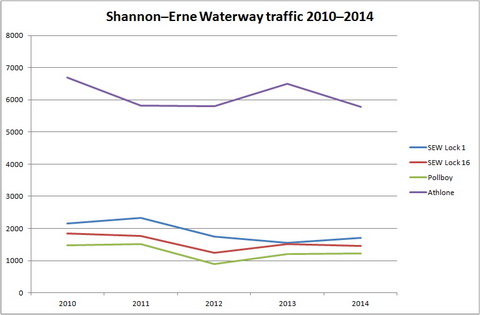
Shannon–Erne Waterway traffic 2010–2014

Shannon–Erne Waterway traffic 2010–2014

Clearly, not all boats go all the way through: if they did, the figures for Locks 1 and 16 might be the same. The hire bases for Locaboat, Riversdale and Corraquill were all on the Erne side of the summit level; does Lock 1’s excess of traffic over Lock 16 suggest that hirers, perhaps wishing to minimise the number of locks they passed through, headed for the Erne rather than the Shannon? The figures, which I presume are gathered automatically, do not distinguish between private and hired boats.

The other point that strikes me is that the level of traffic is actually quite low. I put in the figures for Pollboy and Athlone locks to allow comparison. SEW traffic is greater than that on the Lough Allen Canal, but it is not much greater than that on the River Suck to Ballinasloe. In that case, WI is [according to its Business Plan 2015] considering automating Pollboy Lock to reduce costs.

Pollboy lock passages 2005–2014

Pollboy lock passages 2005–2014

The SEW locks are already automated, but the costs and benefits may have to be re-examined, especially now that Locaboat has moved from Ballinamore to Quigleys Marina at Killinure on Lough Ree: I presume that that will result in less traffic on the SEW.

Pollboy and the CLones Sheugh

In 2006 Pollboy traffic was used as the basis for estimating likely traffic to Clones on the Ulster Canal’s “SW section”:

The total number of boat parties/groups for the SW section is assumed to be 600. This is based on a comparison with another “offshoot” like the Suck Navigation which had around 1,250 boat parties/groups in 2005 (obtained by dividing the passages through Pollboy Lock by 2) in a much busier section of the whole system. So, for the SW section, a level of around 50% (ie. 600) is regarded as a reasonable assumption.

Waterways Ireland Socio economic Summary Report for the NE and SW Sections of the Ulster Canal Final Report February 2006

Now that Pollboy’s traffic is half what it was in 2005, no doubt the estimate for the number of boats that would visit Clones, if a canal ever reached it, has likewise been halved, which would give an average of about ten boats a week over a seven-month season: four boats every Saturday and one a day for the rest of the week. Folk intending to build restaurants to cater for the cruiser traffic might be wise to reassess their investment plans:

In overall terms, the benefits of waterway restoration derive from the fact that these can facilitate a variety of leisure and recreational activity, that the users will benefit from this activity, and that there will also be wider spin-off benefits in the areas, e.g. facilities such as restaurants etc built to service canal traffic.

Department of Arts, Heritage and the Gaeltacht Restoring the Ulster Canal from Lough Erne to Clones Updated Business Case February 2015

There’s not enough business there for a burger van, never mind a restaurant.

The magic of the Shannon–Erne Waterway

But if Pollboy, the River Suck and Ballinasloe are no longer cited as support for the construction of a Clones Sheugh, the Shannon–Erne Waterway is still used as an example, in that and in other contexts. Take, for example, this:

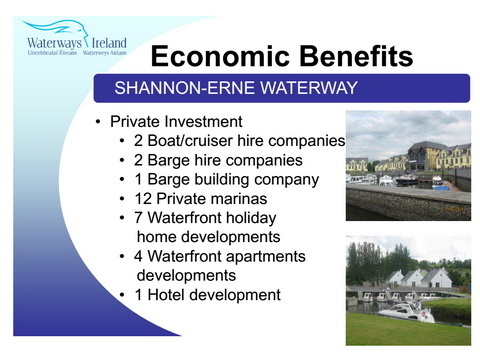
Shannon–Erne Waterway magic

Shannon–Erne Waterway magic

I’ve nicked that from a slide show called Economic, Recreational and Social Benefits of Rural Waterways in Ireland, which was to be delivered [PDF] by Garret McGrath of Waterways Ireland at the World Canals Conference [PDF] in Milan in 2014.

Now, if the Shannon–Erne Waterway had caused all that construction activity, we’d have to drag Waterways Ireland before the Irish banking enquiry. Skipping lightly over the question of the ghost estates, and the departure of Locaboat from Ballinamore, we come to the real problem with this sort of stuff: the post hoc fallacy. We are invited to believe that

  • a waterway was built
  • prosperity followed
  • so the waterway must have caused the prosperity.

Well, maybe it did and maybe it didn’t, but the argument presented in the slide show isn’t sufficient to prove it. You would have to check to see whether there were any other possible explanations: any other changes that might have resulted in all that construction.

Along the Shannon–Erne Waterway, I can think of two other possible factors: Sean Quinn’s business empire and the Upper Shannon Rural Renewal Scheme, a tax dodge that applied in Leitrim, Longford, Roscommon, Cavan and Sligo, five of the six counties that had the highest rates of vacant housing (excluding holiday houses). So there are two problems here:

  • much of that construction activity may have been driven by tax breaks rather than by the existence of a nearby waterway
  • the construction itself may not have had beneficial effects.

You can read more about that here, noting in particular, on the map, the areas around the upper Shannon and the SEW with vacancy rates of over 25%; you might wonder whether Waterways Ireland is wise to claim credit for housing over-development.

But my main concern here is a different one: that, if you want to claim credit for economic benefits that followed waterways development, you have to measure the benefits and subtract those attributable to other factors, such as Sean Quinn and the Rural Renewal Scheme. Then it would be useful if you compared the remaining benefits with the cost of constructing your waterway: it might then be possible to say that waterways development is a good investment.

It may be that such a study has been done on the SEW, but if it has I don’t know where it is; I would like to see it if it exists. Until then, I regard this sort of thing, from DAHG’s Business Case, as drivel:

The broad existence and nature of the potential socio-economic benefits of canals and restored waterways are therefore well established and not really at issue.

Sorry, minister: that’s rubbish. As far as I know no proper evaluation has ever been carried out on the costs and benefits of any restored or new-built Irish waterway. So you’re not getting away with that one.


Shannon history

Folk interested in the history of the Shannon Navigation, and in particular in the work of the Shannon Commissioners in the 1840s, may like to get hold of an article “Steam, the Shannon and the Great British breakfast”, published in the Journal of the Railway & Canal Historical Society Vol 38 Part 4 No 222 March 2015.

They’re taking the [bodily fluid]

Of the cost of land to be acquired for a canal to Clones:

We understand that the costs of land acquisition are based on the purchase of 46 hectares of land (equivalent to approx. 114 acres), the majority of which is poor quality agricultural land for a total estimated cost of €6m. This is equivalent to an average price for acquisition of just over €52,500 per acre, although the total acquisition costs would also include legal costs associated with the process.

Nevertheless, an average price of €52,500 would appear to be very high compared with the average price at which agricultural land is currently sold in the area. If an average price of €25,000 per acre (including legal costs) was applied, then total land acquisition costs would be reduced to €2.85m. This is still a generous assumption. The average RoI price of agricultural land in 2014 was less than €10,000. [Irish Farmers’ Journal Agricultural Land Price Report 2013 January 2014]

That’s from Department of Arts, Heritage and the Gaeltacht Restoring the Ulster Canal from Lough Erne to Clones: Updated Business Case February 2015. Hats off to Fitzpatrick Associates for checking and for leaving the information in the final report. I have written to Waterways Ireland to ask for more information:

I would be grateful if you could let me have a list of

  • the names and addresses of the owners of the land you propose to buy to build a canal to Clones

  • map references or maps showing the location of that land

  • the size and nature of each plot of land you propose to acquire

  • the amount you propose to pay for each plot

  • the justification for each such amount.

Actually, I have the list of landowners in Co Monaghan, because it’s in the planning application. I can’t find the equivalent on the NI Planning Service’s website because I can’t work out how to search by applicant.

The stony grey soil of Monaghan must be worth more than one might think. Either that or this proposal is a steaming dunghill.

Saunderson’s Sheugh and the border problem

Castle Saunderson and the border

Castle Saunderson and the border

Saunderson’s Sheugh, the latest manifestation of the proposed reconstruction of the Ulster Canal, would run along a border for much of its length. That’s the border between Ireland and Northern Ireland, but there is one important border it does not seem to cross [as far as I can see]: that between counties Cavan and Monaghan.

Has Cavan stolen the sheugh from its northern neighbour? I’m sure that folk in the Monaghan part of the Dáil constituency of Cavan-Monaghan won’t mind, but I wonder whether the Minister for Arts, Heritage and the Gaeltacht, who is a TD from the Monaghan end and is in charge of Sheughery, is concerned that her Monaghan colleague Caoimhghín Ó Caoláin [Sinn Féin] might turn the situation to his party’s advantage. On the other hand, from Sinn Féin’s viewpoint, the question might be whether any sheugh is better than none.

Of course, as soon as a coalition of Sinn Féin and the Éamon Ó Cuív wing of Fianna Fáil takes power, we’ll have the entire Ulster Canal built immediately. And there will be grants for growing flax, carrying corn to Dublin and draining the Shannon [which might mean that there are no southern boats to visit the Ulster Canal].

I should say, though, that Davy, in two reports out today, is not very worried about what Sinn Féin might do: Finfacts story here; Davy here; the two reports here and here [each of which should open as a PDF; if that doesn’t work, use the links on the Davy or the Finfacts page].

Map: OpenStreetMap; copyright explained here.

Shannon traffic figures to December 2014

I am grateful to Waterways Ireland for sending me the Shannon traffic figures for the last three months of 2014. They sent them last month but I didn’t have time to deal with them until now.

Regular readers may wish to skip this section

All the usual caveats apply:

  • the underlying figures do not record total waterways usage (even for the Shannon) as, for instance, sailing, fishing or waterskiing on lakes or river stretches, which did not involve a passage through a lock or Portumna Bridge, would not be recorded
  • the passage records would not show, for instance, a change in the balance of types of activities from those in larger cruising boats to those in smaller (sailing, fishing, waterskiing) boats
  • figures like these will not necessarily be representative of those for the year as a whole. The winter months, January to March, see little traffic in any year; for April, May and June, the weather can have a large influence on the amount of activity especially, I suspect, in private boats.

On the other hand, the figures do include the Shannon’s most significant tourism activity, the cruiser hire business. And they are our only consistent long-term indicator of usage of the inland waterways.

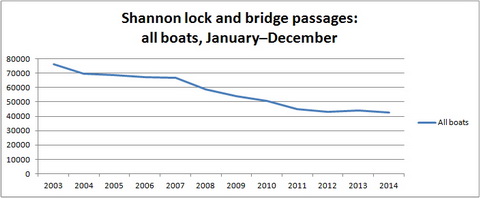
All boats

Shannon 2003-2014 01-12 all boats_resize

Total (private + hired) traffic for the full year

As we saw in September, traffic is down on 2013, but there has been little change over the last three years.

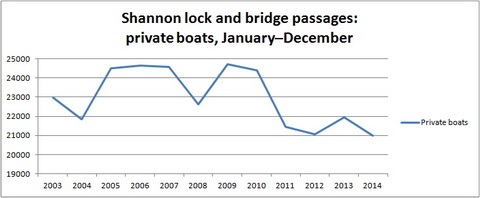
Private boats

Shannon 2003-2014 01-12 private boats_resize

Private-boat traffic for the full years 2003 to 2014

The vertical scale on this chart is different from that for hired boats so the changes in private boating from one year to another are exaggerated (by comparison). The good weather did not prevent a fall in activity.

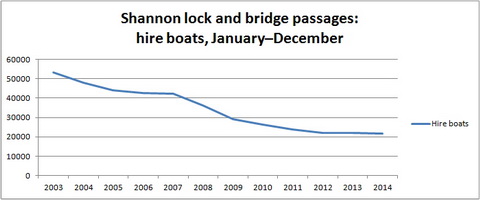
Hire boats

Shannon 2003-2014 01-12 hired boats_resize

Hire-boat traffic for the full years 2003 to 2014

Again, the lowest figure in my records, but the drop was small; perhaps the hire trade is bouncing along the bottom (as it were). I wonder whether anyone has a Grand Plan for recovery or rejuvenation.

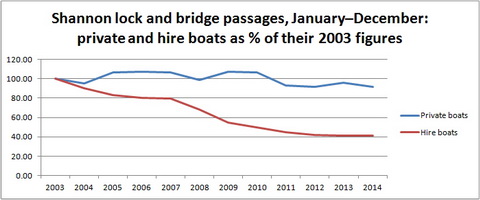
Percentages of 2003 levels

Shannon 2003-2014 01-12 compared with 2003_resize

Percentages of 2003 levels

Private traffic at just over 90% of 2003 levels, hire traffic at just over 40%.

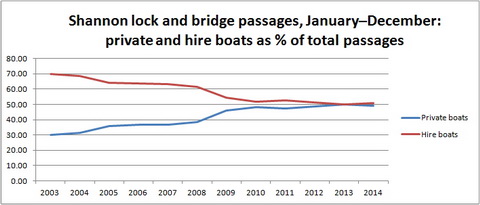
Private -v- hired

Shannon 2003-2014 01-12 private -v- hired_resize

Still roughly 50:50

Seasons

In the five months January, February, March, November and December, there were 385 passages altogether, less than 1% of total boat movements for the year. If money can be saved by ceasing to operate the locks and bridge during the winter, they should be closed except, perhaps, for one Saturday per month, to be arranged for a non-flood day.

Regions

Here is the order of popularity.

ALBERT LOCK 7205
ATHLONE LOCK  5775
CLARENDON LOCK 5650
ROOSKY LOCK 5565
PORTUMNA BRIDGE 5395
VICTORIA LOCK 4934
TARMONBARRY LOCK 3885
POLLBOY LOCK 1222
CLONDRA LOCK 1020
BATTLEBRIDGE 835
DRUMLEAGUE 797
DRUMSHANBO LOCK 387
SARSFIELD LOCK 97

Lough Allen is a delightful place but it is not popular.

Politician asks sensible question shock

The invaluable KildareStreet.com tells us of this written Dáil question and answer on 4 February 2015:

Martin Heydon [FG, Kildare South]: To ask the Minister for Arts, Heritage and the Gaeltacht if her attention has been drawn to concerns regarding the lack of dredging on the lateral canals of the River Barrow and overgrown vegetation which is making navigation difficult; her plans to improve this situation; and if she will make a statement on the matter.

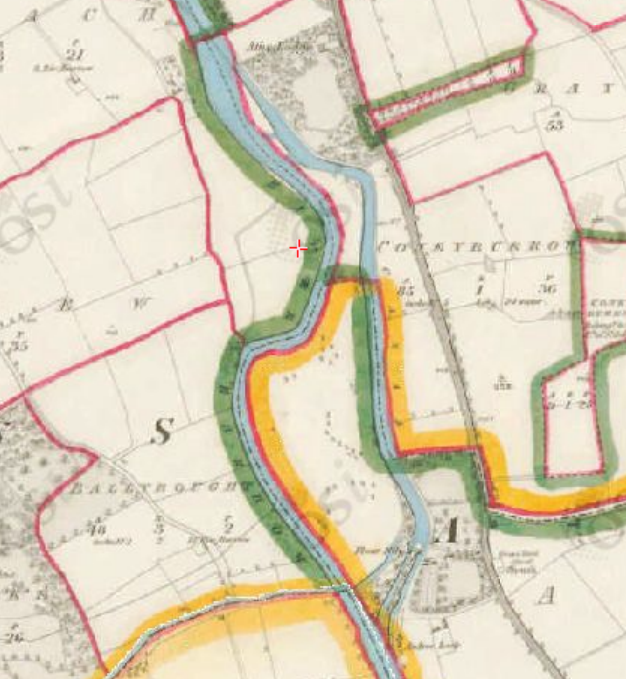
The lateral canal at Ardree on the Barrow

The lateral canal at Ardree on the Barrow [OSI ~1840]

Heather Humphreys [FG, Clones Sheugh]: I am advised by Waterways Ireland that, as the Barrow Navigation is wholly situated within the River Barrow and River Nore Special Area of Conservation (SAC), due regard must be given to the provisions of the EC (Birds and Natural Habitats) Regulations 2011. These require a rigorous assessment to be carried out to assess the impacts of any work on the protected species and habitats, prior to any works being undertaken.

If the impacts cannot be screened out and a Stage II assessment is required, a full planning application must be made. In addition, the Fisheries Consolidation Act 1959 (as amended) prohibits any in-stream works, such as dredging, during the spawning season from October to June.

I am informed by Waterways Ireland that dredging on the lateral canals of the Barrow Navigation was historically done during the winter months but that this is not now possible. However, Waterways Ireland is working with Inland Fisheries Ireland to formulate procedures which would allow work to be carried out in accordance with the relevant legislation. In addition, Waterways Ireland is continuing to work with all relevant agencies to ensure that as much work as possible is carried out on the Barrow within the time constraints which exist.

I have been assured by Waterways Ireland that it remains fully committed to the development of the Barrow Navigation in line with its statutory remit.

This question produced useful information, whereas some TDs seem to ask questions only as a way of assuring their constituents of their undying love and devotion. See, for instance, Brendan Smith, who has asked the same question at least three times.

Note that the short dredging season presumably applies to other rivers that are within SACs, such as the River Shannon at Plassey.

My OSI logo and permit number for website

Killaloe Regatta

If you enjoyed the account of the 1851 cot race at Plassey, you might also like to read about the 1850 regatta at Killaloe.