Category Archives: Extant waterways

Holiday tours in Ireland VII

On Lough Derg

There are two Lough Dergs in Ireland. One is in the County of Donegal, within four and a half miles of Pettigoe, and is celebrated for its St Patrick’s Purgatory. The lake is but six miles long and four miles broad, and can hardly vie for scenery with its namesake in the south.

In order to reach this, probably one of the most exquisitely beautiful loughs in Ireland, it is necessary to make for the town of Killaloe. This can be done by leaving Euston at a quarter-past ten at night, when Killaloe is reached by 3.10 the following afternoon; or should the tourist prefer the Irish mail, he can leave at a quarter to nine in the evening and arrive at Killaloe at half-past eleven the following morning.

Few Irish towns contain so many antiquarian relics, combined with such beautiful scenery, for Killaloe stands on a hillside tufted with wood and surrounded by mountains. The old cathedral occupies the site of a church founded by St Dalua, in the sixth century. The present building dates from the twelfth century, with a central square tower whose effect is somewhat spoiled by a  modern crown. Its gem is a Hiberno-Romanesque doorway, which has, unfortunately, been blocked into the south wall of the nave. The precincts also contain a small stone-roofed church, said to date as far back as the sixth century.

The fishing is generally extremely good, though many prefer Castleconnell, some five miles to the south on the road to Limerick. In any case few portions of the United Kingdom furnish better salmon fishing than that reach of the river Shannon that lies between Killaloe and Castleconnell.

Lough Derg must, however, remain the greatest attraction of the district. It is twenty-three miles in length, and varies in breadth from two to six miles. Nothing can surpass the loveliness of the scene, especially on a fine summer’s day. On the one side the well-wooded and smiling hills of Limerick and Tipperary, where Thomthimia, with its slate quarries, slopes down to the water’s edge; while on the other the darker and more rugged mountains of Slieve Bernagh, Ballycuggeren, and the Crag form the most effective contrast.

Kincora was once the residence of Brian Boroimbh, King of Munster, and its magnificence was long the main theme of the ancient bards. But little now remains of the ancient palace beyond a long circular earthen fort, with a single vallum some twenty feet in height.

Inishcaltra or the Holy Island is, however, well worth a visit, and for this purpose it would be better to utilize the local service from either Scariff or Killaloe to Mountshannon, which faces the island. It possesses a round tower some eighty feet high, and seven churches, or cells, and oratories, the most remarkable of which is that of St Caimin, originally erected by him in the seventh, but subsequently rebuilt by Brian Borombh in the tenth century.

Scariff may this year be approached by steamer, and is a very prettily situated village, within access by road of Woodford, in County Galway, and Ennis in County Clare. The steamer then crosses the lake to Dromineer, at the mouth of the Nenagh river, where the ruins of the castle stand out with such picturesque effect. The bay is one of the most popular resorts, both of the angler and of the yachtsman; for to the latter it has earned a well-deserved reputation for its annual regatta.

The steamer then stops at Williamstown while a boat from Kilgarvan occasionally lands passengers and conveys them to the steamer. As soon as the new jetty has been constructed by the Board of Works, Woodford will be equally accessible; but there is no doubt that the approach to Portumna pier at the head of the Lough, lying as it does between the well-wooded demesnes of Portumna Castle on the one side and Belleisle and Slevoir on the other, presents one of the finest pictures that the lake discloses, for there we see the most striking contrast between the tame verdure of the river Shannon and the bold mountain scenery of Lough Derg.

It would be tedious to dwell on the varied beauties of those innumerable seats that dot the shores of the lake on all sides; suffice it to say that few parts of the United Kingdom present as many diverse attractions as this wide expanse of water. Much as one may appreciate Loch Lomond, Loch Maree, or the Caledonian Canal, this Irish lough certainly surpasses them; and much gratitude is due to the Shannon Development Company for bringing within such easy access of the average tourist a wealth of scenery that certainly equals, if it is not finer, the finest spots that either Scotland, Norway, or Switzerland can offer.

This is, however, but half the trip from Killaloe to Athlone. Portumna is chiefly remarkable for the ruins of a Dominican priory founded in the thirteenth century, as well as for the Castle, the property of Lord Clanricarde, in which he has not resided since his succession to the estate. The village of Lorrha, three miles further up, also contains the ruins of a Dominican abbey, an oblong pile 120 ft long, as well as a castle and two old ecclesiastical buildings called by the peasantry the English churches, owing to their having been built by Norman settlers.

The river now assumes a totally novel character, winding by graceful curves through low-lying but rich meadow lands. Their luxuriant appearance is largely due to the fact that they are usually submerged under the waters of the river during the winter months.

Meelick Abbey is next passed. It was founded by the Franciscans in the twelfth century, and was at one time a sumptuous structure, but is now a roofless and mouldering ruin; and a beautiful pillar which formerly supported the arches on the south side has been torn away with ruthless vandalism, in order to make headstones for the graves in the cemetery.

Banagher can boast of a fine stone bridge, opened some fifty years ago to replace the preceding structure, which displayed no less than twenty-three arches of various forms, with massive piers between, and was so narrow that only one carriage could pass at a time.

Shannon Harbour is best known from the description of its hotel in Lever’s Jack Hinton, but that building is now let in tenements. Shannon Bridge is one of the three fortified passes built to guard the Shannon, and is but four miles from Clonfert, whose cathedral, now being restored, contains one of the finest Hiberno-Romanesque doorways to be found in the three kingdoms.

Few spots, however, offer greater attractions to the antiquary than do the celebrated seven churches of Clonmacnoise. The most remarkable of these are the Diamhliag Mhor or Great Church, which dates from the fourteenth, and Fineens Church, built in the thirteenth century. The former was originally the work of Flann, King of Ireland, in 909, and contains several bits, more especially the sandstone capitals of the west doorway, that may be traced to the earlier period. Besides these churches, there is much to be seen at Clonmacnoise, which includes among its ruins the episcopal palace and castle of the O’Melaghlins, a nunnery, two round towers, Celtic crosses, and inscribed stones. The grand cross, formed of a single stone 15 ft high and elaborately carved, surpasses every other in beauty of execution and elaborate detail.

Though the tourist may gaze upon Clonmacnoise as he approaches and leaves it and enjoys a particularly fine view of its beauties as he passes by the curve of the river on whose banks it is situated, no provision has yet been made to enable him either to land or to make a closer acquaintance of its many beauties as he passes by. This is due to the refusal on the part of its proprietor to meet the proposals of the company. It is, however, to be hoped that more favourable terms may be made in the future, as the traveller must now proceed straight to Athlone and visit the ruins from there either by road or by water.

Much more might be said of Lough Derg as well as of the Shannon from Killaloe to Athlone. Fair hotel accommodation may be obtained at Killaloe, Dromineer, Portumna, and Athlone at from eight to nine shillings a day. Lodgings can also be procured at Killaloe, where the proprietors have learned to cater for the requirements of those anglers who frequent this highly-favoured spot.

Return tickets may be obtained from Euston to Killaloe by the North Wall at
£4 13s 6d first, £2 16s second, and £2 third class. Lough Derg may also be visited from Athlone by the Midland Great Western Railway from Broadstone. The fares by Kingstown and the mail are somewhat dearer.

Pall Mall Gazette 1 August 1898

From the British Newspaper Archive run by Findmypast Newspaper Archive Limited, in partnership with the British Library.
Special Agent O’Brien

Synan Meehan, who absconded from Kilrush with £76, and was apprehended in Liverpool by Mr P O’Brien, the Dublin Steam Packet Company’s [Kilrush] agent, was brought up at the Limerick Police office on Thursday, before T P Vokes Esq, who ordered him to be sent on to Kilrush for final examination, and whither he proceeded by steamer in charge of two policemen. When arrested in Liverpool, he was in a state of intoxication, and but a few shillings were found in his possession. He stated that in February last he lost £30, which he had to make good every month when closing his accounts, and fearing it would be discovered he was induced to make off. The offender was regarded in Kilrush as a strict teetotaller, but having violated his solemn pledge to Father Mathew, little confidence could be reposed in him.

Southern Reporter and Cork Commercial Courier 12 August 1845

From the British Newspaper Archive run by Findmypast Newspaper Archive Limited, in partnership with the British Library.

Northern enterprise

On Friday, 25th ult, the Antrim and Tyrone Lough Neagh Steam Ferry Company’s first boat, the Enterprise, was launched from Port Armagh, on the Tyrone side of Lough Neagh. She is a most beautiful boat, and does great credit to Mr Hiram Shaw, of this town, for his exertions in bringing her out in such fine style. Her engines were built by M’Adam, Currell, and Company, of Belfast.

The Vindicator, Belfast 7 August 1839

From the British Newspaper Archive run by Findmypast Newspaper Archive Limited, in partnership with the British Library.

[Notes: I do not know where Port Armagh is or was. The Enterprise is not mentioned in D B McNeill Irish Passenger Steamship Services Volume 1: North of Ireland Augustus M Kelley Publishers, New York 1969]

The mystery of Mr Worrall

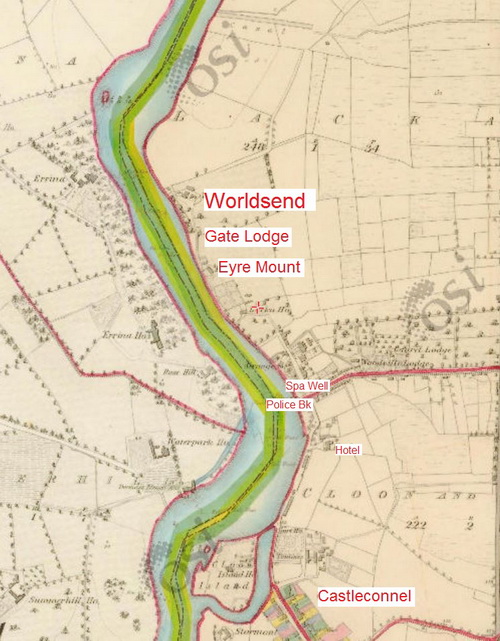
Castleconnell and Worldsend, Co Limerick (OSI 6" ~1840)

Castleconnell and Worldsend, Co Limerick (OSI 6″ ~1840)

The authors of a book called Village by Shannon, about Castleconnell, Co Limerick, say that the area of Worldsend, at the northern end of Castleconnell, derives its name from Worrall’s Inn, an establishment operated by a Mr Worrall in the early eighteenth century.

That may be so, but the book’s accounts of river-borne traffic — to a quay at the inn — do not seem to accord with what is known about the history of the Shannon navigation, and in particular of the Limerick Navigation between the city and Killaloe. Here are some of the problems.

My OSI logo and permit number for website

Sailing canal boats

Very interesting account. And here’s the Hudson Sloop Club.

New Engine and Propellers for Canal Navigation

Mr Peter Taylor, of Hollinwood, has recently taken out patents for two inventions — one for a rotary high-pressure marine steam engine on a new principle; and the other, that which chiefly calls for notice, for paddles or propellers, also of an entirely new construction. His principal object was to attain that desideratum in steam navigation on canals, sufficient motive power for considerable speed, without the injury to the canal banks caused by the action of the ordinary paddles.

The apparatus consists of a series of vanes or curved blades, placed obliquely, like the sails of a windmill, or like portions of a continuous screw. The apparatus is placed at the stern of the vessel in a small enclosure of water, the sides of the boat being continued beyond the stern, and the rudder being fixed beyond the propellers. They occupy a space of about a yard and a half in length, and, in the instance under notice, seven feet in breadth.

There are two parallel axes or shafts, which project from the stern, each shaft having four pairs of vanes or blades, at short distances, and so placed as to strike the water in quick succession, and obliquely, like the scull of a boat. The oars or blades on one shaft have an action like that of a right-hand screw, and those of the other like that of a left-hand one; and the vanes of each shaft work nearly up to the other shaft, and thus their joint action has the effect of propelling the boat forward, or when reversed, by altering the motion of the driving-wheel, in a direction stern first. They are said to differ (amongst other respects) from all propellers previously invented, both in their screw-like action, and in the axles being wholly under water.

By way of trying experiments with these propellers, Mr Taylor has had a set of them fitted to an old iron boat, about fifty-two feet in length, and seven feet in width, formerly worked on the canals by Messrs Buckley, Kershaw and Co. One of Mr Taylor’s new rotary engines of only five horses’ power has been fitted into the boat, which has been named “The Experiment of Hollinwood“. After several private trials, this boat made its first experimental trip on the river Irwell, yesterday week.

Mr Taylor and a few friends proceeded from the Old Quay, Manchester, as far as Barton-on-Irwell, and on the whole they state that the action of both engine and propellers was satisfactory; though in returning there was a deficiency of steam, from the filling-up of the fire-tubes with coke; a casualty which was remedied as soon as discovered. The speed was regarded as in a high degree satisfactory; being, it is stated, generally at the rate of six, and occasionally seven miles an hour. The motive power was deemed inadequate to accomplish all that the inventor had a right to anticipate; but it is mentioned as one proof of the superiority of his inventions, that the Jack Sharp, a passage boat belonging to the Old Quay Company (whose first trip, after being fitted with engine and stern paddles, we noticed some time ago), was not at all able to keep up with the Experiment, though the engine of the former is twelve horses’, and that of the latter is only five horses’ power.

On Wednesday the Experiment steamed down to Runcorn, by river and canal, and the whole distance was accomplished in about five hours’ working; including the stoppages at the locks, and those caused by the parties on the boat having themselves to open the bridges on the Runcorn Canal. The boat stopped a short time at Barton, and several hours at Warrington, which place it did not leave until dark, and performed the distance between Warrington and Runcorn (which, it is said, is about seven miles and three quarters) in about an hour, including delays from the cause just noticed. This increased rate was attributed to having obtained a better description of coke at Warrington.

The boat remained at Runcorn for some hours, and, having so far performed her work to the satisfaction of the voyagers, they determined to proceed in her to Liverpool. They started from Runcorn at half-past three o’clock on Thursday morning, with the tide, and reached the Rock Ferry, opposite Liverpool, by five o’clock, performing the distance in about an hour and a half.

The Experiment is considered to be by no means well adapted for the purposes of canal steam navigation. She is described as in form more like a box than a boat, and as drawing two feet nine inches water; a manifest disadvantage with so small an engine. We are informed, that all who have seen the boat’s performance, including several engineers who took a trip in her, have expressed themselves much pleased with her speed and general action. We understand there is some probability of the Old Quay Company making a trial of the propellers and engine in one of their twin quick passage boats on the Runcorn Canal.

The Experiment, in these trips, was placed under the care of Isaac Taylor, an experienced captain in the Old Quay Company’s employ, the aid of whose services, as pilot and steersman, was afforded for the occasion by Mr T O Lingard. Taylor says the boat answers her helm readily, turns well, and is very manageable. When at her greatest speed, it was found that the agitation and swell caused by her passing through the water, and by the propellers, had very little effect on the canal boats, the stream from the propellers being thrown off in the centre of the canal, leaving a considerable wake there.

Newcastle Courant 5 June 1840, quoting the Manchester Guardian

From the British Newspaper Archive run by Findmypast Newspaper Archive Limited, in partnership with the British Library.

The purity of the ladies of Limerick

The City of Dublin Steam Packet Company have kindly given the use of the Dover Castle, steamer, to the Ladies of Limerick, for Friday next, when the ceremony of laying the foundation stone of the New Docks will be performed. A band will be on board the steamer.

Limerick and Clare Examiner 4 July 1849

Immediately alongside the spot where the stone was to be placed floated the Dover Castle steamer, filled principally with ladies. The excellent Band of the 74th Highlanders was also on board, and contributed much to the delight that animated many a countenance. Several boats and barges were also provided for the accommodation of ladies. Most of the spectators were invited by Cards issued from the Office of Public Works.

Limerick Reporter 6 July 1849

Loud cheering attested the joy that pervaded every bosom at the prospect of employment, which the ceremony held out. The Dover Castle, moored within a few yards of the large platform, was, as a matter of course, the most attractive appendage. It was occupied by the ladies of Limerick. They, too, evidenced by waving their white handkerchiefs (the symbol of their purity, their virtues and sympathy for the suffering poor) how sincerely they felt the importance of the occasion. A stream of music was then poured forth by the beautiful brass band of the 74th, which was quite in keeping with the general harmony.

The proceedings of the day were then brought to a pleasing and chearful close. The military filed off; the Artillery withdrew; the masts and pinnacles became deserted; the groups, about the ground, dissolved; the Corporate functionaries retired; the mace-bearer beat a modest retreat; the ladies were led off by their attendant squires; the people wended their way homewards, the boats disappeared, and the Dock works and ground were left to the sole possession of their ordinary occupants.

May we not hope — at all events, let us pray, that yesterday was an auspicious day for Limerick.

Limerick and Clare Examiner 7 July 1849

From the British Newspaper Archive run by Findmypast Newspaper Archive Limited, in partnership with the British Library.

Gondolas

A superb boat or gondola has been recently finished at the Grand Canal, and is painted and decorated in a most elegant manner. It is of a smaller size than the packet boats, and intended for convenience or pleasure of the directors of that great national and useful undertaking, in order to make occasional excursions therein on the different lines of that navigation — it now lies in one of the harbours near the city Bason.

Saunders’s News-Letter 20 April 1795

The elegant gondola which we mentioned to be lying at the Canal Harbour, and to be intended for the use of the Directors, we learn is not for the use of those Gentlemen, but to carry passengers from and to Portobello, to and from the first lock to meet the passage-boats (as lately advertised) and to gratify with a short voyage on the Canal, from Portobello to James’s-street Harbour, such persons as, having no call of business or pleasure towards the county of Kildare, have not otherwise an opportunity of enjoying that gratification, which latter use of the boat is now making by many persons every fine day.

Saunders’s News-Letter 23 April 1795

From the British Newspaper Archive run by Findmypast Newspaper Archive Limited, in partnership with the British Library.

Crime at Castleconnell

Charles Connors, of Castleconnell, cot builder, has been committed to Killaloe bridewell, for violating the person of a servant girl on Monday morning, at the Doonass side. He crossed the river in a boat, upon the pretence of ferrying her over, and then committed the offence.

Tipperary Vindicator 9 December 1859

From the British Newspaper Archive run by Findmypast Newspaper Archive Limited, in partnership with the British Library.

Drowning at Doonass

Melancholy and distressing accident

By a Letter received at our Office, from Doonas, County Limerick, we regret to announce a melancholy accident having happened on Sunday the 9th inst in that neighbourhood. Mrs Massey, the wife of the Hon William Massy accompanied by her butler and two boatmen were attempting to cross the Shannon to Sir Hugh Masseys, where Mrs Massey was to dine. The evening was dark, accompanied by a dense fog, the boatmen lost their way, the boat was carried down by the current, and precipitated over the Leap, and melancholy to relate the entire party in the boat were drowned. During the entire of yesterday, the boatmen at Castleconnell were dragging for the bodies, but without success.

So dense was the fog that on the road between Kilmastulla, and Sallymount, the guard of the Coach was obliged to walk for upwards of 3 miles of the road, at the heads of the leading horses, and the coach agent was obliged to send a man on horseback with a lantern in his hand before the coach as far as Newcastle.

Dublin Mercantile Advertiser, and Weekly Price Current 17 January 1831

From the British Newspaper Archive run by Findmypast Newspaper Archive Limited, in partnership with the British Library.