
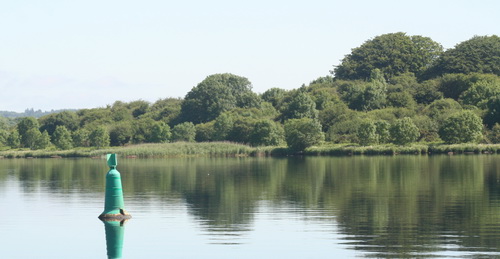
The Red Island green
The Red Island green
Posted in Engineering and construction, Extant waterways, Ireland, Modern matters, Operations, Safety, Scenery, Shannon, waterways, Waterways management
Tagged buoy, green, Lough Derg, marker, Red Island, Scariff, Scarriff, Shannon
This post was originally entitled “The avarice of the ferryman” but, as more information has been added, it seemed best to name the post for the remarkable Float Bridge itself, which links road, rail and waterway transport.
Castlepollard, Sept 11. Last Week the following Accident happened at the Ferry, or Float, plying for Passengers over the River Inny, in the County of Westmeath: — A Post-Chaise and Four, with a Lady and Gentleman, were imprudently put upon this dangerous Conveyance, without separating the Cattle from the Carriage; unfortunately a Car and Horse had been put in before them, which, with the Post-Chaise and Horses, occupied the full Length of the Float.
On the Passage, the Car Horse grew very uneasy, and going back, the Car annoyed the Post-Chaise Horses, which occasioned them to back in like Manner, until the Post-Chaise fell into the River, and dragged the Horses after it; three of the Horses were drowned, being entangled with the Harness; the other broke through his Harness, and swam over to a boggy Place, but could not get upon Land; one of the men followed him in a small Boat, to lead him to a proper landing Place, but not being able alone to guide the Horse and row the Boat, the Horse got too near it, and striking it with one of his Feet, overset and sank it, by which the Man was drowned; the Horse then swam, and was saved.
It was very lucky for the Lady and Gentleman that they alighted from the Chaise at going into the Float. The Carriage, which belonged to the Gentleman, was got out with much difficulty; the Horses were Hacks. The Avarice of the Ferryman occasioned this melancholy Accident.
Hibernian Journal; or, Chronicle of Liberty
18 September 1775

That report came just about a year after this next one.
FERRY-BRIDGE, over the River Inny, between the County of Westmeath and Longford, 3 miles from Castlepollard, 12 miles from Mullingar and Longford, Sept 1st, 1774. Complaint having been made, that the Smallness of the Float rendered it inconvenient, and occasioned timorous People to drive or ride many Miles round to avoid the Ferry, the Proprietor therefore has undertaken to build a Bridge at his own Expence, which will be finished with all convenient Speed; in the mean Time, a Part of the intended Bridge, above 30 Feet long, Battlements fixed on each Side, properly gravelled over &c, will be made Use of to ferry over Carriages, &c. A Coach and four may now pass with the utmost Safety, without taking off the Horses, or 20 Head of Cattle, &c in less than 2 Minutes; and, to accommodate Graziers and others, as soon as said Bridge is compleated, Droves of large Cattle, above 30 in Number, will be passed over at the Rate of a British Shilling per Score, private Soldiers with Furlows from their Commanding Officers, in Time, gratis, all other Passengers, Cattle, &c at the usual Rates taken above these 20 Years.
This Road is now in good Repair, and well known to be many Miles nearer from Dublin to the County of Longford, Leitrim, Roscommon, Sligo, Mayo, &c than any other Road; a commodious Inn, near Ferry-bridge, on the Westmeath Side, is building, and a Carriers Inn on the Longford Side, will be both soon finished, and proper People to keep them.
Wanted, to take Care of said Bridge when finished, and to collect the Toll, &c a sober, honest, careful, active, middle-aged, single Man; he must be a Protestant, write a good Hand, and if a good Shot, and understands fishing in Lakes and Rivers, and delights in those Amusements, it will be more agreeable &c. Comfortable Lodging and Board, and not less than £12 per Ann will be made good to the Person approved of, and shall be treated (as far as can be reasonably expected) agreeable to his former Manner of Life. None need apply but such as have an undeniable good Character, as to Honesty and Sobriety, from his former Employers or Neighbours. Inquire of the Printer hereof.
Saunders’s News-Letter
2, 7, 9, 12, 14 September 1774
The Dublin Evening Post of 9 August 1810 advertised part of the Meath and Westmeath estates of Sir Thomas Chapman Bart to be let. They included
The Tolls of the Float near Castlepollard
And an excellent house and fifty acres of land
Applications were to be sent to Sir Thomas at St Lucy’s, Athboy, or to Mr High Dickison at the same address.
St Lucy’s was also known as Killua Castle, set of the Chapman baronets, of whom Sir Thomas was the second. Do be sure to read about the seventh baronet.
Sir Benjamin James Chapman was the fourth baronet. Ewan Duffy writes:
Float bridge was a privately owned toll bridge. Its owner, Sir Benjamin Chapman, offered the bridge to the Midland Great Western Railway if they would build a station at Float, for which he would also give the necessary land. He subsequently suggested a variation on the agreement that if the company were to cease using the station, the land and bridge should be re-conveyed to him!* As the bridge remained in CIE ownership up to 1971, when it was transferred to Westmeath County Council under the Transport (Miscellaneous Provisions) Act 1971, he clearly did not get such a deal!
The original bridge is no longer there — I paid a site visit there last year, given its railway connection, but it has been replaced sometime in the 20th Century.
* W E Shepherd “The MGWR’s Cavan Branch – 1” JIRRS Vol 16 No 104, pp 282–3
Posted in Extant waterways, Historical matters, Irish inland waterways vessels, Operations, Passenger traffic, Safety, Shannon
Tagged Car, carriage, chaise, ferry, float, horse, Inny, river, safety, Sir Thomas Chapman
Many thanks to the learned Eoin C Bairéad for the information that the good people at logainm.ie have scanned many old maps, and other documents, and made them available here, free of charge. They include maps of counties bordering the Shannon, Murdoch Mackenzie’s 1775 chart of the Shannon Estuary (with some soundings) and Mackenzie’s Views of the West Coast of Ireland.
Note: some of the files are very large.
Posted in Ashore, Engineering and construction, Extant waterways, Historical matters, Ireland, Operations, People, Safety, Sea, Shannon, shannon estuary, Waterways management
Tagged chart, estuary, map, Murdoch Mackenzie, Shannon
The inhabitants of this city [Dublin] were greatly alarmed yesterday evening, between the hours of four and five, by a most violent concussion of the air, which broke several panes of glass, cracked others, and shook houses to the foundation in an unusual manner, accompanied by a very loud explosion. In the country parts adjacent to the city, the fears of the people led them to imagine that there had been a shock of an earthquake — but the cause proves to have been the explosion of two boats, that were coming down the Grand Canal, freighted with gunpowder from Counsellor Caldbeck’s powder-mills at Clondalklin.
Many lives it was reported were lost; but we can assure the public, from the best authority, that no more than two men were killed, and five or six slightly wounded. The loss from the gunpowder is not estimated to be very great.
It is not as yet ascertained through what manner the fire was suffered to communicate to the powder. It was said that it was from one of the hands having dropped some blazing tobacco from a pipe which he was smoking, but for that there appears no foundation.
Dublin Evening Post 24 April 1787
Posted in Canals, Economic activities, Extant waterways, Historical matters, Ireland, Irish inland waterways vessels, Operations, Safety, Sources, waterways
Tagged . Clondalkin, boat, Caldbeck, death, Dublin, explosion, Grand Canal, gunpowder, injury, Ireland, powder-mill
On the morning of the day on which I left Limerick, a truly melancholy and fatal accident occurred. Just as the steamer which starts every morning for Kilrush and Kilkee, was in the act of leaving the quay, a car was seen to approach very rapidly to the station, from which the vessel had just begun to move. Planks are not used at these quays, the water being sufficiently deep to admit of the steamer lying so close as to enable the passengers to step off from the quay on board the vessel.
A fine young man jumped off the car, and took a female who was on the opposite side in his arms, and ran with her to the packet, and had just succeeded in placing her feet in the side of the boat. In order to get her safely aboard he had to push her forward, and by this means accomplished the object he had in view. But alas! in achieving so much for her, he lost himself; for at this moment the packet moved off, and it became impossible for him to reach her; while the efforts he had previously made to get the lady on board occasioned him to stretch so far forward that it was equally impossible for him to recover his upright position on the quay. The consequence was that he fell between the quay and the steamer, and, as it was supposed, was struck by a revolution of the paddle, for he never rose.
What must have been the feelings of the poor female in witnessing the sudden and melancholy death of her gallant preserver? She was in delicate health, and was about to proceed to Kilkee for the benefit of sea-bathing, when this awfully heartrending event took place, which deprived her of him who was her darling and her pride; for alas! he was her son.
Thomas Lacy Home Sketches, on both sides of the channel, being a diary Hamilton, Adams, & Co, London; W H Smith & Co, London; McGlashan, Dublin, 1852
Date of event (deduced) Wednesday 28 August 1850
Posted in Ashore, Built heritage, Charles Wye Williams, Economic activities, Engineering and construction, Extant waterways, Historical matters, Ireland, Irish inland waterways vessels, Operations, Passenger traffic, Safety, Sea, Shannon, shannon estuary, Sources, Steamers, Tourism, Waterways management
Tagged accident, boarding, drowned, Kilkee, Kilrush, Limerick, plank, quay, Shannon, steamer

 Irish waterways history