Tag Archives: boats

Crossing the Barrow

The trackway [towing-path] on the River Barrow changes from the east {left) bank to the west at Leighlinbridge and back again at Graiguecullen/Carlow.

It seems to me that there may have been some difficulties in getting horse-drawn boats from one side of the river to the other and I have found no evidence on how it was done, so here is some speculation instead.

Nobody boats on the canal in winter?

Sallins 20150308 01

Rounding Soldier’s Island

Sallins 20150308 02

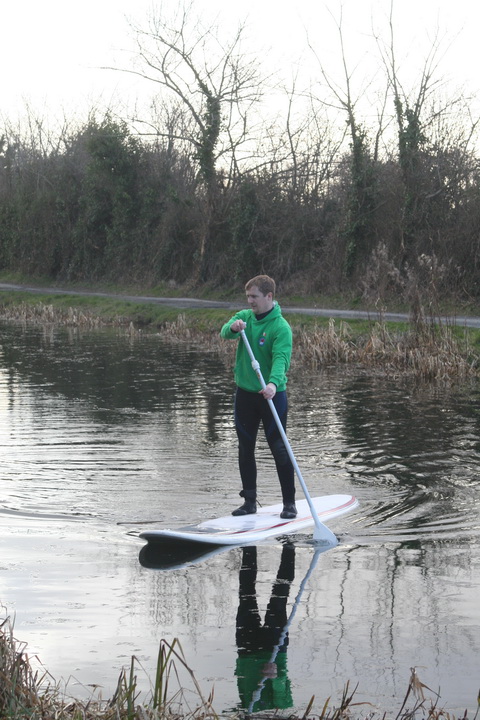
SUPper at the dry dock

… and a two-man racing kayak that I didn’t photograph. All in the space of about half an hour at Sallins.

Shannon–Erne Waterway traffic

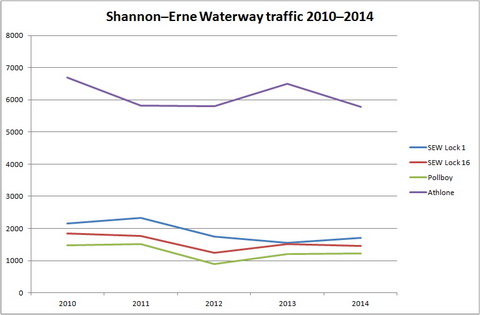
I have reported regularly on Shannon traffic figures [most recently here] but I have paid relatively little attention to the Shannon–Erne Waterway [SEW]. I am therefore grateful to Waterways Ireland for supplying me with the last five years’ monthly traffic figures for Locks 1 and 16 on the SEW. I had some queries about the figures for certain months and I have put them to Waterways Ireland, but I presume that the annual figures are OK.

Shannon–Erne Waterway traffic 2010–2014

Shannon–Erne Waterway traffic 2010–2014

Clearly, not all boats go all the way through: if they did, the figures for Locks 1 and 16 might be the same. The hire bases for Locaboat, Riversdale and Corraquill were all on the Erne side of the summit level; does Lock 1’s excess of traffic over Lock 16 suggest that hirers, perhaps wishing to minimise the number of locks they passed through, headed for the Erne rather than the Shannon? The figures, which I presume are gathered automatically, do not distinguish between private and hired boats.

The other point that strikes me is that the level of traffic is actually quite low. I put in the figures for Pollboy and Athlone locks to allow comparison. SEW traffic is greater than that on the Lough Allen Canal, but it is not much greater than that on the River Suck to Ballinasloe. In that case, WI is [according to its Business Plan 2015] considering automating Pollboy Lock to reduce costs.

Pollboy lock passages 2005–2014

Pollboy lock passages 2005–2014

The SEW locks are already automated, but the costs and benefits may have to be re-examined, especially now that Locaboat has moved from Ballinamore to Quigleys Marina at Killinure on Lough Ree: I presume that that will result in less traffic on the SEW.

Pollboy and the CLones Sheugh

In 2006 Pollboy traffic was used as the basis for estimating likely traffic to Clones on the Ulster Canal’s “SW section”:

The total number of boat parties/groups for the SW section is assumed to be 600. This is based on a comparison with another “offshoot” like the Suck Navigation which had around 1,250 boat parties/groups in 2005 (obtained by dividing the passages through Pollboy Lock by 2) in a much busier section of the whole system. So, for the SW section, a level of around 50% (ie. 600) is regarded as a reasonable assumption.

Waterways Ireland Socio economic Summary Report for the NE and SW Sections of the Ulster Canal Final Report February 2006

Now that Pollboy’s traffic is half what it was in 2005, no doubt the estimate for the number of boats that would visit Clones, if a canal ever reached it, has likewise been halved, which would give an average of about ten boats a week over a seven-month season: four boats every Saturday and one a day for the rest of the week. Folk intending to build restaurants to cater for the cruiser traffic might be wise to reassess their investment plans:

In overall terms, the benefits of waterway restoration derive from the fact that these can facilitate a variety of leisure and recreational activity, that the users will benefit from this activity, and that there will also be wider spin-off benefits in the areas, e.g. facilities such as restaurants etc built to service canal traffic.

Department of Arts, Heritage and the Gaeltacht Restoring the Ulster Canal from Lough Erne to Clones Updated Business Case February 2015

There’s not enough business there for a burger van, never mind a restaurant.

The magic of the Shannon–Erne Waterway

But if Pollboy, the River Suck and Ballinasloe are no longer cited as support for the construction of a Clones Sheugh, the Shannon–Erne Waterway is still used as an example, in that and in other contexts. Take, for example, this:
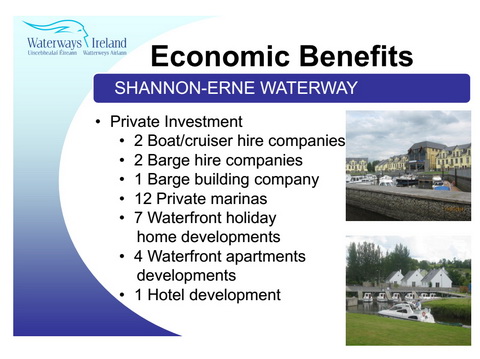
Shannon–Erne Waterway magic

Shannon–Erne Waterway magic

I’ve nicked that from a slide show called Economic, Recreational and Social Benefits of Rural Waterways in Ireland, which was to be delivered [PDF] by Garret McGrath of Waterways Ireland at the World Canals Conference [PDF] in Milan in 2014.

Now, if the Shannon–Erne Waterway had caused all that construction activity, we’d have to drag Waterways Ireland before the Irish banking enquiry. Skipping lightly over the question of the ghost estates, and the departure of Locaboat from Ballinamore, we come to the real problem with this sort of stuff: the post hoc fallacy. We are invited to believe that

  • a waterway was built
  • prosperity followed
  • so the waterway must have caused the prosperity.

Well, maybe it did and maybe it didn’t, but the argument presented in the slide show isn’t sufficient to prove it. You would have to check to see whether there were any other possible explanations: any other changes that might have resulted in all that construction.

Along the Shannon–Erne Waterway, I can think of two other possible factors: Sean Quinn’s business empire and the Upper Shannon Rural Renewal Scheme, a tax dodge that applied in Leitrim, Longford, Roscommon, Cavan and Sligo, five of the six counties that had the highest rates of vacant housing (excluding holiday houses). So there are two problems here:

  • much of that construction activity may have been driven by tax breaks rather than by the existence of a nearby waterway
  • the construction itself may not have had beneficial effects.

You can read more about that here, noting in particular, on the map, the areas around the upper Shannon and the SEW with vacancy rates of over 25%; you might wonder whether Waterways Ireland is wise to claim credit for housing over-development.

But my main concern here is a different one: that, if you want to claim credit for economic benefits that followed waterways development, you have to measure the benefits and subtract those attributable to other factors, such as Sean Quinn and the Rural Renewal Scheme. Then it would be useful if you compared the remaining benefits with the cost of constructing your waterway: it might then be possible to say that waterways development is a good investment.

It may be that such a study has been done on the SEW, but if it has I don’t know where it is; I would like to see it if it exists. Until then, I regard this sort of thing, from DAHG’s Business Case, as drivel:

The broad existence and nature of the potential socio-economic benefits of canals and restored waterways are therefore well established and not really at issue.

Sorry, minister: that’s rubbish. As far as I know no proper evaluation has ever been carried out on the costs and benefits of any restored or new-built Irish waterway. So you’re not getting away with that one.

 

Shannon history

Folk interested in the history of the Shannon Navigation, and in particular in the work of the Shannon Commissioners in the 1840s, may like to get hold of an article “Steam, the Shannon and the Great British breakfast”, published in the Journal of the Railway & Canal Historical Society Vol 38 Part 4 No 222 March 2015.

What DAHG knows about waterways history

Commercial traffic on all waterways in Ireland ended during the first half of the 20th century.

For certain values of “half”.

Boater’s handbook

The Canal & River Trust have a useful PDF Boater’s handbook available for download, free of charge, from this page; there is also a video thingie.

The handbook naturally concentrates on British inland waterways, with narrowboats on canals and rivers but not on lakes, but there is nonetheless much useful material. Even experienced boaters might find it of interest, if only for briefing any non-boaty friends they’ve invited along for a trip.


Ulster Canal restoration: a history

Ulster Canal 01 whole_resize

Studies 1994–2000

Ulster Canal 02 whole_resize

Socio-economic summary report and feasibility study 2006

Ulster Canal 03 whole_resize

North/South Ministerial Council agreement 2007, with the Irish government to pay the full cost

Ulster Canal 04 whole_resize

DCAL business case to DAHG 2015

Exhaustive coverage begins here but use the search facility for updates. More to come.

Shannon traffic figures to December 2014

I am grateful to Waterways Ireland for sending me the Shannon traffic figures for the last three months of 2014. They sent them last month but I didn’t have time to deal with them until now.

Regular readers may wish to skip this section

All the usual caveats apply:

  • the underlying figures do not record total waterways usage (even for the Shannon) as, for instance, sailing, fishing or waterskiing on lakes or river stretches, which did not involve a passage through a lock or Portumna Bridge, would not be recorded
  • the passage records would not show, for instance, a change in the balance of types of activities from those in larger cruising boats to those in smaller (sailing, fishing, waterskiing) boats
  • figures like these will not necessarily be representative of those for the year as a whole. The winter months, January to March, see little traffic in any year; for April, May and June, the weather can have a large influence on the amount of activity especially, I suspect, in private boats.

On the other hand, the figures do include the Shannon’s most significant tourism activity, the cruiser hire business. And they are our only consistent long-term indicator of usage of the inland waterways.

All boats

Shannon 2003-2014 01-12 all boats_resize

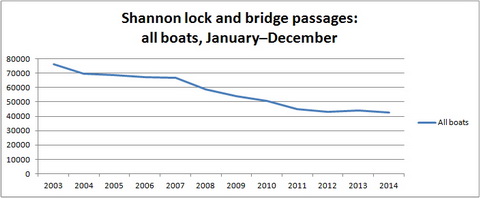
Total (private + hired) traffic for the full year

As we saw in September, traffic is down on 2013, but there has been little change over the last three years.

Private boats

Shannon 2003-2014 01-12 private boats_resize

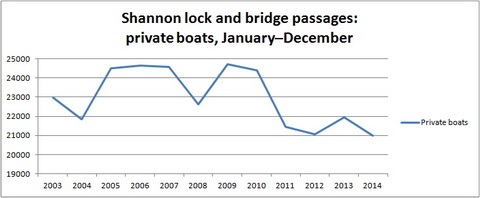
Private-boat traffic for the full years 2003 to 2014

The vertical scale on this chart is different from that for hired boats so the changes in private boating from one year to another are exaggerated (by comparison). The good weather did not prevent a fall in activity.

Hire boats

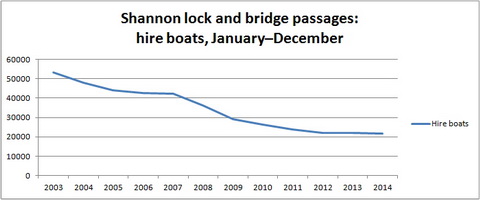
Shannon 2003-2014 01-12 hired boats_resize

Hire-boat traffic for the full years 2003 to 2014

Again, the lowest figure in my records, but the drop was small; perhaps the hire trade is bouncing along the bottom (as it were). I wonder whether anyone has a Grand Plan for recovery or rejuvenation.

Percentages of 2003 levels

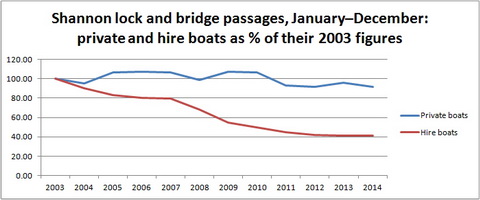
Shannon 2003-2014 01-12 compared with 2003_resize

Percentages of 2003 levels

Private traffic at just over 90% of 2003 levels, hire traffic at just over 40%.

Private -v- hired

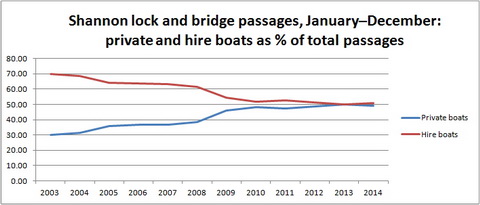
Shannon 2003-2014 01-12 private -v- hired_resize

Still roughly 50:50

Seasons

In the five months January, February, March, November and December, there were 385 passages altogether, less than 1% of total boat movements for the year. If money can be saved by ceasing to operate the locks and bridge during the winter, they should be closed except, perhaps, for one Saturday per month, to be arranged for a non-flood day.

Regions

Here is the order of popularity.

ALBERT LOCK 7205
ATHLONE LOCK  5775
CLARENDON LOCK 5650
ROOSKY LOCK 5565
PORTUMNA BRIDGE 5395
VICTORIA LOCK 4934
TARMONBARRY LOCK 3885
POLLBOY LOCK 1222
CLONDRA LOCK 1020
BATTLEBRIDGE 835
DRUMLEAGUE 797
DRUMSHANBO LOCK 387
SARSFIELD LOCK 97

Lough Allen is a delightful place but it is not popular.

Belleek to Tralee in 10 hours by inland waterway

Learned Readers are undoubtedly familiar with Design-Driven Innovation, but I’m afraid I hadn’t come across it until I read a conference paper: S McCartan, P Murphy, R Starkel, A Sánchez González and M López Cabeceira “Design-Driven Innovation: Sustainable Transport Opportunities for the Inland Waterways of Ireland”, read at the fifth annual conference of the Irish Transportation Research Network at the University of Limerick from 3 to 5 September 2014.

The paper [PDF] can be downloaded free from Sean McCartan’s page on the academia.edu site, though you have to be registered with the site; the paper is also available, I think, from researchgate.net, but I’m not registered there so I haven’t tried the download.

As I understand it — and I am a Bear of Very Little Brain, and Long Words Bother me — Design-Driven Innovation means that a lot of clever chaps and chapesses come up with new and brilliant ideas and then ask people what they think of them:

The process of Design-Driven Innovation is an exploratory research project, which aims to create an entirely new market sector for a given product through changing the design meaning the user has for the product.

It seems that, in Ireland, 99.1% of freight travels by road, leaving just 0.9% for rail; 82.8% of passenger traffic is by car and 14.4% by bus and coach, leaving just 2.8% by rail. Waterways transport could use existing ports and canals; once the canals had the right bridges and automatic locks, running costs would be low. West coast ports could be used by a “coastal cruiser service”; people could travel by fast boat from Donegal right around the west and south coasts to Rosslare. All of this would reduce the carbon dioxide footprint (assuming, of course, that folk on the west coast wanted to travel, or needed to send goods, to anywhere else on the west coast rather than to Dublin).

On the inland waterways, 139 catamaran CLF vessels (Cruise Logistics Ferries) could run from Belleek to Tralee. Travelling at 22 knots, and ignoring lock times, they would complete the journey in only 10 hours; they could carry freight but also carry passengers in green luxury. These CLFs would be 81 metres long and 25 metres wide; each could carry 20 TEUs. At sea, 26 high-speed (40-knot) CLFs could each transport 12 TEUs from Cork to Dublin in just under four hours. And solar-powered catamarans on the Shannon and Erne could carry 64 passengers at 12 knots.

Meanwhile, the Grand, Barrow and Royal would not be forgotten. They would have a fleet of 1549 unmanned canal catamarans, with autonomous control systems, powered either by batteries or by fuel cells, ultimately fed from wind farms. They would each carry two TEUs but could also be converted for tourist cruising.

The overall aim, with those numbers of boats, is to replace half of the amount carried by road.

The paper concludes:

This is a first step in the analysis of the potential of the coastal and inland waterways of Ireland, to meet the EU targets for transport. State aid has been identified as a potential funding mechanism to support the realisation of these proposals.

Sometimes I wonder.


A quick bit of sheughery

Here, read this. I haven’t time to take it all in at the moment, but the minister’s “An updated business case was recently completed for my Department” is, as far as I know, misleading: that business case was completed by DCAL in Northern Ireland and sent to Dublin. Thus, as the SF TD Mr Ó Snodaigh probably knows, the “business case” (which is not a cost-benefit analysis) came from a Sinn Féin minister’s department.

It seems our designation of “Saunderson’s Sheugh” was spot on.