Tag Archives: Shannon

The Shannon in winter

Waterways Ireland has kindly supplied me with the Shannon traffic figures for January and February 2014. The usual caveats apply. I have not made any charts because the traffic levels were so low:

  • in January, nineteen boats were recorded; of them, ten went through Portumna Bridge. Thirteen boats were private and six hired
  • in February, thirteen boats were recorded, five of them at Portumna; nine were private and four hired.

The total of 32 boats in the two months is extremely low. Since 2003, the Jan–Feb totals have been:

2003   45
2004 112
2005  67
2006  92
2007 127
2008  72
2009 124
2010  72
2011 114
2012  94
2013  97
2014  32

As Waterways Ireland intends to “prioritise navigation opening times to the times of greatest use, in order to achieve maximum use of resources available”, we may expect the Shannon to be closed in winter.


More reading material

A bit of a break from the politicking ….

First,  the long-awaited second edition of David Walsh’s extraordinary book Oileáin is now available from Pesda Press. It’s an exhaustive guide to the islands around Ireland, seen from a sea-kayaker’s perspective. It tells you where they are, how you get there, what the tides and currents and hazards are, whether you might be able to camp …. A lot of this is, of course, aimed mainly at folk rather more athletically minded than I am, but I got it for its information about the islands in the Shannon and Fergus estuaries. David’s website keeps an electronic version updated, so that you can check the latest information before you set off, but even if you’re unlikely to start paddling to the Skelligs yourself you may find the information and the photos of interest.

Shannon enthusiasts will be familiar with Richard Hayward’s Where the River Shannon Flows, written as Hitler’s war was breaking out. It is an account of a road trip down the Shannon during which a film about the river was being made: the party was in Portumna when Hayward heard, on a wireless set through a window, that Britain was at war with Germany. I was privileged, some years ago, to be able to see the film and to match it with the scenes from the book, from which L T C Rolt drew information for his Green and Silver. Hayward was a proud Ulsterman, but one who was happy to meet, converse and exchange songs with anyone of any creed anywhere in Ireland. He was, if I remember correctly, a confectionery salesman by way of a day job, but more importantly he was an actor, a writer and a singer. His style is of its time, and perhaps rather laboured by modern standards, but he was a decent skin and I haven’t read anything of his that I didn’t enjoy. I am pleased to learn that a biography, An Unrepentant Romantic — the life and times of Richard Hayward by Paul Clements, is due to be published by Lilliput Press in May.

In the same month, UCD Press is to publish James Murphy’s Ireland’s Czar: Gladstonian government and the lord lieutenancies of the Red Earl Spencer, 1868–86. That’s this chap here, whose claim to fame is that he has a dock on the Royal in Dublin, and a harbour on Lough Allen, both called after him.

I don’t know whether I want to shell out €50 for Nigel Everett’s The Woodlands of Ireland, 700–1800 [Four Courts Press, May], but I like the idea that it

Focuses on the fundamentally pragmatic and commercial view of trees adopted by Gaelic civilisation, and the attempts of the various Anglo-Irish administrations to introduce more conservative woodland practices into Ireland.

Cad a dhéanfaimid feasta gan adhmaid? Why, we’ll import seacoal from Whitehaven, of course.

Finally, I am hoping that Joe Curtis’s Terenure: an illustrated history [The History Press, Ireland, March] will have more information about the remarkable Bourne family.

The information on forthcoming books comes from the magazine Books Ireland, which was until recently edited by old Shannon hand (and, if I mistake not, former Ditchcrawler) Jeremy Addis. Jeremy has now passed over the tiller and the magazine is now edited by Tony Canavan and published by Wordwell.


Shannon traffic 2013

Some weeks ago Waterways Ireland kindly supplied me with the Shannon traffic figures for the final three months of 2013 and I have just now had a chance to add them to my spreadsheets and produce some graphs.

The usual caveats apply: the underlying figures do not record total waterways usage (even for the Shannon) as, for instance, sailing, fishing or waterskiing on lakes or river stretches, which did not involve a passage through a lock or Portumna Bridge, would not be recorded. The passage records are our only consistent long-term indicator of usage of the Shannon but they would not show, for instance, a change in the balance of types of activities from those in larger cruising boats to those in smaller (sailing, fishing, waterskiing) boats. On the other hand, they do include the Shannon’s most significant tourism activity, the cruiser hire business.

It is good to note, incidentally, that, in its draft Corporate Plan 2014–2016, Waterways Ireland says that it intends to

Develop and implement a research programme to measure waterway usage and inform planning and development.

It won’t be easy to do, but we need much better measures of all types of activities on all seven of the waterways managed by WI.

The final outcome for 2013 won’t greatly surprise anyone who has read earlier bulletins on this subject, like this covering the figures to end-September 2013. All the illustrations are based on information supplied by Waterways Ireland, with some minor adjustments by me to eliminate anomalies, but the interpretation and comments are mine own.

All boats full year

Total Shannon traffic 2003–2013, private and hired

The decline in traffic since 2003 seems to have been halted …

All boats full year %

Total Shannon traffic as a percentage of 2003 traffic

… but it is 40% below what it was in 2003.
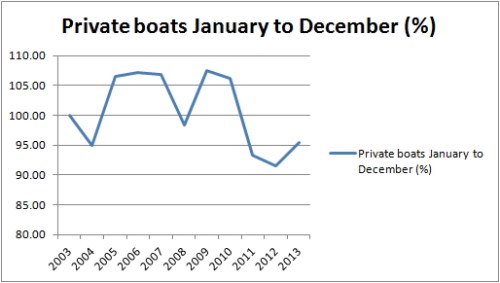
Private boats full year %

Private-boat traffic 2003–2013 as a percentage of 2003 traffic

Traffic in private boats seems to be recovering, but what is perhaps more significant is that it never went more than 10% above or below the 2003 figure. It has been remarkably stable over the period, despite the economic crash and despite the anecdotal evidence of boats being sold to overseas owners and trucked out of the country. Perhaps larger boats were replaced by smaller? Perhaps only boats bought in the boom were sold in the bust? Unfortunately the deficiencies of the registration system make it very difficult to determine what has been happening.

Hire boats full year %

Hire-boat traffic 2003–2013 as a percentage of 2003 traffic

But if private-boat traffic has been remarkably stable since 2003, the same cannot be said of hire-boat traffic. The best that can be said of 2013 is that the figures didn’t get [much] worse, but a 60% decline since 2003 is really, really dreadful.

WI’s draft Corporate Plan, which does not explicitly mention the hire industry, talks of

… unlocking opportunities to achieve recreational growth, and economic and social development.

I don’t know whether that omission means that WI sees little prospect of a rejuvenated hire-boat industry. And I note that, other than in the titles of organisations, the draft plan rarely mentions tourism or tourists. Are the waterways only for natives? If so, is that a deliberate policy decision? Or is there something that could be done, cheaply, to help to revive waterways tourism?

Emma Kennedy, writing in the Sunday Business Post on 23 February 2014, wrote about Fáilte Ireland’s latest brainwave, which is to “target” three groups:

  • social energisers, which are gangs of young people interested in “new and vibrant destinations”, which I take to mean Temple Bar
  • culturally curious folk aged 50 or over, with money, who are interested in “exploring new landscapes, history and culture”
  • great escapers, who like energetic rural holidays with their partners.

No families with kids, I see, although “Families & Loved Ones” (the latter term, by the way, nowadays seems to mean either dead people or their relicts) were one of the two “primary target customer segments” identified in Fáilte Ireland’s Inland Cruising Market Development Strategy. (Fat lot of good that strategy did, but we mustn’t be bitter.)

Anyway, without having done any market studies (though WI has funded lots of them), it seems to me that there is scope for more tourism on the waterways, but it might not be on traditional cruisers. It might involve outdoor activities like cycling and walking along the canals and Barrow: WI’s plan discusses them, but without adverting to an overseas market. And it might involve small-boat activities — canoeing, touring rowing, small-boat sailing, camping — on Shannon, Erne and SEW: WI says it will support micro-enterprises, and those providing outdoor activity holidays may need expertise and assistance rather than hard cash.

I admit to having little evidence on this, but it seems to me to be too early to give up on the tourism potential of the waterways. And the decline of the cruiser hire business does not necessarily mean that all waterway tourism is doomed.
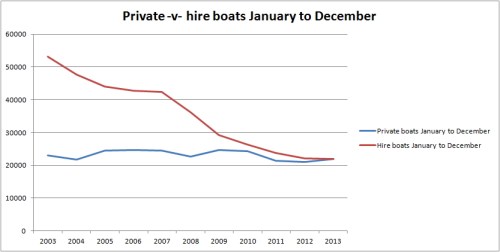
Private -v- hire full year

Private boats overtake hire boats

That said, 2013 was the year when, for the first time since Noah was an Able Seaman, the number of passages by private boats exceeded that by hire boats.
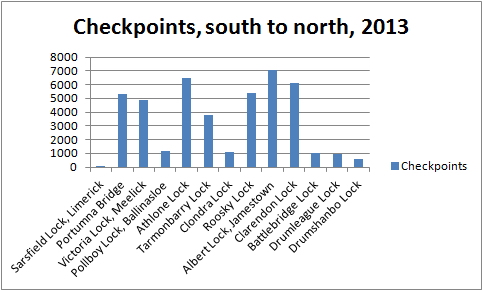
Checkpoints 2013

The points at which numbers were recorded

Finally, this chart suggests that any structures that were not built by the Shannon Commissioners in the 1840s will not attract many visitors. The extensions off the main stem of the Shannon — south to Limerick, west to Ballinasloe, east through Clondra, north to Lough Allen — are much less used than the main line from Lough Derg to Lough Key. It seems unlikely that any further extensions, especially to small towns that it would take three hours (at canal speed) to get to, are likely to be any more successful in attracting traffic.

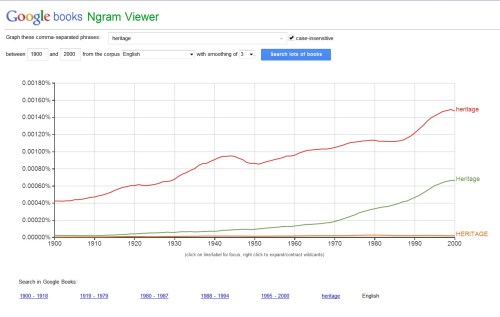
The (re)invention of heritage

From Google’s Ngram viewer (more here):

ngram[Sorry, Google: couldn’t get the embedding to work properly. WordPress’s whitelist omits Google, though maps seem to work OK. Here’s the original.]

The growth in the use of “Heritage” with an initial capital is particularly interesting. I can think of three possible reasons:

  • that more organisations, eg The Heritage Council, use the word in their titles
  • that the word is increasingly used as an abstract noun at the start of sentences like “Heritage is important”
  • that the word is increasingly used as an attributive adjective at the start of sentences like “Heritage apples should be preserved”.

Traditional, personal uses (like “My heritage from my ancestors …”) are, I think, less likely to require initial capital letters. That in turn might suggest that Google’s Ngram viewer is reflecting a new(ish) set of meanings for the word and might lead us to ask what that new(ish) usage is (or was) intended to achieve.

It might also lead us to ask whether an even newer concept might now be more useful: one that would dissuade well-meaning folk from preserving and displaying context-free old tat and persuade them to find and record information instead.

The Gillogue railroad

Gillogue, in Co Clare, is the site of a former Burlington factory and of a Clare entrance to the University of Limerick. It is also the site of a lock on the Plassey–Errina Canal, a section of the old Limerick Navigation, and of quarries, gravel pits and lime kilns.

And, according to the 6″ Ordnance Survey map, of around 1840, Gillogue also had a railroad.

The Gillogue rail road

The Gillogue rail road (click to enlarge)

The railroad was almost certainly not for carrying passengers; it may have been a light railway, with small wagons pushed by men or pulled by horses, and designed to be taken up and moved elsewhere fairly easily. However, I have no hard information about who owned it, who built it or what it was for. I can make guesses, based on its closeness to the canal and to the quarries, but it would be nice to have evidence.

If, Gentle Reader, you know anything about it, do please leave a Comment below.

My OSI logo and permit number for website

Heritage nonsense and the Naomh Éanna

There was a Dáil debate last week about the scrapping of the Naomh Éanna; nobody gave any good reason for keeping the vessel. Preservation proponents decided not to ask for money: instead they wanted the thing left hanging around while they worked out an “investment plan“, something that they could have done at any time over the last twenty-five years.

The funniest part was the final paragraph of the third contribution by Éamon Ó Cuív [FF, Galway West], who said:

Agus muid ag caint faoi stair, is fiú a lua gur úsáid RTÉ an bád seo le haghaidh scannán an-mhaith a rinne siad, “The Treaty”. Nuair a bhí Collins ag dul go Sasana sa scannán, is ar an mbád seo, seachas bád amuigh i nDún Laoghaire, a bhí sé. Tá ceangal stairiúil le hócáidí thar a bheith stairiúil ag an mbád sin. Níl ag teastáil ach cúpla mí ionas go mbeadh deis ag daoine rud éigin a eagrú. Beidh beagáinín slándáil i gceist. B’fhéidir go mbeidh costas beag ar Uiscebhealaí Éireann. Ní dóigh liom go mbeidh sé suntasach i gcomhthéacs an maitheas a d’fhéadfadh sé seo a dhéanamh dá gcoinneofaí an bád. Má táimid ag lord eiseamláir don rud a bhféadfadh a bheith i gcest, níl le déanamh againn ach cuairt a thabhairt ar Faing agus dul isteach ar an flying boat ansin.

Learned readers will recognise that Google Translate’s version needs improvement:

And we are talking about history, it is worth mentioning that RTÉ use the boat for a very good film they made, “The Treaty “. When Collins was going to England in the film, most of the boats, except boat out in Dun Laoghaire, it was. There are historical connections with historical events particularly at this boat. All you need is a few months so that people have the opportunity to organize something. The security bit concerned. There may be a small cost of Waterways Ireland. I do not think it will be significant in the context of the good it could do this if the boat is kept. If we lord model for what could be gcest, we do not just visit Foynes and go flying into the boat then.

So the Naomh Éanna is valuable because it was used as a film set. And Foynes flying-boat museum shows what could be done.

Foynes flying-boat

Foynes flying-boat

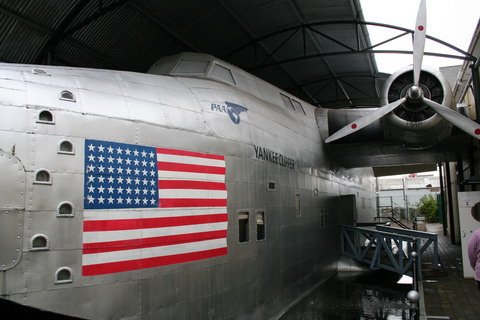
Up to a point, Lord Copper. You see — and I know this may come as a shock — the flying-boat on display at Foynes is not actually a real flying-boat. It’s not even a portion of a real flying-boat. It’s a reproduction of a portion of a flying-boat and it was built by a film-set designer.

If anyone really needs to be able to see around a small mid-twentieth-century ship, I suspect that the Foynes folk could provide a replica that would cost less to keep than the real thing.

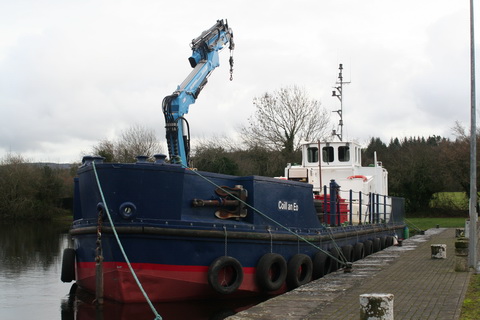
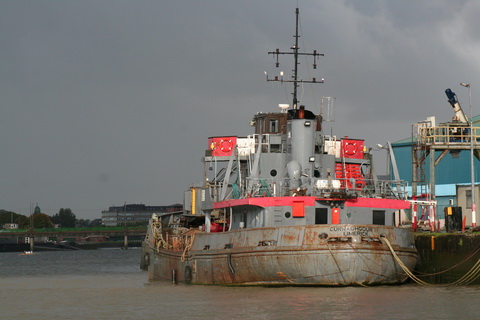
Alternatively, if Dublin needs another example of a locally built vessel, and one different in form from the Cill Áirne, it could take over the Curraghgour II or the Coill an Eo, both also built in Dublin. Maybe the preservationists should start now on their investment planning.

Coill an Eo

Coill an Eo

Limerick Port old dredger Curraghgour II 6_resize

Curraghgour II

Flood plains

Patrick O’Donovan [FG, Limerick] wants to drain the Shannon. Or wants farmers to do it. He doesn’t want the “multiplicity of agencies [which] have made it virtually impossible for anything to be done with the river and the rivers and streams draining into it”; he wants a non-multiplicity of agencies — “the OPW, the Department of the Environment, Community and Local Government, Inland Fisheries Ireland or whoever” — to dig sheughs and stop flood plains flooding. He says

The one group of people who seem to have no say are those who live on the banks of the rivers or who have watched thousands of gallons of water coming in their front door and out their back door.

But he is wrong. That is the one group of people who can stop flood waters coursing through their houses and who can do it most quickly, most easily and without the permission of a single state agency.

The solution is simple: they should move house, away from the flood plains to higher ground.

Lowering Lough Derg

Boat-owners concerned about high water levels on Lough Derg will be glad to know that relief is in sight, although it may take a little while to arrive. Irish Water has taken over the project to send Shannon water to Dublin and is procuring something, although it is not at all clear what that is. The, er, news item is so far leading in the competition for least informative press release of the year.

Registered boats

Waterways Ireland (whom God preserve) tell me that, at end December 2013, there were

  • 8816 boats registered on the Shannon
  • 5570 boats registered on the Erne.

There are different requirements for registration on the two waterways. But the main problem with the figures is that there is no incentive to deregister if a boat is sold off the system. As there is no annual charge for registration (or anything else), an owner whose boat is sold to an owner overseas or indeed on the sea loses nothing by failing to deregister. it is therefore possible that the figures overstate the numbers of registrable boats on the two systems [on the Shannon–Erne Waterway, which registration on either of the other two is required]. And then there are the boats that are not required to be registered ….

But, for what they’re worth, there the figures are.


Big it up for the OPW

I’ve just been reading some particularly nitwitted Dáil discussions and I need some time to calm down enough to report on them to the Learned Readers of this site. Let me just say that anyone who thinks that politicians cannot distinguish fact from fiction is absolutely right. But enough of that for the moment.

I reported earlier on an oddity in the results from the OPW’s Athlone waterlevel gauge. I emailed the OPW about it and a helpful chap got back on more or less immediately.

He explained that the data we see on the waterlevel.ie site is, as it were, live: raw unfiltered data with nothing added, nothing taken away. The same data goes in to the OPW and they spotted that the Athlone gauge was reading too high. They found the sensor was faulty; they have now adjusted it and the new, lower readings are correct.

The disappearance of the placenames is because of some work in progress on improving the website; they will be back.

He kindly pointed me to a list, in .xlsm format, downloadable from here; it shows all hydrometric stations in Ireland. It shows who operates them, whether they’re active and whether they use telemetry (which I take to mean that they can be monitored remotely). Unfortunately OPW itself doesn’t seem to have any gauges on Lough Derg and nor does Waterways Ireland. OPW does have a rather excitable gauge at Scarriff and gauges upstream of Meelick Weir and Meelick (Victoria) Lock. The ESB has gauges with telemetry at Ballyvalley (25073) and Killaloe (25074) but I can’t find any website giving the levels. If, Gentle Reader, you can find one, perhaps you would let us know.

The consoling part of dealing with the OPW is that you get the distinct impression that they know some useful stuff. Unlike, say, some folk working in Kildare Street ….