Tag Archives: vessels

Waterways [and other] archives

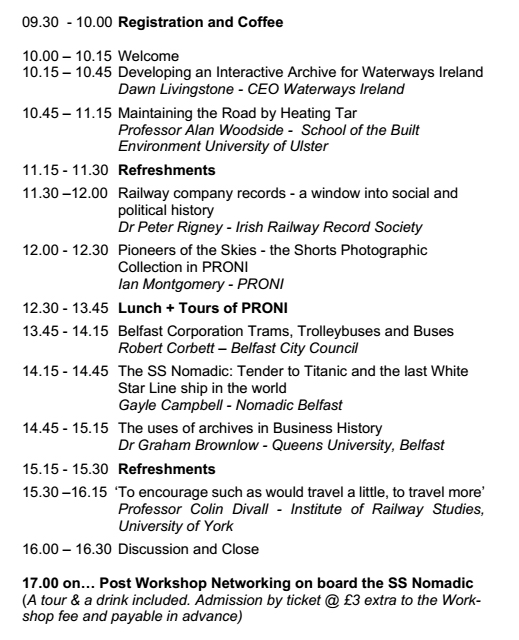
For anyone interested in transport history, there is an interesting-looking workshop scheduled for Belfast on 8 September 2014. It’s being held in the Public Record Office of Northern Ireland [PRONI] in the Titanic Quarter and there’s an optional extra tour and reception on the SS Nomadic afterwards.

The programme covers waterways, roads, railways and flight. For this site, the opening session is of great interest: Dawn Livingstone, CEO of Waterways Ireland, is to talk about an interactive archive for Waterways Ireland.

By air, sea and land

By air, sea and land

The workshop is being organised for PRONI by A²SN, the Archives and Artefacts Study Network, supported by the Historical Model Railway Society, the Business Archives Council and the Postal History Society.

The [two-page PDF] brochure is downloadable here PRONI transport archives workshop. The workshop fee is £20/€25 with an extra £3/€3.50 for the SS Nomadic visit. Sterling cheques are accepted; there is provision for paying in euro by online banking.

While on the subject of archives, I might mention again the Archives & Records Association, Ireland branch, whose [freely downloadable PDF] newsletters often cover topics of interest, and their Learn About Archives site here.

NSMC

The joint communiqué from last week’s North/South Ministerial Council Inland Waterways meeting is now available here. There was an exciting bit:

SECTORAL PRIORITIES

2. Ministers had a discussion on various priorities within their remit and noted that these will be contained in a report to be considered at a future NSMC Institutional meeting as part of the ongoing review into sectoral priorities.

Hmm … what’s cooking there? I do wonder why the NSMC bothers publishing content-free stuff like this. We may have to ask the US NSA to bug the meetings. Oh, hang on ….

Here’s a good bit, though:

PRESENTATION BY WATERWAYS IRELAND

3. Waterways Ireland delivered a presentation to Ministers entitled “Ireland’s Inland Waterways – Building a Tourism Destination”. The presentation provided an overview of the progress being made by Waterways Ireland in placing the waterways and the waterway experience at the centre of the tourism offering both in Ireland and internationally.

Now that is useful and important work. But, as I have pointed out elsewhere [including to Waterways Ireland], the WI draft Corporate Plan 2014–2016 said nothing about tourism. Some years ago, I thought that it was a mistake to have a Marketing & Communications Strategy and a Lakelands tourism initiative that seemed to exist outside the corporate planning process; I am still of the same mind.

I have asked Waterways Ireland for a copy of the presentation, and for a copy of the Strategic Development Plan for the Grand Canal Dock, Spencer Dock and Plot 8 that was mentioned in WI’s progress report. That report also covered:

  • continuing maintenance
  • public consultation on canal bye-laws
  • a Built Heritage Study and a GIS-based navigation guide for the Lower Bann
  • an environmental award for  work in restoring, protecting and promoting the heritage assets that are Spencer Dock and Grand Canal Dock
  • towpath development and work on the cycleway from Ashtown to Castleknock on the Royal
  • donating two barges for “recreational and community use”
  • “partnerships to utilise three unused navigation property for community and recreational use”, which I don’t know anything about.

The important part was this:

BUSINESS PLAN AND BUDGETS 2013 AND 2014 AND CORPORATE PLAN 2014-2016

5. Ministers noted the position with the 2013 Business Plan and budget. They also noted that Waterways Ireland has undertaken a public consultation on the draft Corporate Plan 2014-2016, the preparation of a draft 2014 Business Plan by Waterways Ireland and that the plans will be reviewed after the public consultation is analysed. They also noted that Sponsor Departments will continue to work together with Waterways Ireland to finalise the Business Plans and Budgets for 2014 and the Corporate Plans for 2014-2016 that will be brought forward for approval at a future NSMC meeting.

I read that as showing that the north-south deadlock continues. The 2012 accounts have still not been published and the plans for 2014 won’t be approved until (at the earliest) three quarters of the way through the year.

The NSMC heard something about the Clones Sheugh but has decided not to tell the citizenry anything about it. It agreed to some property disposals and decided to meet again in October. But there was one odd item:

SPECIAL EU PROGRAMMES BODY BUSINESS PLAN AND BUDGET 2014 AND CORPORATE PLAN 2014-16

8. Ministers approved the Special EU Programmes Body Business Plan and Budget 2014 and Corporate Plan 2014-16.

The oddity is that the SEUPB is a separate body and usually gets its own meeting and communiqué. The last six meetings (before this one) have been attended by NI folk from Finance & Personnel and RoI folk from Public Expenditure & Reform (or, before that, Finance).

So who let spending ministers into the sweetshop? And why? Suspicious-minded folk might think that there is a plan to  nick a lot of Euroloot for the Clones Sheugh to get the Irish government off the hook persuade the Europeans of the benefits of investing in the reconstruction of a small portion of the Ulster Canal. We note that, on the previous day, Jimmy Deenihan gave a longer than usual reply to the standard question about the Sheugh, including this:

The Inter-Agency Group has met four times, last meeting on 9 December 2013. The Group continues to examine leveraged funding opportunities for the project. This includes the exploration of EU funding which may be potentially available in the next round of structural funds covering the period 2014–2020.

I have a better idea. Vladimir? There are oppressed Russians in Clones ….


Carrick-on-Suir to Clonmel towing-path

Messrs RPS, consulting engineers, have been asked by South Tipperary County Council

… to design a minimal impact walking & cycling greenway route along the towpath of the River Suir between the towns of Clonmel and Carrick-on-Suir.

I have written about this stretch of the river here, so I was pleased to be asked to submit some comments and I welcomed the proposal. I made three suggestions, commenting more on principles than on details, which local people would know more about than I do.

First, I said that the heritage artefacts along the route should be protected and, if possible, explained. That might be done unobtrusively by making online information available to those equipped with smartphones. Such systems are used by the Canal & River Trust in Britain (here’s an example) and I understand that there have been experiments in using them on the Royal Canal here.

Second, I said that use by walkers requires more than a good trail: walkers also need safe parking places for their cars and information about public transport services that will return them to their starting-points. Car parks themselves need not be along the greenway but the information has to be provided there.

Third, there is scope for more use of the waterway itself, especially by canoes, kayaks and rafts, as well as by anglers. While such uses are (I imagine) outside RPS’s brief, I thought that it would be better to take account now of the needs of such users, and to ensure that the engineering would be able to cater for them in the future (I was not proposing that facilities necessarily be provided now), rather than to have to re-engineer the greenway later. My main concern was provision for enhanced access by rescue services, and Carrick-on-Suir River Rescue would probably be the best people to comment on that. I also suggested that a certain amount of unobtrusive hard edging along the towing-path might be of assisstance to boaters.

If you’ve looked at my page on this section of the Suir, you’ll know that it’s very scenic. Up to now, not all of the route has been accessible and making it so is a Good Thing — and at relatively low cost.


The Mahmoudié Canal

There is a possible link between the Mahmoudié Canal, which ran from Alexandria to the Nile, and Irish waterways. I have not managed to establish a definite link to this Irish canal-boat but it is not ruled out either, and a few other Irish connections came up along the way: Oscar Wilde’s father, for instance, who wrote about the Boyne and the Corrib, and sent his most famous son to school on the Erne, travelled on the Mahmoudié Canal.

And did you know that, in the early 1840s, you could buy bottled Guinness and Bass in Cairo? Or that, to transport 50 people (including 12 ladies and 3 female servants) and 3 bags and 62 chests of mail across 84 miles of desert, you would have needed, in 1841,

  • 130 camel men, donkey men and servants
  • an escort of 17 Arab horsemen
  • 145 camels
  • 60 donkeys
  • 12 saddle horses
  • 12 carriage horses
  • 7 carriage camels
  • 12 donkey chairs: “for invalids, or ladies, the donkey-chair forms as easy a conveyance as a palanquin or sedan”
  • 3 two-wheeled carriages
  • 1 four-wheeled carriage?

Or that, to reduce the number of rats and insects on a cangia (sailing boat) on the Nile, you should sink it for two or three days before boarding?

You can read about all of that and more in this PDF. However, it’s not for the faint-hearted: it’s 51 pages, with over 300 endnotes (which you don’t have to read) and lots of links for those who are really interested. There are illustrations in some of the linked materials.

The Mahmoudié mystery v04 iwh [PDF]

Rural nitwits and retirement communities

I’ve just been writing elsewhere to the effect that national politicians are a pack of nitwits. I was cheered therefore, in a sense, to note that local politicians, at least in Co Mayo, are (if possible) even more thick-headed than their national counterparts.

However, I am happy to be able to offer a solution, one that kills two birds with one stone. There are, it seems, many English pensioners living in poverty on boats on the canals and unable (or at least unwilling) to pay for the privilege. I had intended to suggest that Waterways Ireland should provide them with moorings away from the honeypot areas.

WI could then charge more for berths at, say, Hazelhatch, Sallins, Blanchardstown and Lowtown, catering for those in work who could afford a couple of thousand a year, while the pensioners, who don’t need to be within commuting distance of Dublin, could be accommodated in rural areas where their small additional spending would make a difference. That would help to increase those community and economic benefits to which the subsidy-seeking boat-owners draw our attention, bringing spending to deprived rural areas.

I was thinking of Pollagh, for instance: it has a pub, a shop, a church and a visiting burger van, and easy access to supplies of turf.

But the Mayo problem reminds me that Mayo too has lakes. So why not ship the boats to Mayo? As the canals byelaws provide that boats should not discharge any water other than from engine-cooling, these boats must be fitted with holding tanks or other non-discharging loos, so there would be no pollution problem. In fact Mayo could advertise itself to the world as offering floating retirement communities at modest cost, thus renewing its own population while solving a problem for boat-owners. I thnk this is a winner.

Another turf canal system

Here is a short page about a canal system I had not heard of before today. It was a network of turf canals, with a sea lock, on the estate of Scotts of Willsborough, near Eglinton, on Lough Foyle; the Scotts supplied [London]Derry with turf and, like James Macnab at Portcrusha, reclaimed the land from the bog.

The Armagh Canal

Another unbuilt canal mentioned by the indefatigable Mr Atkinson.

A proposal for making a canal from the city of Armagh to the river Blackwater, near the town of Moy

In order to shew, that carrying into effect the annexed sketch of a line [alas not annexed to the Google scan of Atkinson’s book], for opening a navigable communication from Armagh to the river Blackwater, would be a work of public utility, the following reasons are most respectfully submitted to the Right Honourable and Honourable the Committee of the House of Commons.

From Armagh, being the most considerable market in the kingdom for the sale of brown linens, the manufacture of that staple article is carried on to a very great extent in its neighbourhood; but this manufacture is in danger of being most materially injured, from the great scarcity of fuel, which is such as to oblige the opulent inhabitants to use English coal, at a great expense of land carriage; and they have latterly, at inclement seasons, been under the necessity of subscribing large sums, to procure that article at a low price for the poor, to prevent them from perishing.

Should a navigation be opened from Lough Neagh it would give the means of a supply of turf from the extensive bogs in the neighbourhood of the lake, would open a communication with the collieries at Coal island, in the county of Tyrone, and bring English or Scotch coal at considerably under the prices at which they can now be procured.

An extensive trade in general articles of merchandise being carried on from Armagh, not only to its own neighbourhood, but to a considerable part of the counties of Monaghan and Tyrone, by opening a navigation through Lough Neagh to the ports of Belfast and Newry, this trade would be very considerably extended, to the great advantage of Armagh, and all those places to which its trade extends, and would tend much to improve the public revenue.

To the great number of bleach-greens and flour mills in the neighbourhood of Armagh, water carriage would be of the highest importance, as well for the conveyance of bleaching stuffs, coals, grain, and flour, as of timber, slates, and other heavy articles, used in erecting and repairing the necessary buildings, machinery, &c.

In a large tract of country, from Blackwater town to Lough Neagh, and from thence up the river Bann, and along the canal to Newry (an extent of nearly 30 miles), there is no limestone whatever; so that lime can only be procured by land carriage from a distance of several miles, which prevents its being at all used in that important national object — agriculture.

Was a canal opened from Armagh, it must necessarily go through the lands in that vicinity, containing inexhaustible quantities of limestone, which could be conveyed by boats returning from Armagh, at a very inconsiderable expense, to all that part of the county above mentioned.

The cut, as laid down in the plan, would extend about five and a half miles; and according to the estimate, would, when completed, cost from £18,000 to £20,000, about one-third of which could be raised by subscription.

To keep the works in repair, and pay interest to the subscribers, would require a toll of about sixpence per ton on all boats carrying coals, or any other species of merchandise; but boats laden merely with turf or limestone might be charged only twopence per ton.

The number of horses constantly employed in bringing coals, turf, and other necessaries, to Armagh, amount to some hundreds; two-thirds of these would, from a canal, become unnecessary, and consequently make a saving to the country of their keeping, attendance, &c to a very large amount.

Should the Armagh navigation be carried into execution, it would be necessary to give the commissioners of it a power of laying on a very small toll on vessels coming into the Blackwater from Lough Neagh, to enable them to clear, and keep in order, a cut which was made many years ago (as marked in the plan), to avoid a sand bank in the mouth of the river Blackwater.
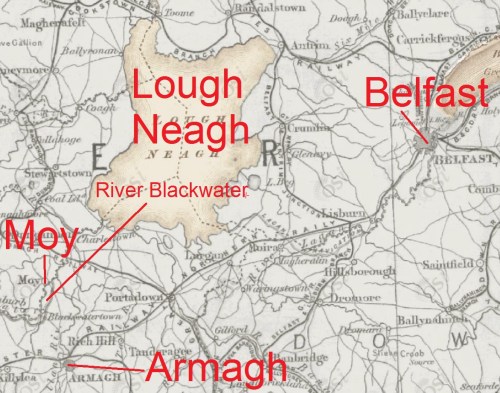
 

Armagh, Moy and Lough Neagh

Armagh, Moy and Lough Neagh

A Atkinson Esq (late of Dublin) Ireland exhibited to England, in a political and moral survey of her population, and in a statistical and scenographic tour of certain districts; comprehending specimens of her colonisation, natural history and antiquities, arts, sciences, and commerce, customs, character, and manners, seats, scenes and sea views. Violent inequalities in her political and social system, the true source of her disorders. Plan for softening down those inequalities, and for uniting all classes of the people in one civil association for the improvement of their country. With a letter to the members of His Majesty’s Government on the state of Ireland Vol II Baldwin, Cradock, and Joy, London 1823.

The Armagh canal document, bearing a date of June 20th 1800, is also included in Rev John Dubourdieu Statistical Survey of the County of Antrim, with observations on the means of improvement; drawn up for the consideration, and by direction of The Dublin Society Dublin 1812 [Google scan, again sketchless] but is not, oddly, mentioned in Sir Charles Coote Bart Statistical survey of the County of Armagh: with observations on the means of improvement; drawn up in the years 1802, and 1803, for the consideration, and under the direction of the Dublin Society Dublin 1804 [at archive.org here], although Coote does say of Newry

A canal has been in contemplation, to be cut from this town to Armagh, and an iron road is also talked of, but there has been no decision in either cases.


My OSI logo and permit number for website

The (re)invention of heritage

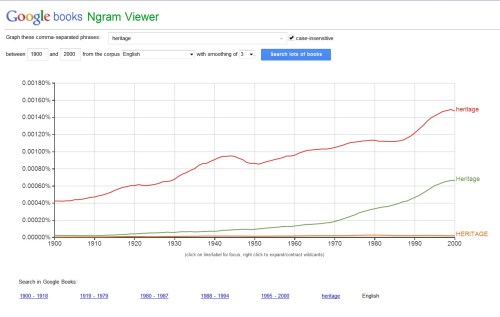
From Google’s Ngram viewer (more here):

ngram[Sorry, Google: couldn’t get the embedding to work properly. WordPress’s whitelist omits Google, though maps seem to work OK. Here’s the original.]

The growth in the use of “Heritage” with an initial capital is particularly interesting. I can think of three possible reasons:

  • that more organisations, eg The Heritage Council, use the word in their titles
  • that the word is increasingly used as an abstract noun at the start of sentences like “Heritage is important”
  • that the word is increasingly used as an attributive adjective at the start of sentences like “Heritage apples should be preserved”.

Traditional, personal uses (like “My heritage from my ancestors …”) are, I think, less likely to require initial capital letters. That in turn might suggest that Google’s Ngram viewer is reflecting a new(ish) set of meanings for the word and might lead us to ask what that new(ish) usage is (or was) intended to achieve.

It might also lead us to ask whether an even newer concept might now be more useful: one that would dissuade well-meaning folk from preserving and displaying context-free old tat and persuade them to find and record information instead.

The Gillogue railroad

Gillogue, in Co Clare, is the site of a former Burlington factory and of a Clare entrance to the University of Limerick. It is also the site of a lock on the Plassey–Errina Canal, a section of the old Limerick Navigation, and of quarries, gravel pits and lime kilns.

And, according to the 6″ Ordnance Survey map, of around 1840, Gillogue also had a railroad.

The Gillogue rail road

The Gillogue rail road (click to enlarge)

The railroad was almost certainly not for carrying passengers; it may have been a light railway, with small wagons pushed by men or pulled by horses, and designed to be taken up and moved elsewhere fairly easily. However, I have no hard information about who owned it, who built it or what it was for. I can make guesses, based on its closeness to the canal and to the quarries, but it would be nice to have evidence.

If, Gentle Reader, you know anything about it, do please leave a Comment below.

My OSI logo and permit number for website

G boats, Biffs, armoured cars and the Lagan

On the Grand Canal, M boats (boats with the letter M added to their numbers) were motor barges owned by the Grand Canal Company itself; E boats were engineering boats, used for canal maintenance and B boats (whether motor or horse-drawn) were bye-traders’ or hack boats, boats owned by traders other than the Grand Canal Company itself.

G boats were wooden horse-drawn boats, built to carry turf (peat) during The Emergency, which to the rest of the world was the second world war. Some of them [PDF] were built by Thompsons of Carlow, whose archives are now in the National Archives of Ireland; you can read about them in the Summer 2012 newsletter [PDF] of the Archives & Records Assocation.

The same organisation’s Autumn 2013 newsletter had an interesting article about Lagan Navigation archives in the Public Record Office of Northern Ireland. Unfortunately something has gone wrong with the links on its newsletter web page so the relevant PDF is not available at the moment.

h/t CO’M