
-

Waterways and Means by Brian J Goggin available now -
Join 585 other subscribers
RSS links
Pages
- Waterways & past uses
- Saving the nation
- Turf and bog navigations
- The Bog of Allen from the Grand Canal in 1835
- John’s Canal, Castleconnell
- The Canal at the World’s End
- The Finnery River navigation
- The Lough Boora Feeder
- The Little Brosna
- The Lullymore canal as wasn’t
- The Roscrea canals
- The Monivea navigations
- Lacy’s Canal
- The Rockville Navigation page 1
- The Rockville Navigation page 2
- The Rockville Navigation page 3
- Rockingham
- The Colthurst canals
- The Inny navigation
- The lower Shannon
- The piers, quays and harbours of the Shannon Estuary
- Nimmo’s non-existent harbour
- The Doonbeg Ship Canal
- Querrin
- Kilrush and its sector lock
- The Killimer to Tarbert ferry
- The Colleen Bawn at Killimer
- Knock knock. Who’s there?
- Cahircon: not at all boring
- Ringmoylan
- The hidden quay of Latoon
- The stones of Kilteery
- The Maigue
- Sitting on the dock of the Beagh
- Massy’s Quay, Askeaton and the River Deel
- Saleen Pier
- The Lord Lieutenant’s Visit to Limerick — trip down the Shannon [1856]
- The Fergus
- The Limerick Navigation
- The boundaries of the Shannon
- The power of the Shannon
- The locks on the Limerick Navigation
- Plassey
- Worldsend, Castleconnell, Co Limerick
- The bridge at O’Briensbridge
- The Limerick Navigation and the Monmouthshire Canal
- The Limerick Navigation (upper end) in flood November 2009
- The Limerick Navigation (lower end) in flood November 2009
- The Limerick Navigation (tidal section) in flood November 2009
- Floods in Limerick (1850)
- Limerick to Athlone
- The piers, quays and harbours of the Shannon Estuary
- The middle and upper Shannon
- The Grand Canal
- Monasterevan, the Venice of the west
- The Grand Canal lottery
- Grand Canal carrying: some notes
- The dry dock at Sallins
- The Naas Branch
- The Mountmellick Line of the Grand Canal
- Dublin to Ballinasloe by canal
- The Ballinasloe Line
- A Grand Canal lock: Belmont
- South of Moscow, north of Geneva
- Water supply to the Grand Canal
- The Grand Canal Company strike of 1890
- The Royal Canal
- Water supply to the Royal Canal: the feeders
- The Lough Owel feeder
- The proposed Lough Ennell water supply to the Royal Canal
- From Clonsilla to Clew Bay
- Kinnegad and the Royal Canal
- The sinking of the Longford in 1845
- Steamers on the Royal Canal
- Leech of Killucan: horse-drawn boats on the Royal
- Horses on board
- Royal eggs
- Prothero on the Royal
- The whore who held the mortgage on the Royal Canal
- Waterways in Dublin
- The Naller
- Visit Dublin. Walk canals. Drink beer.
- The Broadstone Line of the Royal Canal
- Effin Bridge: its predecessors
- Between the waters
- The abandoned Main Line of the Grand Canal 1
- The abandoned Main Line of the Grand Canal 2
- The abandoned Main Line of the Grand Canal 3
- The abandoned Main Line of the Grand Canal 4
- Waterways of the south-east
- Waterways of Cork and Kerry
- Waterways of the west
- Waterways of Ulster and thereabouts
- People
- Systems & artefacts
- Irish waterways furniture
- Irish waterways operations
- Miscellaneous articles
- Irish inland waterways vessels
- Cots -v- barges: defining Irish waterways
- Waterways Ireland workboats
- Wooden boats on Irish inland waterways
- Traditional boats and replicas
- Non-WI workboats
- Older Irish working boats
- The barge at Plassey
- Dublin, Athlone and Limerick
- Waterford to New Ross by steam
- The steamer Cupid
- Liffey barges 1832
- Steam on the Grand Canal
- The Mystery of the Sunken Barge
- Steam on the Newry Canal
- Guinness Liffey barges 1902
- Up and under: PS Garryowen in 1840
- Watson’s Double Canal Boat
- The Cammoge ferry-boat
- The ’98 barge
- Late C19 Grand Canal Company trade boats
- Chain haulage
- Ballymurtagh
- The Aaron Manby and the Shannon
- A sunken boat in the Shannon
- Sailing boats on Irish inland waterways
- Some boats that are … different
- Square sail
- 4B mooring
- Irish waterways scenery
- Engineering and construction
- Irish navigation authorities
- Opinion
- The folly of restoration
- The Ulster Canal now
- The Ulster Canal 00: overview
- The Ulster Canal 01: background
- The Ulster Canal 02: the southern strategic priority
- The Ulster Canal 03: implementation
- The Ulster Canal 04: Ulster says no
- The Ulster Canal 05: studies and appraisals
- The Ulster Canal 06: the costs
- The Ulster Canal 07: the supposed benefits
- The Ulster Canal 08: the funding
- The Ulster Canal 09: affordability
- The Ulster Canal 10: kill it now
- The Ulster Canal 11: some information from Waterways Ireland (and the budget)
- The Ulster Canal 12: departmental bullshit
- The Ulster Canal 13: an investment opportunity?
- The Ulster Canal 14: my search for truth
- The Ulster Canal 15: spinning in the grave
- The Ulster Canal 16: looking for a stake
- The Ulster Canal 17: the official position in November 2011
- The Ulster Canal 18: Sinn Féin’s canal?
- The Ulster Canal 19: update to February 2012
- The Ulster Canal 20: update to April 2013
- The Ulster Canal 21: update to August 2018
- The Barrow
- A bonfire at Collins Barracks
- Living on the canals
- Waterways tourism
- Guano
- The Park Canal: why it should not be restored
- The Park Canal 01: it says in the papers
- The Park Canal 02: local government
- The Park Canal 03: sinking the waterbus
- The Park Canal 04: the Limerick weir
- The Park Canal 05: cruisers from the Royal Canal
- The Park Canal 06: What is to be done? (V I Lenin)
- The Park Canal 07: another, er, exciting proposal
- Accounting for risk
- Tax-dodging boat-owners
- Rail
- Waterways & past uses
Blogroll
boats
- Canal steamers [UK]
- Chris Deuchar's boating page
- Douglas Self retrotech and steam
- Grace's Guide: British Industrial History
- Heritage Boat Association
- Historic Inland Working Boats
- Irish maritime history
- irish shipwrecks database
- Kilrush & District Historical Society
- Lough Corrib charts and scans
- Railway and Canal Historical Society
Book sales
Industrial heritage
Inland waterways
Ireland
Overseas
Seafaring
Sources
Category Archives: Irish inland waterways vessels
Expected benefits of the Ulster Canal (aka the Clones Sheugh)
The members for Donegal, Cavan, Fermanagh, Monaghan, and Tyrone, assisted by the leading gentry of each county, have joined in the grand object of improving the navigation of Lough Erne, and are at present in communication with sseveral experienced civil engineers, the Board of Works, and Colonel Burgoyne. Mr Saunderson, of Castle Saunderson, is indefatigable in improving the Upper Lough, and it is probably his exertions will be met and well seconded by John Creighton Esq, Crom Castle.
Already have several gentlemen been summoned from Enniskillen to value the land at Newtownbutler through which the Ulster Canal is to pass; and when its junction with Lough Erne is effected, and a stream of Commercial communication is opened between Ballyshannon and Belfast, the central point of which must be Enniskillen, enterprising individuals will not be wanted to establish steamboats and vessels of large tonnage upon the lake, which will render such encouragement to manufacturers and commerce by the quick and cheap transmission of goods and mails, as will in a few years render this a most flourishing town.
Ballyshannon Herald 20 April 1838

Posted in Built heritage, Canals, Economic activities, Engineering and construction, Extant waterways, Foreign parts, Forgotten navigations, Historical matters, Industrial heritage, Ireland, Irish inland waterways vessels, People, Politics, Restoration and rebuilding, Sources, Steamers, Ulster Canal, waterways
Tagged Ballyshannon, belfast, Clones sheugh, Creighton, Crom, Enniskillen, Erne, Saunderson, steamers, Ulster Canal
Cupid at Athlone
Aquatic Excursion (from a correspondent)
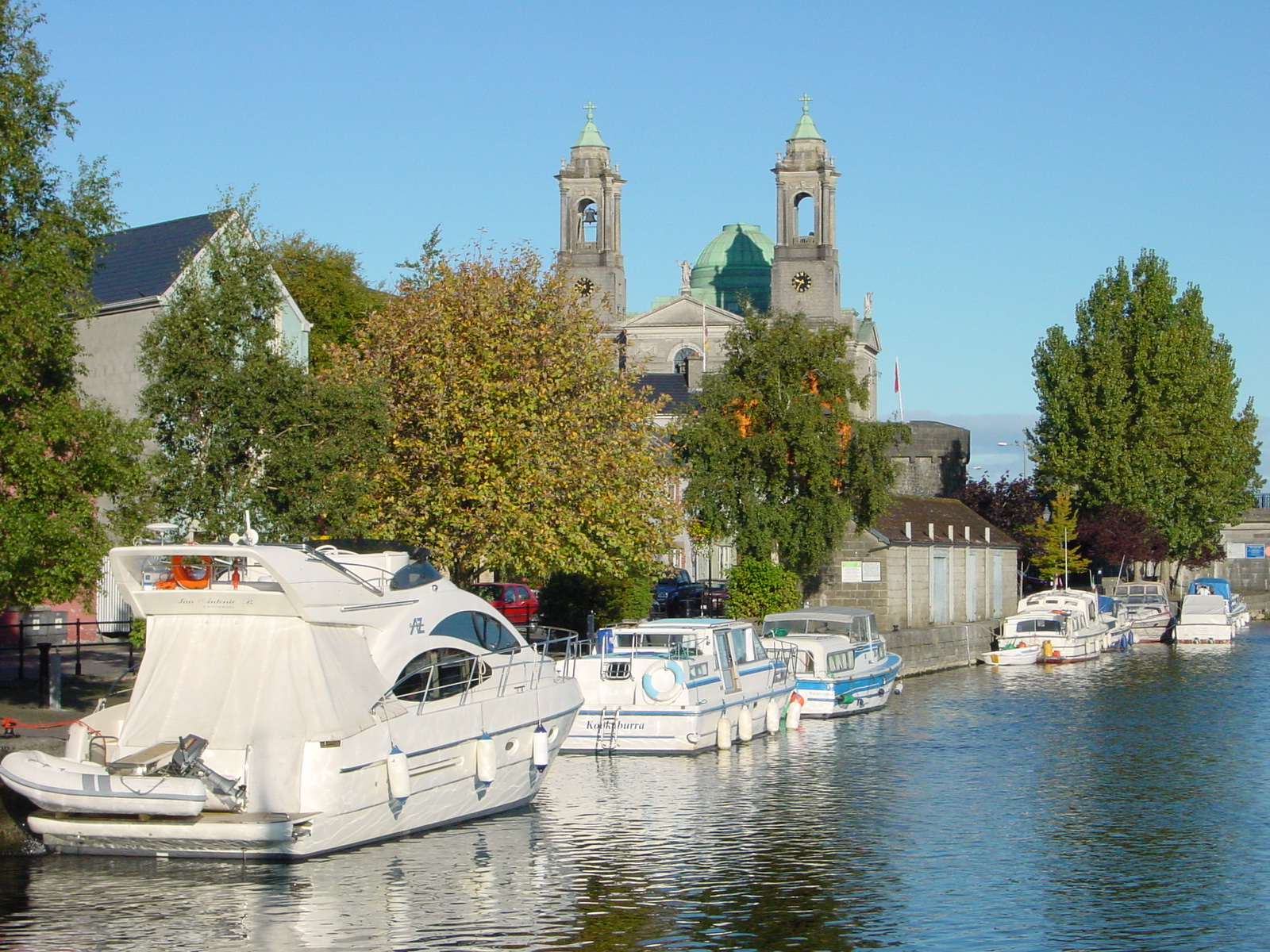
Athlone (2003)
September 17, 1846 — The Amateur Band of St Peter’s, who deserve so much from the inhabitants of Athlone for the many opportunities they seize upon, to amuse them, having provided — on a large scale — for themselves and guests a sumptuous and plentiful feast, with the necessary teetotal drinks, sailed up the lake on last Sunday in the Cupid Steamer. The day was beautiful and inviting and the placid stream of the noble Shannon — as if in harmony with the circumstance — opening wide its expansive bosom to receive them, displayed in gorgeous grandeur, the verdant beauties of its multitudinous islands and grove-covered promontories of its indented coasts.
I never saw the lake to such advantage as on that occasion. We had about eighty persons on board, amongst whom were the Rev Mr Philips CC and RW, Mr Keating and family, and other pic-nic parties, with viands and refreshments in abundance. As the steamer made the lake and swept through an Archipelago of islands — namely, Carbery, Kid, the Wren, and Crow Islands, &c, having the wood-embosomed Hare Island, the present insulated residence of my Lord Castlemaine, on the right and the grove-crested cape of the Yeu or, as some call it, the Loo Point on the left — then it was that she breasted the serene bosom of this inland ocean not as Byron says, “walking the waters like a thing of life”, but bounding over its mirrored surface like an impetuous courser she seemed to devour the distance, while she tossed a road of foaming surges from her heels.
On each side appeared emerging from wood and grove beautiful villas and noble ruins, towers and antiquated telegraphs, with their declivous lawns sweeping to the water’s edge. As we passed between Inchmore, Innisbofin, the Nun’s Island, the cultivated and rich callows of the Longford coasts, and Warren’s Point, St John’s and Mount Plunket on the Roscommon side, hill and dale land and water reverbrated with the dulcet tones of our excellent band under their inimitable instructor, Mr Keating, while at intervals the gay and cheerful dance on deck, to the music of the violin, enlivened the enjoyment of the exhilirating prospects that accumulated around us.
One or two objects which I observed, struck me very forcibly, and reminded me of the left-handed, nay, monopolising policy of former days, and the state of vassalage under which we yet groan and which “Ireland for the Irish” would never tolerate. In a beautiful valley, and modestly peeping from the clustering foliage of circumnambient trees and in accommodating contiguity to the “big house” stood the snug and aristocratic church of the minority, styled in legal parlance “the Established”, while at a distance on the bleak hill of Newtown, exposed to wind and weather, a chapel dedicated to the worship of the millions, displayed all the frigid isolation of a step-mother’s care.
We now arrived at Quaker’s Island, and having tacked about, we made for Warren’s Point, on our way home, and went on shore at St John’s Castle. With feelings of deep melancholy mingled with admiration, we viewed the venerable ruins of this once majestic pile (huge masses of which lay scattered here and there), its dismantled bastions, deep fosse, and the roofless walls of its antiquated chapel, while on a neighbouring hill stands the shell of its watch-tower to give timely warning of the approach of the feudal rival who would dare contest sovereignity with its lord. We then warmly and eagerly discussed the viands abundantly spread on the verdant sward at the base of
These ivy crowned turrets, the pride of past ages,
Tho’ mould’ring in ruins still grandeur impart.
After which the merry dance commenced, unconstrained laughter and encouraging shouts accompanying the performers, bringing the memory back to the times of rural felicity; when under the fostering tutelage of a domestic legislature, every family had its own quern to grind its own grain, every peasant could drink his own beer and the daily toil of virtuous industry being over, the children of simplicity, to the sounds of the oaten reed or the violin, or the more national bag-pipes, tripped it gaily on the “light fantastic toe”. And this was the happy and tranquil state of “Old Ireland” before the importation into it of such exotic materials as Sir Walter Raleigh and his rotten potatoes. To return to the ruins. I wish Lever, Carlton, or some one of those compilers of Irish legendary lore, had visited Lough Ree, he would find there more traditionary facts connected with the pristine magnificence of the different localities, than very many of those which have been already noticed in Magazines.
Having embarked once more we soon arrived home, and thus ended to the satisfaction of all parties, one of the most amusing days I, at least, ever spent in my life. To Bernard Mullins Esq, the young men composing the band return their sincere acknowledgements, for his kindness in accommodating them with the Cupid for this very pleasant excursion.
O’B
Athlone Sentinel 18 September 1846
Posted in Built heritage, Engineering and construction, Extant waterways, Historical matters, Industrial heritage, Ireland, Irish inland waterways vessels, Passenger traffic, Scenery, Shannon, Sources, Steamers, Tourism, Water sports activities, waterways, Weather
Tagged Athlone, band, Bernard Mullins, Cupid, dance, Lough Ree, St Peter's, steamer, viands
What Éanna Rowe might say
In the minor arrangements made by us, and the rates fixed for small boats, we have been influenced by the same general principles already mentioned, and have been guided by the further principle of making every class of traffic or boat, however small, liable to some rate of toll, in order to establish a useful and beneficial control over the navigation.
Second Report of the Commissioners for improving the Navigation of the Shannon; with an appendix Ordered, by The House of Commons, to be Printed, 26 February 1841 [88]
The new header photo
Kilteery pier, on the Shannon estuary, August 2015
Hilda Ormond?
In December 2012 I published a post entitled Looking for Hilda in which I said that D B McNeill had written in his Irish Passenger Steamship Services Volume 2: South of Ireland (David & Charles, Newton Abbot 1971) that
In the autumn of 1964 the Ormonde Hotel at Nenagh took delivery of the Hilda from Holland. She is a modern canal cruising launch with central heating and a transparent roof. She is used for local trips on Lough Derg.
I said that she was described as a single-screw motor vessel with a diesel engine but that no further details are given. I sought more information about the Hilda, and hoped that a photo might be available.
Earlier today Loire commented on that post:
The MV Ormond was purchased in Amsterdam in 1964 by Denis Gilmartin, owner of the Ormond Hotel in Nenagh, Co Tipperary. Denis was accompanied on that trip to Amsterdam by local solicitor Michael O’Meara. The vessel was used to entertain guests staying at the Ormond Hotel and in promoting tourism around Lough Derg in the 1960s. Home port for MV Ormond was Garrykennedy on Lough Derg. The MV Ormond was sold to Company in Cork that deployed it for cruises on the river Lee. I have photo of the MV Ormond docked at Garrykennedy Harbour circa 1968 which I will send you.
I am very grateful for that information and for the photo, which has now arrived.
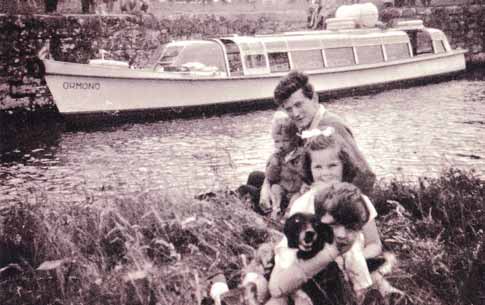
M V Ormond ~1968 (courtesy of Loire)
Obviously the name Ormond was bestowed when the vessel reached Lough Derg, so it is possible that it was named Hilda when in Holland.
Can anyone identify the people and dog in the photo?
Posted in Ashore, Extant waterways, Historical matters, Ireland, Irish inland waterways vessels, Operations, Passenger traffic, People, Scenery, Shannon, Tourism
Tagged Garrykennedy, Hilda, Lough Derg, Nenagh, Ormond
This month’s header
Bartlett drawing of turf boats below Wellesley (now Sarsfield) Bridge, Limerick.
Egypt and Ireland
We embarked [on the Mahmoudié Canal at Alexandria] in a boat not unlike those that ply in Ireland upon the Grand Canal and, to say the truth, among the dreary wastes of swamp that surrounded us, we might also have fancied ourselves in the midst of the Bog of Allen.
The boat was towed by four wild, scraggy-looking horses, ridden by four wilder, scraggier-looking men; their naked feet were stuck in shovel stirrups, with the sharp sides of which they scored their horses flanks, after the fashion of crimped cod.
It is true, these jockeys wore tattered turbans instead of tattered hats, and loose blue gowns instead of grey frieze. Yet still there was nothing very new or imposing in the equipage, and the mud cabins that here and there encrusted the banks did not tend to obliterate Tipperary associations.
Eliot Warburton The Crescent and the Cross; or, romance and realities of eastern travel new ed, George P Putnam, New York 1848
There will be more on links between the Shannon and the Nile, Ireland and Egypt, at the Mountshannon Arts Festival on Saturday 1 June 2019 at 3.00pm, aboard one of the boats that used to “ply in Ireland upon the Grand Canal”.
Grand Canal carrying 1816
GRAND CANAL
Reduction of Freights etc
B Hyland and Sons return their most grateful Thanks to their Friends and the Public, for the very flattering Encouragement they have received since their commencement in Business, above 20 years, and hope, that by their constant care and attention to merit a continuance thereof. They now take the opportunity of acquainting the Friends of their Trade, that all goods committed to their care, will be forwarded as usual, with the utmost expedition. Three of their Boats leave Dublin every week, for the conveyance of all kinds of Building Materials; Wines, Spirits, Porter, Tea, Sugar, Cotton Goods, and all kinds of Merchandize &c, at tge following reduced Prices, viz:
Dublin to Rathangan 8s 10d per Ton
Do. to Monastereven 10s 6d do.
Do. to Vicarstown 12s 4d do.
Do. to Athy 14s 2d do,
They beg leave to state to their Friends and the Public that they have got each of their Boats Hatched (so that it is impossible for Goods to meet with the slightest injury) and each Hatch is properly iron barred, with cross bars of Iron, in the most secure manner, and the moment the Goods are put into each Boat, the Hatches are put on, and locked down with brass-warded Locks of the best description, and then sealed. Each of their Agents at the above-named Stages have counter keys to open the Boats to get out the necessary Goods that is for each place. They have also provided excellent Stores at each of the above Harbours, for the general accommodation of all those who are pleased to favour them with the carriage of their Goods.
They return their best thanks to the Grand Canal Company, for their having so kindly reduced their Tolls, by which means they are thus enabled to carry Goods at the above Rates, and also to carry all kinds of Goods, Flour, Meal, Malt, Corn, &c at the under-mentioned rate of Freight to Dublin, where three of their regular fast-sailing Boats arrive each week from the country.
Athy to Dublin 12s 6d per Ton
Vicarstown to do. 11s 6d do.
Monastereven to do. 10s 6d do.
Rathangan to do. 8s 10d do.
Exclusive of the above arrangement they have also commenced plying another Boat drawn by two Horses, which Boat leaves Monastereven every Friday evening at Four o’Clock, and arrives in Dublin on the Saturday night following; this same Boat leaves Dublin every Tuesday morning at Five o’Clock, and arrives in Monastereven on the Wednesday evening following.
They hereby give notice, that any Grain or Corn that may come by their Boats, in bulk, to Dublin, will not be entitled to the above reduction of Freight; but if the Owners of such Grain or Corn, put it into Sacks, they will then be only charged at the above-mentioned Rates (so regulated and ordered by the Grand Canal Company).
They have also established Drays with Covers for the accommodation of their Customers in Dublin, and also in the Country, for the purpose of delivering all kinds of Goods that may be conveyed by their Boats to their respective Owners.
Samples are taken from all Wines and Spirits sent to their care, the instant they are laid down off the cars, in the presence of the Carrier, in small Vial Bottles, sealed, one of which is sent to the Owners, the other retained as a proof; and they are in all cases accountable.
Their Boat Agents are Mr Henry Farrell, at Rathangan; Mr John Coyle, at Monastereven; Mr Thomas Doyle, at Vicarstown; and Mr Michael Commins, at Athy; each of whom are purchasers of Grain, and will give the full value for Wheat, Bere, Barley, Oats and Rapeseed.
Wanted, 800 new Hemp Sacks of the best Irish Manufacture; each Sack must weigh 7 lb exactly standing beam.
They have always a large supply of the best KILKENNY COALS, on reasonable Terms.
Dublin Evening Post 12 September 1816
Posted in Ashore, Canals, Economic activities, Extant waterways, Historical matters, Ireland, Irish inland waterways vessels, Irish waterways general, Operations, The grain trade, waterways, Waterways management
Tagged Athy, Barrow Line, boat, canal, coals, Dublin, grain, Grand Canal, Monasterevan, Rathangan, tolls, Vicarstown
The Mountshannon dog-prison
Let us suppose that you are on a boat, with your dog, and perhaps some humans, and that you decide to visit Mountshannon, Co Clare, in the summer.
Here is a map of Mountshannon. I have stolen it from Clare County Council’s Beach Bye-Laws document, which you can download here [PDF].
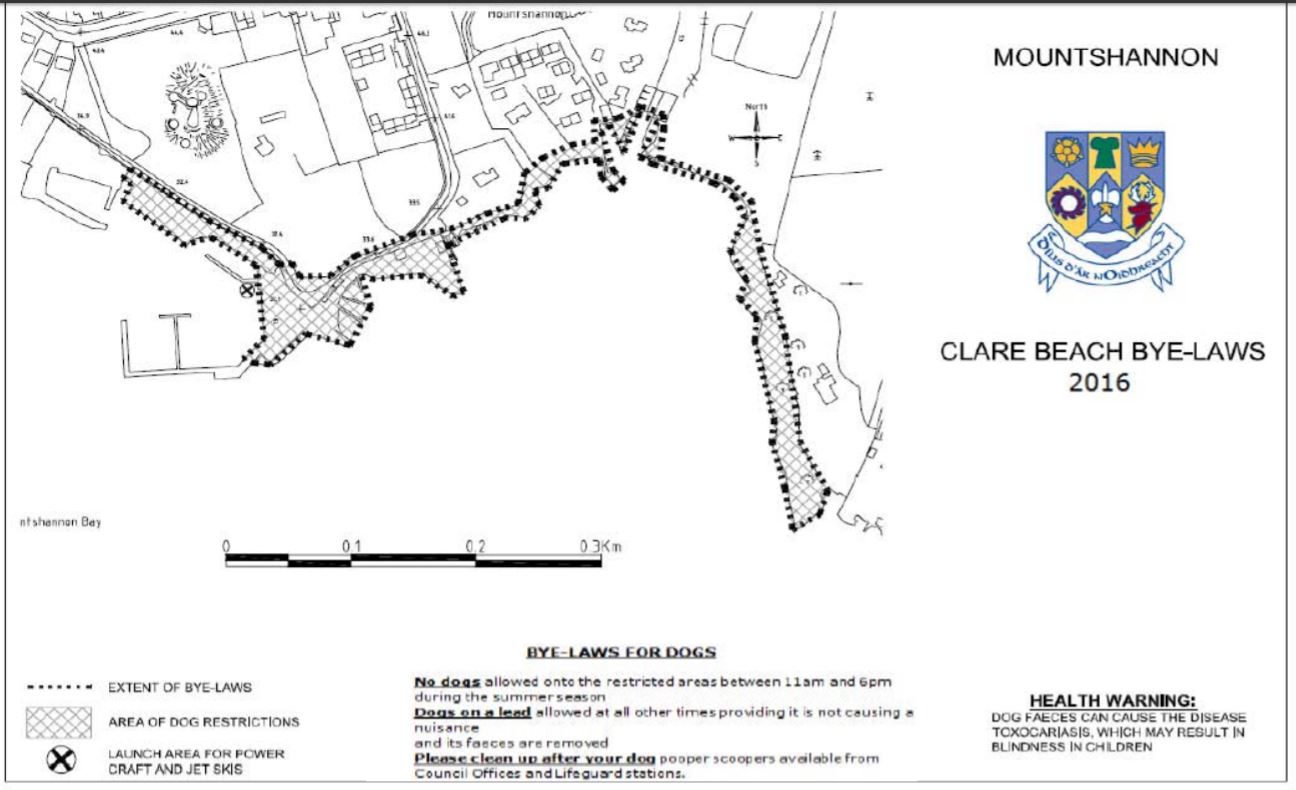
Mountshannon, Co Clare
Bye-Law 16 applies to this “beach”:
16) Between the hours of 11am and 6pm during the Summer Season, it shall be prohibited to bring any dog onto any part of the beach except the exempted areas delineated on the schedule of maps attached hereto. Before 11am and after 6pm, a dog may be brought onto the non-exempted areas of the beach on the conditions that:
- the dog is on a leash;
- it is not causing annoyance, danger or nuisance to any person using the beach or worrying, chasing, injuring or disturbing any animals, birds or other creatures on the beach; and
- its faeces is removed and deposited in a suitable receptacle.
There are some exceptions: guide dogs and those employed by the constabulary and the excise-persons.
The area from which dogs are excluded is shown by the hatching on the map. It covers the only exit from the piers to the shore. Thus it is not permissible to take little Fido to the land between 11.00 and 18.00 in the summer.
Little Fido had better be good at crossing his legs.
Posted in Ashore, Extant waterways, Ireland, Irish inland waterways vessels, Non-waterway, Operations, Shannon, Tourism, Waterways management
Tagged beach, bye-laws, Co Clare, dog prison, Mountshannon
 Irish waterways history