
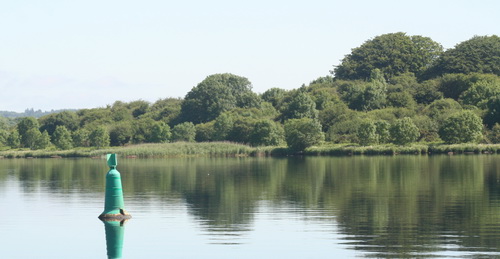
The Red Island green
The Red Island green
Posted in Engineering and construction, Extant waterways, Ireland, Modern matters, Operations, Safety, Scenery, Shannon, waterways, Waterways management
Tagged buoy, green, Lough Derg, marker, Red Island, Scariff, Scarriff, Shannon
I had much pleasure in availing myself of an ascent in Mr Hampton’s Balloon on Monday, accompanied by that gentleman and Mr Townsend. At two minutes to five, all the necessary arrangements being made, the bridling was cast off, and we ascended (apparently to us in the balloon gradually), but having relieved the car of five bags of ballast, which was thrown over, our ascent then became much more rapid.
The course taken by the balloon being at first almost due north we glided beautifully across the Shannon, and found ourselves at twelve minutes after five, at the north side of the river. The balloon, in this position, rested for some minutes, giving us an opportunity of gazing on the grand and magnificent panorama beneath us.
The prospect of Limerick was very extraordinary, every street, lane, and building, being at the same moment distinctly visible, but so apparently diminished in size that it assumed more the appearance of a beautiful miniature model than the actual city; the expanse of view was vastly greater than I anticipated, the various windings of the Shannon, with little interruption, being visible to Killaloe, above which the grand and noble expanse of water on Lough Derg was a prominent feature, flanked on either side with a lofty range of mountains. The view of the lower Shannon was also very attractive, extending far below the Beeves’ tower, and on which was visible one of the river steamers towing, I will not say a large ship, for it appeared no bigger than a turf boat.
We now bent our course towards Cratloe Wood, and at 22 minutes after 5, found ourselves standing right over its centre, the appearance of which was very extraordinary, the trees appearing more like a beautiful mantling of richly-coloured heath, or of short brushwood. Here I took an indication of a barometer, brought up at the request of Mr Wallace, the proprietor of the Observatory, for the purpose of getting for him its indication at the greatest altitude, and by which I found we were still ascending, soon getting us into another current, floating the balloon gradually towards the Shannon; and, at 30 minutes after 5, we found ourselves over the north bank of the river, opposite the Maigue.
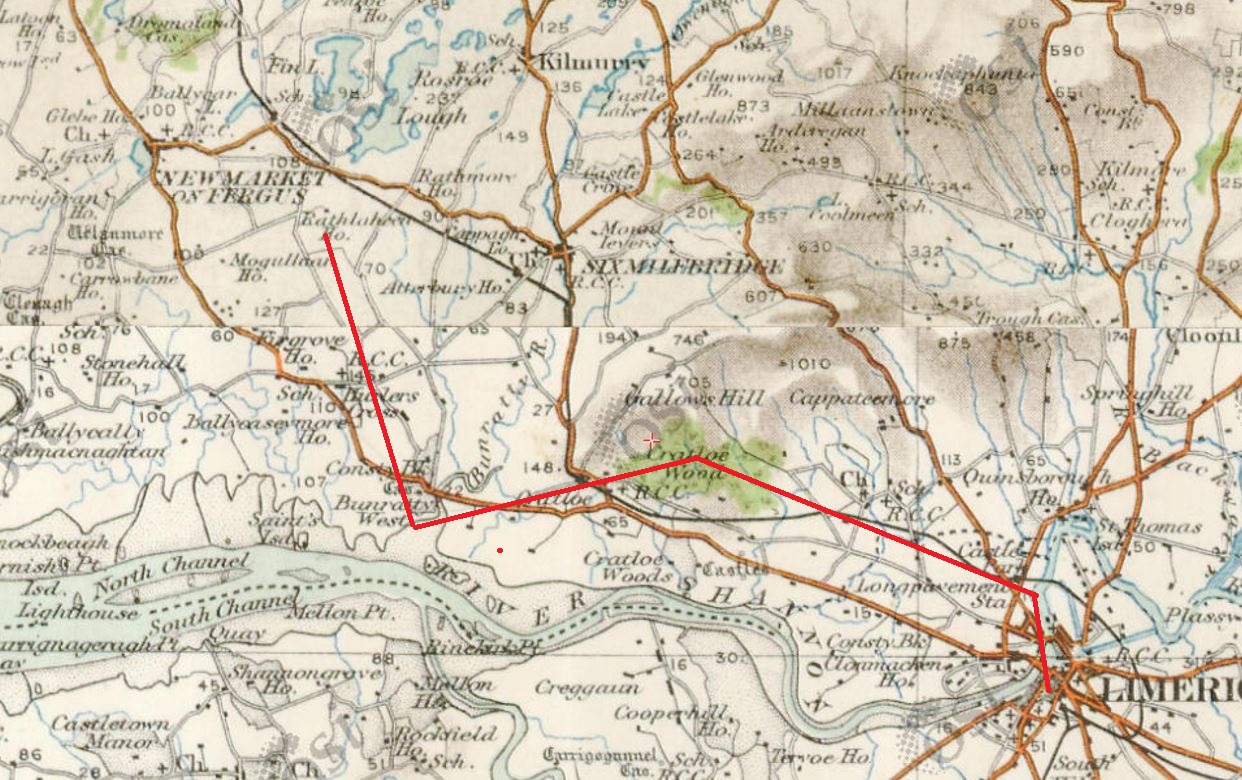
The flight of the balloon (OSI ~1840)
There, by indication of the barometer, it appeared we attained our greatest altitude, being then 4261 feet above the level of the river. The country beneath, from this great height, much resembled one of the Ordnance Survey maps. Undulations of the ground, except hills and mountains at a distance, not being visible, and large fields looking not much bigger than pocket-handkerchiefs; nor could I help thinking what a sad waste of land there was under stone walls, making such varied subdivision of property, and being much more numerous than I had any idea of.
At this altitude the atmosphere was so rarified that Mr Townsend felt his respiration considerably affected, which, under such circumstances, is very usual, though I did not experience it.
I was particularly attracted in this place, as would be supposed of perfect tranquillity, removed from the busy world, to find the buzz or murmuring sound of those beneath us (though, I need hardly say, invisible) ascend and fall on the ear distinct, though faintly, being different from any sound I ever before experienced, and but ill-conveyed by my inadequate description.
I found we had now got into another current diametrically opposite to what had been our last travelling, having taken a rapid course in the direction of Ennis. The barometer indicating a gradual descent, at 45 minutes after 5, Mr Hampton deemed it advisable to prepare for his descent, the country wearing a favourable aspect for doing so, and here he first worked the valves for that purpose; so that our descent and progressive movement now became very rapid.
And at two minutes to six we once more came in contact with terra firma; the car first striking obliquely two walls about 5 feet high, of dry masonry, being at either side of a road or bye way, through which it made a clean breach to the very foundation; the car, after passing through the breach, again oscillated, and found its resting place in a pasture field at the foot of Ralahine demesne, about three miles from Newmarket-on-Fergus, where we were quickly surrounded by a large peasantry, showing forth their true national characteristic generosity, for they not alone gave their most anxious aid in the saving of the balloon, and its various appendages, but many offered their horses to bring us into Limerick. Mr Creagh, I should also add, was most polite, having invited us to Ralahine, to partake of his hospitality.
I hope it may not be considered presumptive of me to state, from my slight knowledge of mechanical operations, that I consider Mr Hampton a perfect master of the management of a balloon, so far as practicable, and is, I feel, owed a debt of gratitude by the citizens of Limerick, for the very great treat which he has afforded them.
Hampden W Russell
Limerick and Clare Examiner 8 September 1849 in the British Newspaper Archive
On Tuesday 21 August 1849 the Southern Reporter and Cork Commercial Courier announced that “Mr Hampton, the aeronaut” had arrived in Limerick and was preparing to ascend thence in his balloon, the Erin go Bragh. It was not his first flight from Limerick: he had ascended in October 1846, when the necessary gas (£14 worth) seems to have been sponsored by the “Limerick Gas consumers company” [Limerick Reporter 6 and 13 October 1846].
The 1849 ascent was on Monday 3 September from Mr Marshall’s Repository, Upper Cecil Street, and was advertised in advance. According to the Limerick and Clare Examiner of 29 August 1849, the “Splendid Band of the 3d Buffs” was to attend. Ladies and Gentlemen could watch from reserved seats [2/=; children 1/=] in a gallery; Second Places cost 1/=, children 6d.
Mr [John] Hampton offered seats in the balloon’s car to ladies or gentlemen who wished to accompany him; the balloon could lift six people and had two cars, one for descending over land and the other “for Sea-ports, in case the wind should be for Sea”. Those interested could find the fares by applying to himself at 12 Cecil Street or to Mr G Morgan Goggin at 34 George Street.


Posted in Ashore, Engineering and construction, Extant waterways, Historical matters, Industrial heritage, Ireland, Irish inland waterways vessels, Operations, People, Scenery, Sea, Shannon, shannon estuary, Sources, Steamers, Weather
Tagged aerial, aeronaut, balloon, Buffs, Cratloe, Erin-go-Bragh, flight, Hampton, Killaloe, Limerick, Lough Derg, Maigue, Newmarket-on-Fergus, Ralahine, Shannon
There are two Lough Dergs in Ireland. One is in the County of Donegal, within four and a half miles of Pettigoe, and is celebrated for its St Patrick’s Purgatory. The lake is but six miles long and four miles broad, and can hardly vie for scenery with its namesake in the south.
In order to reach this, probably one of the most exquisitely beautiful loughs in Ireland, it is necessary to make for the town of Killaloe. This can be done by leaving Euston at a quarter-past ten at night, when Killaloe is reached by 3.10 the following afternoon; or should the tourist prefer the Irish mail, he can leave at a quarter to nine in the evening and arrive at Killaloe at half-past eleven the following morning.
Few Irish towns contain so many antiquarian relics, combined with such beautiful scenery, for Killaloe stands on a hillside tufted with wood and surrounded by mountains. The old cathedral occupies the site of a church founded by St Dalua, in the sixth century. The present building dates from the twelfth century, with a central square tower whose effect is somewhat spoiled by a modern crown. Its gem is a Hiberno-Romanesque doorway, which has, unfortunately, been blocked into the south wall of the nave. The precincts also contain a small stone-roofed church, said to date as far back as the sixth century.
The fishing is generally extremely good, though many prefer Castleconnell, some five miles to the south on the road to Limerick. In any case few portions of the United Kingdom furnish better salmon fishing than that reach of the river Shannon that lies between Killaloe and Castleconnell.
Lough Derg must, however, remain the greatest attraction of the district. It is twenty-three miles in length, and varies in breadth from two to six miles. Nothing can surpass the loveliness of the scene, especially on a fine summer’s day. On the one side the well-wooded and smiling hills of Limerick and Tipperary, where Thomthimia, with its slate quarries, slopes down to the water’s edge; while on the other the darker and more rugged mountains of Slieve Bernagh, Ballycuggeren, and the Crag form the most effective contrast.
Kincora was once the residence of Brian Boroimbh, King of Munster, and its magnificence was long the main theme of the ancient bards. But little now remains of the ancient palace beyond a long circular earthen fort, with a single vallum some twenty feet in height.
Inishcaltra or the Holy Island is, however, well worth a visit, and for this purpose it would be better to utilize the local service from either Scariff or Killaloe to Mountshannon, which faces the island. It possesses a round tower some eighty feet high, and seven churches, or cells, and oratories, the most remarkable of which is that of St Caimin, originally erected by him in the seventh, but subsequently rebuilt by Brian Borombh in the tenth century.
Scariff may this year be approached by steamer, and is a very prettily situated village, within access by road of Woodford, in County Galway, and Ennis in County Clare. The steamer then crosses the lake to Dromineer, at the mouth of the Nenagh river, where the ruins of the castle stand out with such picturesque effect. The bay is one of the most popular resorts, both of the angler and of the yachtsman; for to the latter it has earned a well-deserved reputation for its annual regatta.
The steamer then stops at Williamstown while a boat from Kilgarvan occasionally lands passengers and conveys them to the steamer. As soon as the new jetty has been constructed by the Board of Works, Woodford will be equally accessible; but there is no doubt that the approach to Portumna pier at the head of the Lough, lying as it does between the well-wooded demesnes of Portumna Castle on the one side and Belleisle and Slevoir on the other, presents one of the finest pictures that the lake discloses, for there we see the most striking contrast between the tame verdure of the river Shannon and the bold mountain scenery of Lough Derg.
It would be tedious to dwell on the varied beauties of those innumerable seats that dot the shores of the lake on all sides; suffice it to say that few parts of the United Kingdom present as many diverse attractions as this wide expanse of water. Much as one may appreciate Loch Lomond, Loch Maree, or the Caledonian Canal, this Irish lough certainly surpasses them; and much gratitude is due to the Shannon Development Company for bringing within such easy access of the average tourist a wealth of scenery that certainly equals, if it is not finer, the finest spots that either Scotland, Norway, or Switzerland can offer.
This is, however, but half the trip from Killaloe to Athlone. Portumna is chiefly remarkable for the ruins of a Dominican priory founded in the thirteenth century, as well as for the Castle, the property of Lord Clanricarde, in which he has not resided since his succession to the estate. The village of Lorrha, three miles further up, also contains the ruins of a Dominican abbey, an oblong pile 120 ft long, as well as a castle and two old ecclesiastical buildings called by the peasantry the English churches, owing to their having been built by Norman settlers.
The river now assumes a totally novel character, winding by graceful curves through low-lying but rich meadow lands. Their luxuriant appearance is largely due to the fact that they are usually submerged under the waters of the river during the winter months.
Meelick Abbey is next passed. It was founded by the Franciscans in the twelfth century, and was at one time a sumptuous structure, but is now a roofless and mouldering ruin; and a beautiful pillar which formerly supported the arches on the south side has been torn away with ruthless vandalism, in order to make headstones for the graves in the cemetery.
Banagher can boast of a fine stone bridge, opened some fifty years ago to replace the preceding structure, which displayed no less than twenty-three arches of various forms, with massive piers between, and was so narrow that only one carriage could pass at a time.
Shannon Harbour is best known from the description of its hotel in Lever’s Jack Hinton, but that building is now let in tenements. Shannon Bridge is one of the three fortified passes built to guard the Shannon, and is but four miles from Clonfert, whose cathedral, now being restored, contains one of the finest Hiberno-Romanesque doorways to be found in the three kingdoms.
Few spots, however, offer greater attractions to the antiquary than do the celebrated seven churches of Clonmacnoise. The most remarkable of these are the Diamhliag Mhor or Great Church, which dates from the fourteenth, and Fineens Church, built in the thirteenth century. The former was originally the work of Flann, King of Ireland, in 909, and contains several bits, more especially the sandstone capitals of the west doorway, that may be traced to the earlier period. Besides these churches, there is much to be seen at Clonmacnoise, which includes among its ruins the episcopal palace and castle of the O’Melaghlins, a nunnery, two round towers, Celtic crosses, and inscribed stones. The grand cross, formed of a single stone 15 ft high and elaborately carved, surpasses every other in beauty of execution and elaborate detail.
Though the tourist may gaze upon Clonmacnoise as he approaches and leaves it and enjoys a particularly fine view of its beauties as he passes by the curve of the river on whose banks it is situated, no provision has yet been made to enable him either to land or to make a closer acquaintance of its many beauties as he passes by. This is due to the refusal on the part of its proprietor to meet the proposals of the company. It is, however, to be hoped that more favourable terms may be made in the future, as the traveller must now proceed straight to Athlone and visit the ruins from there either by road or by water.
Much more might be said of Lough Derg as well as of the Shannon from Killaloe to Athlone. Fair hotel accommodation may be obtained at Killaloe, Dromineer, Portumna, and Athlone at from eight to nine shillings a day. Lodgings can also be procured at Killaloe, where the proprietors have learned to cater for the requirements of those anglers who frequent this highly-favoured spot.
Return tickets may be obtained from Euston to Killaloe by the North Wall at
£4 13s 6d first, £2 16s second, and £2 third class. Lough Derg may also be visited from Athlone by the Midland Great Western Railway from Broadstone. The fares by Kingstown and the mail are somewhat dearer.
Pall Mall Gazette 1 August 1898
From the British Newspaper Archive run by Findmypast Newspaper Archive Limited, in partnership with the British Library.
Posted in Ashore, Built heritage, Drainage, Economic activities, Engineering and construction, Extant waterways, Historical matters, Ireland, Passenger traffic, Rail, Roads, Scenery, Shannon, Steamers, The fishing trade, Tourism, Uncategorized, waterways, Weather
Tagged angler, Athlone, Banagher, Belleisle, Board of Works, Broadstone, callows, Clanricarde, Clare, Clonfert, Clonmacnois, Clonmacnoise, Derg, Donegal, Dromineer, Galway, Holy Island, Inis Cealtra, Kilgarvan, Killaloe, Kingstown, Limerick, Lorrha, Meelick, MGWR, Midland Great Western Railway, Mountshannon, Nenagh, North Wall, Pettigo, Pettigoe, Portumna, Scariff, Scarriff, Shannon Bridge, Shannon Development, Shannon Harbour, Shannonbridge, slate, Slevoir, steamer, Tipperary, Williamstown, Woodford
By a Letter received at our Office, from Doonas, County Limerick, we regret to announce a melancholy accident having happened on Sunday the 9th inst in that neighbourhood. Mrs Massey, the wife of the Hon William Massy accompanied by her butler and two boatmen were attempting to cross the Shannon to Sir Hugh Masseys, where Mrs Massey was to dine. The evening was dark, accompanied by a dense fog, the boatmen lost their way, the boat was carried down by the current, and precipitated over the Leap, and melancholy to relate the entire party in the boat were drowned. During the entire of yesterday, the boatmen at Castleconnell were dragging for the bodies, but without success.
So dense was the fog that on the road between Kilmastulla, and Sallymount, the guard of the Coach was obliged to walk for upwards of 3 miles of the road, at the heads of the leading horses, and the coach agent was obliged to send a man on horseback with a lantern in his hand before the coach as far as Newcastle.
Dublin Mercantile Advertiser, and Weekly Price Current 17 January 1831
From the British Newspaper Archive run by Findmypast Newspaper Archive Limited, in partnership with the British Library.
Posted in Extant waterways, Historical matters, Ireland, Irish inland waterways vessels, Operations, Passenger traffic, People, Scenery, Shannon, Sources, waterways, Weather
Tagged Castleconnell, coach, cot, Doonas, Doonass, falls, Kilmastulla, Leap, Limerick, Massey, Massy, Sallymount, Shannon
KILRUSH HOTEL, AND TEPID BATHS
This Elegant Establishment is fitted up in a superior style for the accommodation of Visitors, on the reduced terms of last Season.
The House adjoining the Hotel, now occupied by Mrs Colonel Stammers, of Cahernelly, will be Let, from the 12th of June, for the remainder of the Season; it has ample accommodation for a large Family, who can be supplied with any thing they may require from the Hotel; they will also have the use of the Bathing Machines and Bathing Houses — from this House to the Tepid Baths there is a covered passage.
The Lady of the Shannon steam packet sails from Limerick for the Hotel, on Tuesdays, Thursdays and Saturdays, and returns on Mondays, Wednesdays and Fridays, making her passage in five hours.
Kilrush, May 15th, 1823
Dublin Evening Post 20 May 1823. From the British Newspaper Archive run by Findmypast Newspaper Archive Limited, in partnership with the British Library.
[…] The hotel and baths, for which this Town was remarkable, have been suffered to go to decay — at least, are not occupied as such at present.
Limerick Evening Post 8 May 1829. From the British Newspaper Archive run by Findmypast Newspaper Archive Limited, in partnership with the British Library.
Posted in Ashore, Economic activities, Engineering and construction, Extant waterways, Historical matters, Ireland, Irish inland waterways vessels, Operations, Passenger traffic, Scenery, Sea, shannon estuary, Sources, Steamers, Tourism, Water sports activities, waterways, Waterways management
Tagged bathing machines, hotel, Kilrush, Lady of the Shannon, steamer, tepid baths
Here is a little information about the steamer Cupid, which was owned or used by the contractor Bernard Mullins on the Shannon in the 1840s.
Posted in Built heritage, Charles Wye Williams, Economic activities, Engineering and construction, Extant waterways, Historical matters, Industrial heritage, Ireland, Irish inland waterways vessels, Operations, People, Politics, Scenery, Shannon, Sources, Steamers, waterways, Waterways management, Weather
Tagged Athlone, Bernard Mullins, bridge, contractor, Cupid, Limerick, Lough Ree, Samuel Cunard, Shannon, Shannon Commissioners, shannon estuary, steamer, transatlantic packets

 Irish waterways history