Category Archives: Steamers

Transport history

Tyler Cowen of Marginal Revolution quotes an interesting extract today from a new book on the history of India:

…the most important technological change for the transportation of heavy goods in nineteenth-century India was not the arrival of the quick, expensive railway: it was the move from pack animals to carts pulled by two or four beasts in the first half of the century.  This was the process historian Amalendu Guha calls ‘the bullock cart revolution’.  Throughout the 1860s and 1870s railways found it impossible to compete not only with bullock carts, but also with human-powered river transport.  Rowing boats along the Ganges and Jamuna won a price war with the railways over the cost of transporting heavy goods.  Vessels powered by human beings were able to undercut steam vessels elsewhere.

There is a description of the book (which I have now ordered) here.

How did transport in Ireland compare? In the first half of the century, road transport using Scotch carts dominated carrying. Within about 55 miles of Dublin, eastward of Mullingar on the Royal and Tullamore on the Grand, canal carriers did little business except in the heaviest goods: the Scotch carts, each drawn by one horse and carrying about one ton, dominated the trade. But the Scotch carts relied on there being good roads, which in many cases required government intervention of one sort or another.

But rowing boats do not seem to have been serious contenders on Irish inland waterways. They might have been used on the Shannon, to tow canal boats, and the idea was mooted, but nothing seems to have come of it. The problem, I suspect, was that there was little or no trade: when it did arrive, it did so because the steamers created it. And the capital cost of a large pulling boat might have been beyond the means of a small-scale entrepreneur who might have been able to afford a cart.

On the other hand, vessels powered by sail retained certain markets, including traffic across the Irish Sea, until the middle of the twentieth century.

Much about Irish transport history remains unclear to me.

Cussane lock

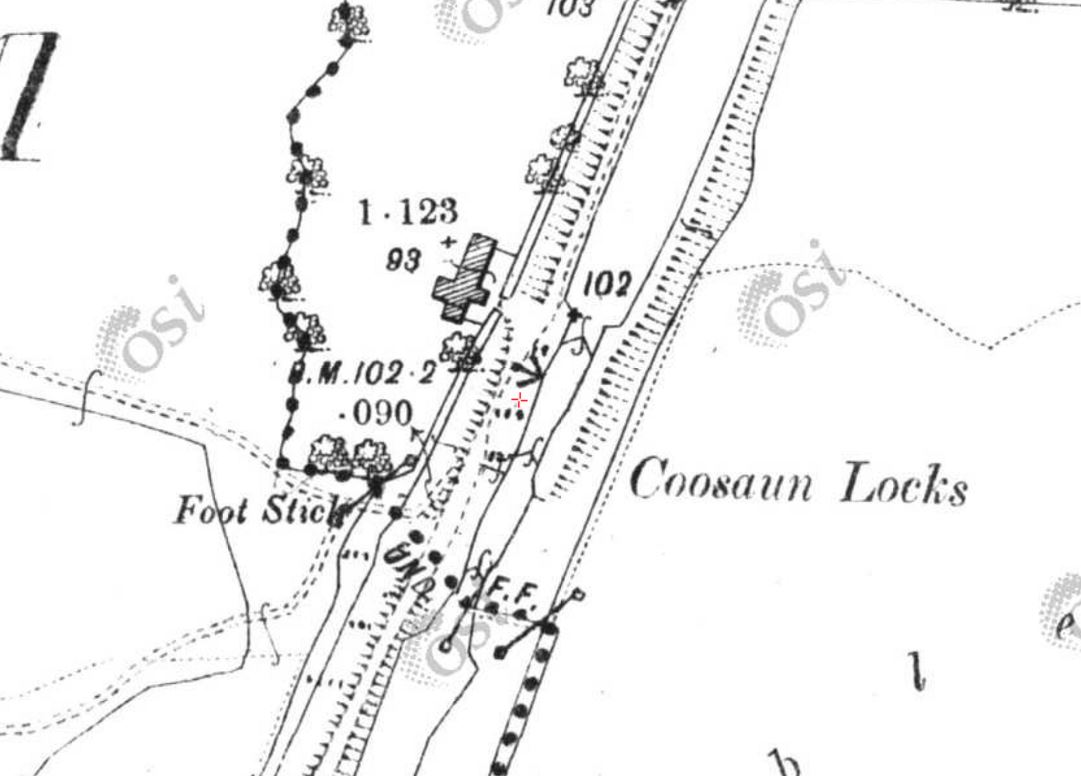
Cussane or Coosaun Lock was the lowest of three on the Killaloe Canal, which was the uppermost section of the Limerick Navigation. It was a double lock or “staircase pair”.

Cussane Lock (OSI ~1900)

Cussane Lock (OSI ~1900)


You can see what the lockkeeper’s house looked like in 2015 in the article “A Flooded Landscape Revealed“, written by folk who surveyed the area last year for Irish Water.

My OSI logo and permit number for website

An aerial view of the Shannon

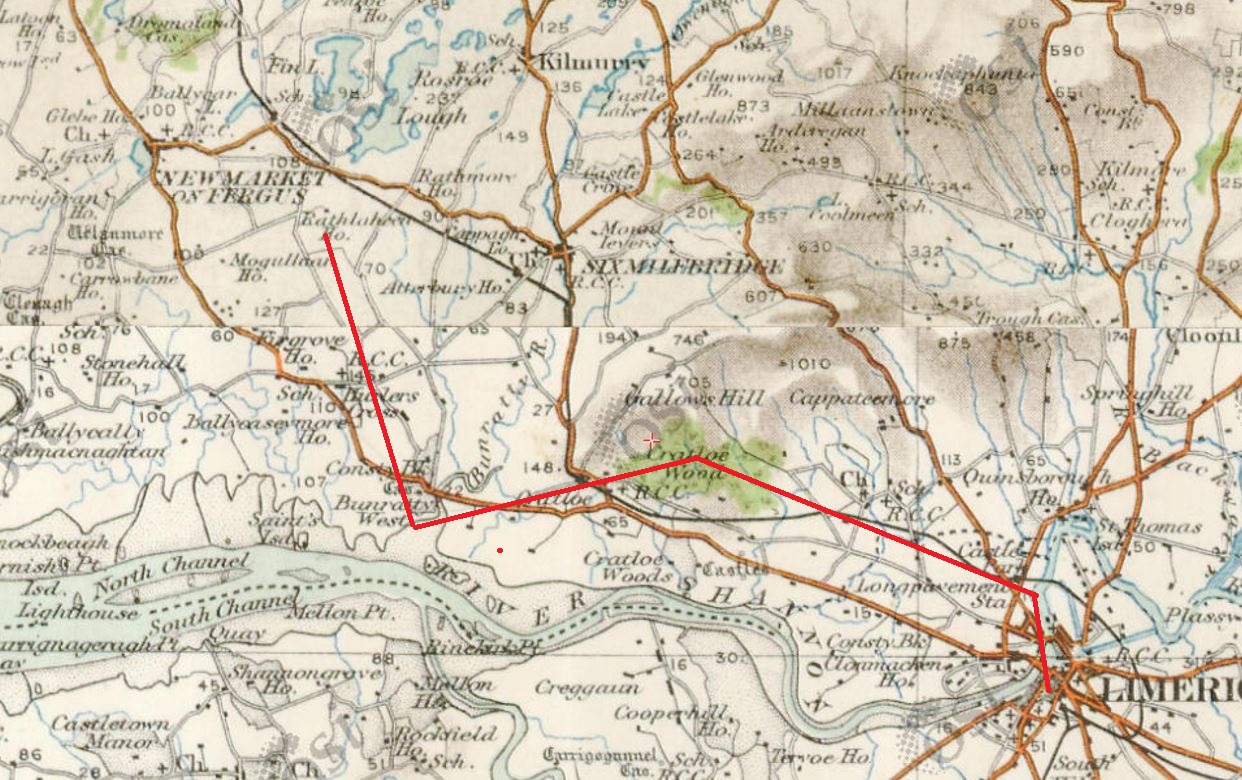
I had much pleasure in availing myself of an ascent in Mr Hampton’s Balloon on Monday, accompanied by that gentleman and Mr Townsend. At two minutes to five, all the necessary arrangements being made, the bridling was cast off, and we ascended (apparently to us in the balloon gradually), but having relieved the car of five bags of ballast, which was thrown over, our ascent then became much more rapid.

The course taken by the balloon being at first almost due north we glided beautifully across the Shannon, and found ourselves at twelve minutes after five, at the north side of the river. The balloon, in this position, rested for some minutes, giving us an opportunity of gazing on the grand and magnificent panorama beneath us.

The prospect of Limerick was very extraordinary, every street, lane, and building, being at the same moment distinctly visible, but so apparently diminished in size that it assumed more the appearance of a beautiful miniature model than the actual city; the expanse of view was vastly greater than I anticipated, the various windings of the Shannon, with little interruption, being visible to Killaloe, above which the grand and noble expanse of water on Lough Derg was a prominent feature, flanked on either side with a lofty range of mountains. The view of the lower Shannon was also very attractive, extending far below the Beeves’ tower, and on which was visible one of the river steamers towing, I will not say a large ship, for it appeared no bigger than a turf boat.

We now bent our course towards Cratloe Wood, and at 22 minutes after 5, found ourselves standing right over its centre, the appearance of which was very extraordinary, the trees appearing more like a beautiful mantling of richly-coloured heath, or of short brushwood. Here I took an indication of a barometer, brought up at the request of Mr Wallace, the proprietor of the Observatory, for the purpose of getting for him its indication at the greatest altitude, and by which I found we were still ascending, soon getting us into another current, floating the balloon gradually towards the Shannon; and, at 30 minutes after 5, we found ourselves over the north bank of the river, opposite the Maigue.

The flight of the balloon (OSI ~1840)

The flight of the balloon (OSI ~1840)

There, by indication of the barometer, it appeared we attained our greatest altitude, being then 4261 feet above the level of the river. The country beneath, from this great height, much resembled one of the Ordnance Survey maps. Undulations of the ground, except hills and mountains at a distance, not being visible, and large fields looking not much bigger than pocket-handkerchiefs; nor could I help thinking what a sad waste of land there was under stone walls, making such varied subdivision of property, and being much more numerous than I had any idea of.

At this altitude the atmosphere was so rarified that Mr Townsend felt his respiration considerably affected, which, under such circumstances, is very usual, though I did not experience it.

I was particularly attracted in this place, as would be supposed of perfect tranquillity, removed from the busy world, to find the buzz or murmuring sound of those beneath us (though, I need hardly say, invisible) ascend and fall on the ear distinct, though faintly, being different from any sound I ever before experienced, and but ill-conveyed by my inadequate description.

I found we had now got into another current diametrically opposite to what had been our last travelling, having taken a rapid course in the direction of Ennis. The barometer indicating a gradual descent, at 45 minutes after 5, Mr Hampton deemed it advisable to prepare for his descent, the country wearing a favourable aspect for doing so, and here he first worked the valves for that purpose; so that our descent and progressive movement now became very rapid.

And at two minutes to six we once more came in contact with terra firma; the car first striking obliquely two walls about 5 feet high, of dry masonry, being at either side of a road or bye way, through which it made a clean breach to the very foundation; the car, after passing through the breach, again oscillated, and found its resting place in a pasture field at the foot of Ralahine demesne, about three miles from Newmarket-on-Fergus, where we were quickly surrounded by a large peasantry, showing forth their true national characteristic generosity, for they not alone gave their most anxious aid in the saving of the balloon, and its various appendages, but many offered their horses to bring us into Limerick. Mr Creagh, I should also add, was most polite, having invited us to Ralahine, to partake of his hospitality.

I hope it may not be considered presumptive of me to state, from my slight knowledge of mechanical operations, that I consider Mr Hampton a perfect master of the management of a balloon, so far as practicable, and is, I feel, owed a debt of gratitude by the citizens of Limerick, for the very great treat which he has afforded them.

Hampden W Russell

Limerick and Clare Examiner 8 September 1849 in the British Newspaper Archive

Background

On Tuesday 21 August 1849 the Southern Reporter and Cork Commercial Courier announced that “Mr Hampton, the aeronaut” had arrived in Limerick and was preparing to ascend thence in his balloon, the Erin go Bragh. It was not his first flight from Limerick: he had ascended in October 1846, when the necessary gas (£14 worth) seems to have been sponsored by the “Limerick Gas consumers company” [Limerick Reporter 6 and 13 October 1846].

The 1849 ascent was on Monday 3 September from Mr Marshall’s Repository, Upper Cecil Street, and was advertised in advance. According to the Limerick and Clare Examiner of 29 August 1849, the “Splendid Band of the 3d Buffs” was to attend. Ladies and Gentlemen could watch from reserved seats [2/=; children 1/=] in a gallery; Second Places cost 1/=, children 6d.

Mr [John] Hampton offered seats in the balloon’s car to ladies or gentlemen who wished to accompany him; the balloon could lift six people and had two cars, one for descending over land and the other “for Sea-ports, in case the wind should be for Sea”. Those interested could find the fares by applying to himself at 12 Cecil Street or to Mr G Morgan Goggin at 34 George Street.

My OSI logo and permit number for website

From the BNA

White flour

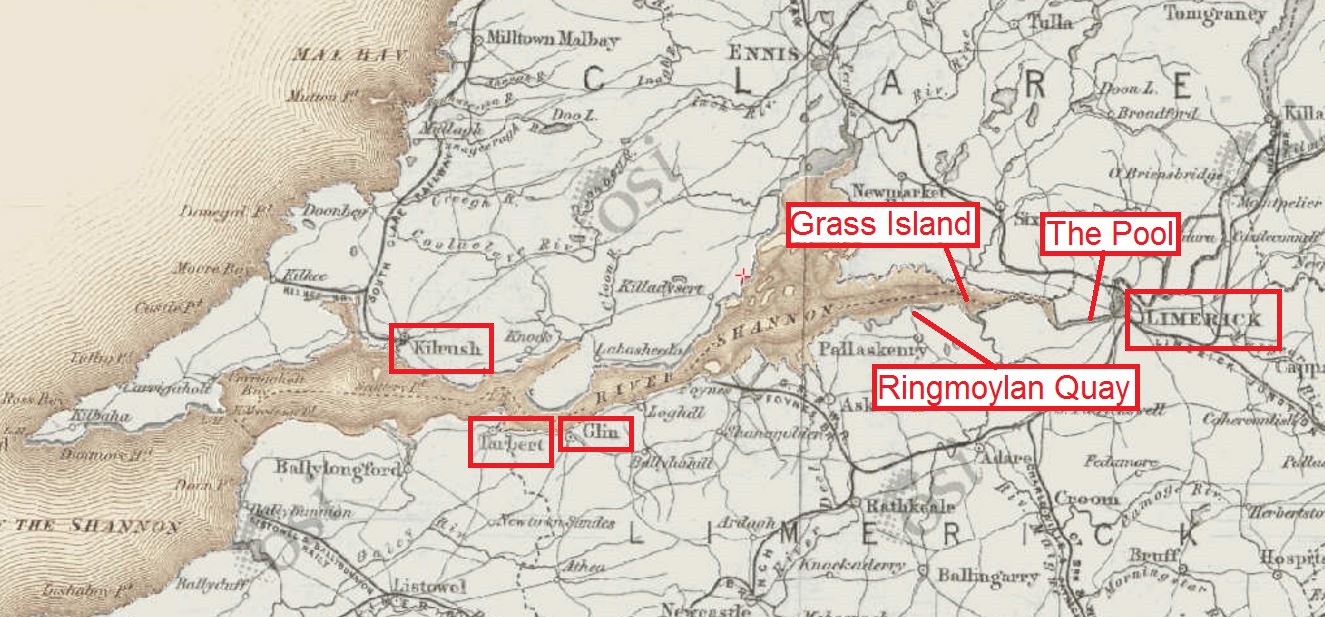
A few minutes past two o’clock in the evening of Wednesday, the 6th instant, the Dover Castle left Glin [that should read Limerick] for Tarbert, with between 30 and 40 persons on board, including some of the Glin police.

shannon-estuary-osi-02

The route of the Dover Castle (OSI 25″ ~1900)

When she reached the pool, she took a large brig and a schooner in tow, which she took as far as Grass Island. She then continued her course, and when about three miles west of Ring Moylan quay, a thick fog came like a wall upon her, so that it was impossible to see half the length of the deck.

Captain White immediately dropped anchor, and was obliged to remain so. The fog continuing all night and the next day.

About two o’clock on Thursday, there being no appearance of the fog clearing off, and several persons on board having eaten nothing since Wednesday morning, two women fainted, and the circumstance having been communicated to the captain, he immediately ordered the steward to open a bag of flour, and served it out in large buckets to the women, who, in a short time, had large cakes made, and baked them for the passengers.

At half-past four o’clock the fog began to clear, and at five the steamer weighed anchor, and reached Kilrush in safety.

Statesman and Dublin Christian Record
19 January 1841 quoting Limerick Standard

My OSI logo and permit number for website

From the BNA

The American and Colonial Steam Navigation Company

What a collection of notables ….

Provisional Committee of 1836

Captain Beaufort RN, Hydrographer to the Admiralty
The Right Hon Maurice A Fitzgerald
Simon M’Gillivray Esq
The Right Hon Lord Talbot de Malahide
George Richardson Porter Esq, Board of Trade
Richard Griffith Esq, Civil Engineer
John David Latouche Esq
Peirce Mahony Esq
Daniel O’Connell Esq
The Hon Frederick Ponsonby
Charles Wye Williams Esq
Christopher Bullin Esq
James Ferrier Esq
James Jameson Esq
Richard Williams Esq
George M’Bride Esq
Francis Carleton Esq

Dublin Mercantile Advertiser, and Weekly Price Current 1 August 1836

From the British Newspaper Archive

From the BNA

A distinguished visitor to the Shannon

Dwarkanauth Tagore, of Calcutta, the distinguished and princely East Indian, who is making a tour of the United Kingdom, arrived in this city, on Tuesday evening with his suit [sic], in an elegant drag with four horses, and he put up at Cruise’s hotel.

The native Prince merchant partook of a dejeune at Killaloe on Tuesday. The City of Dublin Steam Company placed all their vessels on the Upper Shannon, at his command, and they were gaily decorated with flags, in compliment to the distinguished stranger, who left Limerick this day on a visit to Killarney Lakes, and is expected to call at Derrynane, the seat of Mr O’Connell.

Dwarkanauth Tagore dined and slept at Lord Rosse’s, on Monday night, where he examined the prodigious telescope — drove to Banagher, on Tuesday morning, and embarked on board the Lansdown [sic] steamer, proceeded through Victoria Locks Meelick, accompanied by Colonel Jones, and Mr Rhodes CE, also by Mr Howell, Secretary to the Dublin Steam Company. He was much pleased with the new works at Meelick, and also with the operations of a diver in a helmet, who exhibited the mode of using that apparatus.

The dejeune on board the Lansdown was provided by the Steam Company. Several ladies and gentlemen came up by the Lady Burgoyne to join the party of [at?] Portumna in the Lansdown. After partaking of the good cheer, they had dancing and music on deck till they reached Killaloe, much to the amusement of the stranger guest, who felt edlighted, not only with the scenery of the lake, but also with the company of the ladies.

Limerick Reporter 5 September 1845

From the BNA

The PS Clarences

A steamer called the Clarence served on the Shannon estuary in the 1830s. There are different accounts of when she left the Shannon. Here is an attempt at resolving the problem.

Clydebuilt

According to the Clydebuilt database of ships on www.clydesite.co.uk, a paddle steamer called the Clarence was built in 1827 and “launched on” by Robert Napier of Govan. A note to the entry says that this was presumably the same vessel as that listed for Denny.

The Denny entry says that a 70-ton wooden paddle steamer called the Clarence was “launched on” in 1827 by William Denny and A McLachlan of Dumbarton for R Napier. Its owners are listed as R Napier and, from 1829, “Inland Steam Nav Co, Limerick”; it is said to have run between Limerick and Clare Castle on the River Shannon between 1829 and 1840.

Clydeships

The Clydeships database has one entry for Clarence, a wood paddle steamer launched in 1827 by Messrs Lang & Denny of Dumbarton. A passenger vessel, its tonnage is given as 60 nrt, 70 om, 60 nm. Its dimensions are given as

Length 92′ 0″
Breadth 16′ 3″
Depth 8′ 0″
Draft —

Its 45hp beam engine was supplied by Robert Napier & Sons and its first owner was Robert Napier of Glasgow; it served Glasgow, Greenock and Helensburgh. It is said to have been owned by the Carlisle Canal Company (The Carlisle and Annan Steam Navigation Company) from 1839 and used for passenger tendering and for towing between Annan Water-Foot and Port Carlisle. Its dimensions in 1839 are given as 96.9 x 15.1 x 8.0 ft. It went on fire in 1846 and, after repair, was used on the Eastham Ferry service on the Mersey. The Clydeships site does not mention any service in Ireland.

McNeill

D B McNeill, in Irish Passenger Steamship Services Volume 2 South of Ireland (David & Charles, Newton Abbot 1971) says that the Clarence, built in Dumbarton in 1827, was the first steamer on the Shannon estuary [he omits the Lady of the Shannon, the Mona and the Kingstown], having been reported in 1829 as working between Limerick and Clare Castle. He says

Trade must have been bad, for in 1833 she was back on the Clyde working from Gareloch.

He agrees that Clarence was a wooden paddle steamer built in Dumbarton; he gives her dimensions as 92 ft by 16 ft, with a single-expansion steam engine; he says she was broken up around the 1840s.

McRonald

Malcolm McRonald, in his invaluable The Irish Boats Volume 1 Liverpool to Dublin [Tempus Publishing Limited, Stroud 2005], says that the City of Dublin Steam Packet Company operated the Mona on the Shannon estuary in 1829 and the Kingstown in 1830, then abandoned the estuary later in 1830 and resumed it in 1832 [the Kingstown operated on the estuary until at least the end of November 1830 and was there in April 1831]. The service was resumed, McRonald says, “using the chartered Clyde steamer Clarence“, which also operated there in 1833 and 1834.

Clarence was back on the Clyde in 1835, but returned to Limerick by 1837, to operate a service from Limerick to Clarecastle and Ennis. […] Clarence was sold to the Carlisle Canal Co in 1838, but there is conflicting evidence over her date of departure from the Shannon. She was advertised on the Clare service as late as April 1840, although the local Carlisle newspaper had expected her in service there in June 1838. [page 20]

In the fleet lists, McRonald shows the Clarence as having been 96′ 10″ X 15′ 2″ X 8′ 0″, 70 gross tons, made of wood, with a 45hp condensing steam engine. She was built, he says, in 1827 by James Lang of Dumbarton, for Robert Napier of Glasgow, who also provided the engines. She was chartered to the City of Dublin Steam Packet Company from 1832 to 1839, then sold to the Carlisle Canal Co.

One or two?

The accounts by McNeill and McRonald suggest that there was a single steamer called the Clarence, which moved to the Shannon in 1829 [McNeill] or 1832 [McRonald], then to the Clyde in 1833 [McNeill] or 1835 [McRonald], then back to the Shannon in 1837 before being sold to the Carlisle Canal Company in 1838 or 1839 [McRonald]. McRonald does note, however, that the Clarence was advertised as running on the Shannon in 1840.

Steamers did move between stations and owners or operators, and could thus serve in two areas in the same year. However, I think that the evidence of the Clarence‘s activity on the Shannon is strong enough to show that there must have been two steamers with that name: one which started on the Clyde and was bought by the Carlisle Canal Company in 1839, the other serving on the Shannon until 1841.

The years 1833 to 1837

McNeill says that the Clarence was back on the Clyde in 1833. The Morning Post of 27 August 1833 quoted the Limerick Chronicle of 21 August 1833, which said that the Clarence had carried Captain Brown’s company of the 28th Regiment from Limerick to Kilrush on the previous day; it had also carried some detachments to the forts of Tarbert and Carrig Island. There are similar reports for July and September.

McRonald says that the Clarence operated on the Clyde between 1835 and 1837. Yet she is shown operating on the Shannon in City of Dublin Steam Packet Company ads for June, July, August and October of 1835, for every month in 1836 and for every month in 1837.

From 1838 onwards

To judge by the local newspapers, it was in 1839, not 1838, that Carlisle acquired a Clarence steamer. The Carlisle Journal of 12 January 1839 said that the canal company and the two steam companies had purchased a steamer called Clarence from Robert Napier of Glasgow: 96′ X 16′ X 8′ depth of hold, with a 45 hp engine and very handsome cabins, being “fitted up entirely for passengers”, although she was intended to tow lighters too. She was having an overhaul and a new boiler and was expected in Carlisle in two or three weeks.

On 23 February 1839 the Carlisle Patriot carried an ad seeking a master for the Clarence; it seems that Thomas Maling got the job, as the Patriot named him as master in its report, on 20 April 1839, of a collision involving the Clarence. On 1 July 1839 she took fifty gentlemen — the Managing Directors of the Carlisle and Newcastle Railway, the Commissioners of the Nith Navigation, the members of the two Carlisle and Liverpool steam navigation companies, all invited by the Commissioners of the Carlisle Canal Company — on a voyage of inspection of the buoyage of the Solway. Dinner was provided by Mr Gray of the Coffee House but, after the meal, the toasts and the speeches, several of the gentlemen were seasick on the way home. The voyage was reported in the Ayr Advertiser, or West Country Journal on 4 July 1839 and in the Carlisle Journal on 13 July 1839.

It is clear, then, that there was a Clarence on the Solway Firth in 1839. However, both during and after 1839 the Clarence continued to be advertised as serving on the Shannon. A long-running series of ads promoted “Cheap travelling between Dublin and Limerick” using the boats of the Grand Canal Company from Dublin to the Shannon and the steamers of the City of Dublin Steam Packet Company on the inland Shannon and its estuary. The estuary section began

GARRYOWEN, KINGSTOWN AND CLARENCE
Steamers on the Lower Shannon

The ads appeared in many Irish newspapers and the series ran until 13 March 1841 when it appeared in the Warder and Dublin Weekly Mail. The ads were not updated to reflect seasonal changes in the estuary steamers’ sailings, but a paragraph about the service from Limerick to the town of Clare [now Clarecastle, near Ennis] was dropped in 1840. That presumably signified the ending of the service, but the Clarence continued to be listed amongst the estuary steamers until the ad’s final appearance in March 1841.

Up to December 1840, the City of Dublin Steam Packet Company ran its own series of ads, promoting its Irish Sea as well as its inland services, and listing its vessels. The list included the Clarence and the Kingstown amongst those “Plying on the Shannon”, for instance in the ad in the Dublin Weekly Herald of 12 December 1840. That ad does not seem to have been used in 1841.

The company also advertised in local newspapers: in 1839 the Clarence was mentioned in ads in the Clare Journal, and Ennis Advertiser on 2 May, 2 September, 7 October and 16 December. The same paper mentioned the Clarence in news reports on 30 May 1839 and 7 May 1840.

In 1841 the City of Dublin Steam Packet Company bought the Dover Castle from a rival operator on the Shannon estuary; its new-built iron steamer Erin go Bragh also joined the estuary fleet. The Clarence and the Kingstown seem to have left the estuary service at or around that time, the Clarence going first: the company’s ad in the Limerick Reporter of 9 March 1841 mentions the Kingstown and the Garryowen but not the Clarence.  By 11 May 1841, ads in the same paper listed the Garryowen and the Erin go Bragh; the Kingstown was no longer mentioned.

I have not been able to find any information about the history of the Clarence before it came to the Shannon estuary or after it left the estuary service. However, because there is so much evidence that a Clarence was still in service on the estuary after a Clarence was bought by the Carlisle Canal Company, I cannot accept that the two Clarences were the same vessel. I believe that there must have been a Shannon Clarence as well as a Clyde/Carlisle Clarence.

Sources

The newspapers referred to here were found on the British Newspaper Archive, a service is owned and run by Findmypast Newspaper Archive Limited in partnership with the British Library.

Gunboats at Banagher

The gun boats — extraordinary affair

From our own correspondent, Dublin, Dec 11

You may remember a statement I sent last week, respecting the arrival of the Penelope war steamer, with six gun-boats of formidable calibre, which were sent down by the Grand Canal to Banagher, in order to guard the pass across the Shannon between Leinster and Connaught. A letter which I have seen this morning, from that place, announced that the gun-boats reached their destination, but, strange to say, no one can be induced to come forward and take charge of them. All persons in authority, who had been applied to, disavowed all responsibility regarding them; and an application has been made to the Castle on the subject, to ascertain what is to be done with these formidable gun-boats. The wisest course would be to take them back to the dock-yard from whence they have been imported.

Morning Chronicle 13 December 1843

From the BNA

Holiday tours in Ireland VII

On Lough Derg

There are two Lough Dergs in Ireland. One is in the County of Donegal, within four and a half miles of Pettigoe, and is celebrated for its St Patrick’s Purgatory. The lake is but six miles long and four miles broad, and can hardly vie for scenery with its namesake in the south.

In order to reach this, probably one of the most exquisitely beautiful loughs in Ireland, it is necessary to make for the town of Killaloe. This can be done by leaving Euston at a quarter-past ten at night, when Killaloe is reached by 3.10 the following afternoon; or should the tourist prefer the Irish mail, he can leave at a quarter to nine in the evening and arrive at Killaloe at half-past eleven the following morning.

Few Irish towns contain so many antiquarian relics, combined with such beautiful scenery, for Killaloe stands on a hillside tufted with wood and surrounded by mountains. The old cathedral occupies the site of a church founded by St Dalua, in the sixth century. The present building dates from the twelfth century, with a central square tower whose effect is somewhat spoiled by a  modern crown. Its gem is a Hiberno-Romanesque doorway, which has, unfortunately, been blocked into the south wall of the nave. The precincts also contain a small stone-roofed church, said to date as far back as the sixth century.

The fishing is generally extremely good, though many prefer Castleconnell, some five miles to the south on the road to Limerick. In any case few portions of the United Kingdom furnish better salmon fishing than that reach of the river Shannon that lies between Killaloe and Castleconnell.

Lough Derg must, however, remain the greatest attraction of the district. It is twenty-three miles in length, and varies in breadth from two to six miles. Nothing can surpass the loveliness of the scene, especially on a fine summer’s day. On the one side the well-wooded and smiling hills of Limerick and Tipperary, where Thomthimia, with its slate quarries, slopes down to the water’s edge; while on the other the darker and more rugged mountains of Slieve Bernagh, Ballycuggeren, and the Crag form the most effective contrast.

Kincora was once the residence of Brian Boroimbh, King of Munster, and its magnificence was long the main theme of the ancient bards. But little now remains of the ancient palace beyond a long circular earthen fort, with a single vallum some twenty feet in height.

Inishcaltra or the Holy Island is, however, well worth a visit, and for this purpose it would be better to utilize the local service from either Scariff or Killaloe to Mountshannon, which faces the island. It possesses a round tower some eighty feet high, and seven churches, or cells, and oratories, the most remarkable of which is that of St Caimin, originally erected by him in the seventh, but subsequently rebuilt by Brian Borombh in the tenth century.

Scariff may this year be approached by steamer, and is a very prettily situated village, within access by road of Woodford, in County Galway, and Ennis in County Clare. The steamer then crosses the lake to Dromineer, at the mouth of the Nenagh river, where the ruins of the castle stand out with such picturesque effect. The bay is one of the most popular resorts, both of the angler and of the yachtsman; for to the latter it has earned a well-deserved reputation for its annual regatta.

The steamer then stops at Williamstown while a boat from Kilgarvan occasionally lands passengers and conveys them to the steamer. As soon as the new jetty has been constructed by the Board of Works, Woodford will be equally accessible; but there is no doubt that the approach to Portumna pier at the head of the Lough, lying as it does between the well-wooded demesnes of Portumna Castle on the one side and Belleisle and Slevoir on the other, presents one of the finest pictures that the lake discloses, for there we see the most striking contrast between the tame verdure of the river Shannon and the bold mountain scenery of Lough Derg.

It would be tedious to dwell on the varied beauties of those innumerable seats that dot the shores of the lake on all sides; suffice it to say that few parts of the United Kingdom present as many diverse attractions as this wide expanse of water. Much as one may appreciate Loch Lomond, Loch Maree, or the Caledonian Canal, this Irish lough certainly surpasses them; and much gratitude is due to the Shannon Development Company for bringing within such easy access of the average tourist a wealth of scenery that certainly equals, if it is not finer, the finest spots that either Scotland, Norway, or Switzerland can offer.

This is, however, but half the trip from Killaloe to Athlone. Portumna is chiefly remarkable for the ruins of a Dominican priory founded in the thirteenth century, as well as for the Castle, the property of Lord Clanricarde, in which he has not resided since his succession to the estate. The village of Lorrha, three miles further up, also contains the ruins of a Dominican abbey, an oblong pile 120 ft long, as well as a castle and two old ecclesiastical buildings called by the peasantry the English churches, owing to their having been built by Norman settlers.

The river now assumes a totally novel character, winding by graceful curves through low-lying but rich meadow lands. Their luxuriant appearance is largely due to the fact that they are usually submerged under the waters of the river during the winter months.

Meelick Abbey is next passed. It was founded by the Franciscans in the twelfth century, and was at one time a sumptuous structure, but is now a roofless and mouldering ruin; and a beautiful pillar which formerly supported the arches on the south side has been torn away with ruthless vandalism, in order to make headstones for the graves in the cemetery.

Banagher can boast of a fine stone bridge, opened some fifty years ago to replace the preceding structure, which displayed no less than twenty-three arches of various forms, with massive piers between, and was so narrow that only one carriage could pass at a time.

Shannon Harbour is best known from the description of its hotel in Lever’s Jack Hinton, but that building is now let in tenements. Shannon Bridge is one of the three fortified passes built to guard the Shannon, and is but four miles from Clonfert, whose cathedral, now being restored, contains one of the finest Hiberno-Romanesque doorways to be found in the three kingdoms.

Few spots, however, offer greater attractions to the antiquary than do the celebrated seven churches of Clonmacnoise. The most remarkable of these are the Diamhliag Mhor or Great Church, which dates from the fourteenth, and Fineens Church, built in the thirteenth century. The former was originally the work of Flann, King of Ireland, in 909, and contains several bits, more especially the sandstone capitals of the west doorway, that may be traced to the earlier period. Besides these churches, there is much to be seen at Clonmacnoise, which includes among its ruins the episcopal palace and castle of the O’Melaghlins, a nunnery, two round towers, Celtic crosses, and inscribed stones. The grand cross, formed of a single stone 15 ft high and elaborately carved, surpasses every other in beauty of execution and elaborate detail.

Though the tourist may gaze upon Clonmacnoise as he approaches and leaves it and enjoys a particularly fine view of its beauties as he passes by the curve of the river on whose banks it is situated, no provision has yet been made to enable him either to land or to make a closer acquaintance of its many beauties as he passes by. This is due to the refusal on the part of its proprietor to meet the proposals of the company. It is, however, to be hoped that more favourable terms may be made in the future, as the traveller must now proceed straight to Athlone and visit the ruins from there either by road or by water.

Much more might be said of Lough Derg as well as of the Shannon from Killaloe to Athlone. Fair hotel accommodation may be obtained at Killaloe, Dromineer, Portumna, and Athlone at from eight to nine shillings a day. Lodgings can also be procured at Killaloe, where the proprietors have learned to cater for the requirements of those anglers who frequent this highly-favoured spot.

Return tickets may be obtained from Euston to Killaloe by the North Wall at
£4 13s 6d first, £2 16s second, and £2 third class. Lough Derg may also be visited from Athlone by the Midland Great Western Railway from Broadstone. The fares by Kingstown and the mail are somewhat dearer.

Pall Mall Gazette 1 August 1898

From the British Newspaper Archive run by Findmypast Newspaper Archive Limited, in partnership with the British Library.

Special Agent O’Brien

Synan Meehan, who absconded from Kilrush with £76, and was apprehended in Liverpool by Mr P O’Brien, the Dublin Steam Packet Company’s [Kilrush] agent, was brought up at the Limerick Police office on Thursday, before T P Vokes Esq, who ordered him to be sent on to Kilrush for final examination, and whither he proceeded by steamer in charge of two policemen. When arrested in Liverpool, he was in a state of intoxication, and but a few shillings were found in his possession. He stated that in February last he lost £30, which he had to make good every month when closing his accounts, and fearing it would be discovered he was induced to make off. The offender was regarded in Kilrush as a strict teetotaller, but having violated his solemn pledge to Father Mathew, little confidence could be reposed in him.

Southern Reporter and Cork Commercial Courier 12 August 1845

From the British Newspaper Archive run by Findmypast Newspaper Archive Limited, in partnership with the British Library.