Category Archives: Ireland

Lough Neagh to Carlingford Lough

Thanks to David Davis for the link to this video, following the water route from Lough Neagh by the Upper Bann, the Newry Canal and the Newry Ship Canal to Carlingford Lough.
Hunting the Lough Derg monster

Hunting L Derg monster 02_resize

The hunter scans the deep

Hunting L Derg monster 06_resize

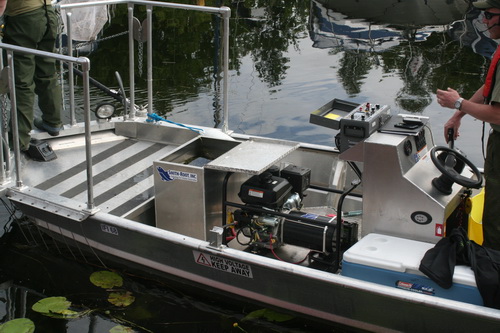
The techie bit, probably to power the harpoon gun

Hunting L Derg monster 07_resize

Thar she doesn’t blow

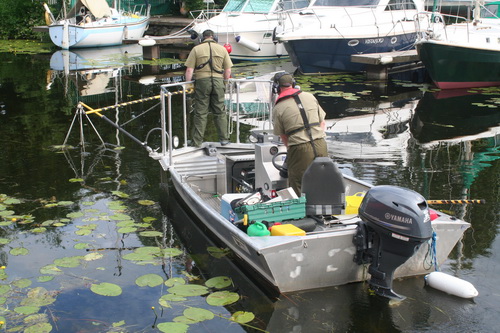
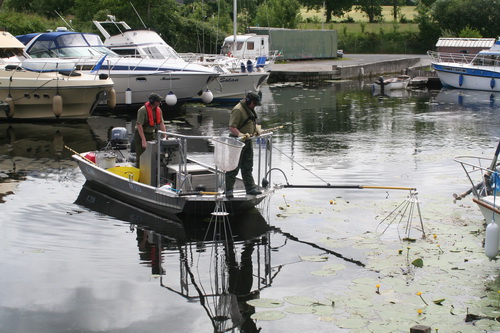
Who are these chaps? What are they doing? Why are they doing it in a marina on Lough Derg? Are they inserting large numbers of volts into the water and, if so, what effect might that have on boats? Answer on a postcard, please.

Castle-Connell Regatta

To take place on 1st and 2nd Oct, 1850

First days race

£        s        d

1st For all Four Oared Gigs                                                5        0        0
Entrance                                                                                0       10        0
Second boat to save entrance money

2nd For all First Class Cots                                                3        0        0
Entrance                                                                                0        5        0
Second Boat                                                                          0      15        0

3rd For all Fishing Cots to be rowed down stream and polled back with 2 Polls
First Boat                                                                              2       10        0
Second do                                                                             0       15        0
Entrance Each                                                                     0         2        6

4th For all Cots to be paddled down River with 2 Paddles and polled back with 2 Polls
First Boat                                                                              1       10        0
Second Boat                                                                         0         7        6

Second Day’s Race

First — For all Four Oared Gigs                                       4        0        0
Entrance                                                                                0        2        6
Second Boat to save Entrance Money

Second — For all Fishing Cots to be rowed with
two oars and a paddle                                                        2        0        0
Second Cot                                                                           0       10        0
Entrance                                                                               0         2        6

Third Race — For all Fishing Cots to be rowed
down the river with two oars and paddled
and polled back with two poles                                       1        10        0
Second Boat                                                                        0        10        0
Entrance                                                                              0          2        6

Fourth Race — For all Fishing Cots with
one paddle                                                                           1          0        0
Second Boat                                                                        0          5        0
Six to start or no race

NB No Race for any of the above Plates, unless 3 Boats start.

The decision of the Stewards to be final in all cases, and by whom the distance on the river will be laid out.

Boats for the First Race to start at Ten o’Clock precisely, and to be entered at Mr Wilson’s before Ten o’Clock each day.

An Ordinary at Wilson’s Hotel each day.

There will be a Ball at the Old Assembly Rooms, of which further notice will be given on Saturday.

Stewards

Sir Richard De Burgho, Bart
Colonel Vandeleur
Captain Wyndham 1st Royals
S Vansittart 1st Royals
A Vincent Esq
A W Heard Esq

Limerick and Clare Examiner 25 September 1850

From the British Newspaper Archive run by Findmypast Newspaper Archive Limited, in partnership with the British Library.


Walking the Royal

Great walking match

A CELEBRATED MATCH is now performing by W F Simpson, a Native of Dublin, at RUSSELL-STREET, or JONES’S-BRIDGE, Royal Canal. He purposes Walking

1000 Quarter Miles in 1000 Quarter Hours!

for a Wager of £100 to £50. Such a feat has never been performed by any Pedestrian trained in England.

Admission, 2d each.

Freeman’s Journal 25 September 1850

From the British Newspaper Archive run by Findmypast Newspaper Archive Limited, in partnership with the British Library.

Bedding

A pawnbroker at Kilrush, in the county of Clare, is said to hold nearly 800 feather beds, most of which he is endeavouring to sell, as the terms for which they were severally pledged have expired.

Preston Chronicle 30 June 1849

From the British Newspaper Archive run by Findmypast Newspaper Archive Limited, in partnership with the British Library.

[The earliest mention of this story that I have found is in Bell’s Weekly Messenger 23 June 1849, which named the pawnbroker as Dowling but cited no source. Several other newspapers repeated the item on 30 June and in the week or so following.]

[Slater’s National Commercial Directory of 1846 lists Jeremiah Dowling of 111 Moore st, Kilrush, as a pawnbroker.]

Holiday tours in Ireland VII

On Lough Derg

There are two Lough Dergs in Ireland. One is in the County of Donegal, within four and a half miles of Pettigoe, and is celebrated for its St Patrick’s Purgatory. The lake is but six miles long and four miles broad, and can hardly vie for scenery with its namesake in the south.

In order to reach this, probably one of the most exquisitely beautiful loughs in Ireland, it is necessary to make for the town of Killaloe. This can be done by leaving Euston at a quarter-past ten at night, when Killaloe is reached by 3.10 the following afternoon; or should the tourist prefer the Irish mail, he can leave at a quarter to nine in the evening and arrive at Killaloe at half-past eleven the following morning.

Few Irish towns contain so many antiquarian relics, combined with such beautiful scenery, for Killaloe stands on a hillside tufted with wood and surrounded by mountains. The old cathedral occupies the site of a church founded by St Dalua, in the sixth century. The present building dates from the twelfth century, with a central square tower whose effect is somewhat spoiled by a  modern crown. Its gem is a Hiberno-Romanesque doorway, which has, unfortunately, been blocked into the south wall of the nave. The precincts also contain a small stone-roofed church, said to date as far back as the sixth century.

The fishing is generally extremely good, though many prefer Castleconnell, some five miles to the south on the road to Limerick. In any case few portions of the United Kingdom furnish better salmon fishing than that reach of the river Shannon that lies between Killaloe and Castleconnell.

Lough Derg must, however, remain the greatest attraction of the district. It is twenty-three miles in length, and varies in breadth from two to six miles. Nothing can surpass the loveliness of the scene, especially on a fine summer’s day. On the one side the well-wooded and smiling hills of Limerick and Tipperary, where Thomthimia, with its slate quarries, slopes down to the water’s edge; while on the other the darker and more rugged mountains of Slieve Bernagh, Ballycuggeren, and the Crag form the most effective contrast.

Kincora was once the residence of Brian Boroimbh, King of Munster, and its magnificence was long the main theme of the ancient bards. But little now remains of the ancient palace beyond a long circular earthen fort, with a single vallum some twenty feet in height.

Inishcaltra or the Holy Island is, however, well worth a visit, and for this purpose it would be better to utilize the local service from either Scariff or Killaloe to Mountshannon, which faces the island. It possesses a round tower some eighty feet high, and seven churches, or cells, and oratories, the most remarkable of which is that of St Caimin, originally erected by him in the seventh, but subsequently rebuilt by Brian Borombh in the tenth century.

Scariff may this year be approached by steamer, and is a very prettily situated village, within access by road of Woodford, in County Galway, and Ennis in County Clare. The steamer then crosses the lake to Dromineer, at the mouth of the Nenagh river, where the ruins of the castle stand out with such picturesque effect. The bay is one of the most popular resorts, both of the angler and of the yachtsman; for to the latter it has earned a well-deserved reputation for its annual regatta.

The steamer then stops at Williamstown while a boat from Kilgarvan occasionally lands passengers and conveys them to the steamer. As soon as the new jetty has been constructed by the Board of Works, Woodford will be equally accessible; but there is no doubt that the approach to Portumna pier at the head of the Lough, lying as it does between the well-wooded demesnes of Portumna Castle on the one side and Belleisle and Slevoir on the other, presents one of the finest pictures that the lake discloses, for there we see the most striking contrast between the tame verdure of the river Shannon and the bold mountain scenery of Lough Derg.

It would be tedious to dwell on the varied beauties of those innumerable seats that dot the shores of the lake on all sides; suffice it to say that few parts of the United Kingdom present as many diverse attractions as this wide expanse of water. Much as one may appreciate Loch Lomond, Loch Maree, or the Caledonian Canal, this Irish lough certainly surpasses them; and much gratitude is due to the Shannon Development Company for bringing within such easy access of the average tourist a wealth of scenery that certainly equals, if it is not finer, the finest spots that either Scotland, Norway, or Switzerland can offer.

This is, however, but half the trip from Killaloe to Athlone. Portumna is chiefly remarkable for the ruins of a Dominican priory founded in the thirteenth century, as well as for the Castle, the property of Lord Clanricarde, in which he has not resided since his succession to the estate. The village of Lorrha, three miles further up, also contains the ruins of a Dominican abbey, an oblong pile 120 ft long, as well as a castle and two old ecclesiastical buildings called by the peasantry the English churches, owing to their having been built by Norman settlers.

The river now assumes a totally novel character, winding by graceful curves through low-lying but rich meadow lands. Their luxuriant appearance is largely due to the fact that they are usually submerged under the waters of the river during the winter months.

Meelick Abbey is next passed. It was founded by the Franciscans in the twelfth century, and was at one time a sumptuous structure, but is now a roofless and mouldering ruin; and a beautiful pillar which formerly supported the arches on the south side has been torn away with ruthless vandalism, in order to make headstones for the graves in the cemetery.

Banagher can boast of a fine stone bridge, opened some fifty years ago to replace the preceding structure, which displayed no less than twenty-three arches of various forms, with massive piers between, and was so narrow that only one carriage could pass at a time.

Shannon Harbour is best known from the description of its hotel in Lever’s Jack Hinton, but that building is now let in tenements. Shannon Bridge is one of the three fortified passes built to guard the Shannon, and is but four miles from Clonfert, whose cathedral, now being restored, contains one of the finest Hiberno-Romanesque doorways to be found in the three kingdoms.

Few spots, however, offer greater attractions to the antiquary than do the celebrated seven churches of Clonmacnoise. The most remarkable of these are the Diamhliag Mhor or Great Church, which dates from the fourteenth, and Fineens Church, built in the thirteenth century. The former was originally the work of Flann, King of Ireland, in 909, and contains several bits, more especially the sandstone capitals of the west doorway, that may be traced to the earlier period. Besides these churches, there is much to be seen at Clonmacnoise, which includes among its ruins the episcopal palace and castle of the O’Melaghlins, a nunnery, two round towers, Celtic crosses, and inscribed stones. The grand cross, formed of a single stone 15 ft high and elaborately carved, surpasses every other in beauty of execution and elaborate detail.

Though the tourist may gaze upon Clonmacnoise as he approaches and leaves it and enjoys a particularly fine view of its beauties as he passes by the curve of the river on whose banks it is situated, no provision has yet been made to enable him either to land or to make a closer acquaintance of its many beauties as he passes by. This is due to the refusal on the part of its proprietor to meet the proposals of the company. It is, however, to be hoped that more favourable terms may be made in the future, as the traveller must now proceed straight to Athlone and visit the ruins from there either by road or by water.

Much more might be said of Lough Derg as well as of the Shannon from Killaloe to Athlone. Fair hotel accommodation may be obtained at Killaloe, Dromineer, Portumna, and Athlone at from eight to nine shillings a day. Lodgings can also be procured at Killaloe, where the proprietors have learned to cater for the requirements of those anglers who frequent this highly-favoured spot.

Return tickets may be obtained from Euston to Killaloe by the North Wall at
£4 13s 6d first, £2 16s second, and £2 third class. Lough Derg may also be visited from Athlone by the Midland Great Western Railway from Broadstone. The fares by Kingstown and the mail are somewhat dearer.

Pall Mall Gazette 1 August 1898

From the British Newspaper Archive run by Findmypast Newspaper Archive Limited, in partnership with the British Library.

Northern enterprise

On Friday, 25th ult, the Antrim and Tyrone Lough Neagh Steam Ferry Company’s first boat, the Enterprise, was launched from Port Armagh, on the Tyrone side of Lough Neagh. She is a most beautiful boat, and does great credit to Mr Hiram Shaw, of this town, for his exertions in bringing her out in such fine style. Her engines were built by M’Adam, Currell, and Company, of Belfast.

The Vindicator, Belfast 7 August 1839

From the British Newspaper Archive run by Findmypast Newspaper Archive Limited, in partnership with the British Library.

[Notes: I do not know where Port Armagh is or was. The Enterprise is not mentioned in D B McNeill Irish Passenger Steamship Services Volume 1: North of Ireland Augustus M Kelley Publishers, New York 1969]

The mystery of Mr Worrall

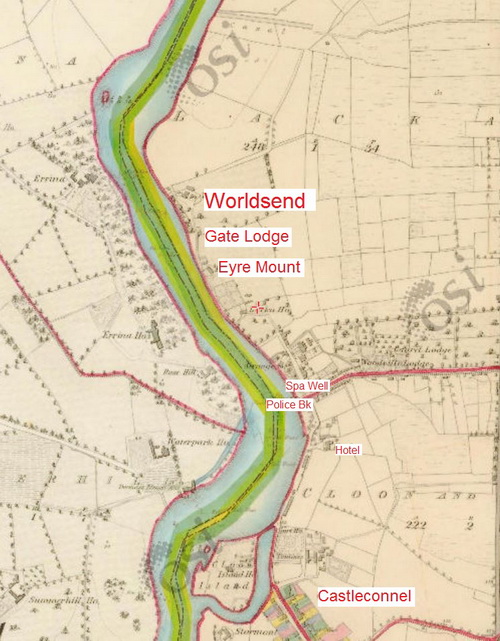
Castleconnell and Worldsend, Co Limerick (OSI 6" ~1840)

Castleconnell and Worldsend, Co Limerick (OSI 6″ ~1840)

The authors of a book called Village by Shannon, about Castleconnell, Co Limerick, say that the area of Worldsend, at the northern end of Castleconnell, derives its name from Worrall’s Inn, an establishment operated by a Mr Worrall in the early eighteenth century.

That may be so, but the book’s accounts of river-borne traffic — to a quay at the inn — do not seem to accord with what is known about the history of the Shannon navigation, and in particular of the Limerick Navigation between the city and Killaloe. Here are some of the problems.

My OSI logo and permit number for website

EPPIc fail

One of the most useful resources for amateur historians, and especially for those without ready access to large libraries, has been the online collection of parliamentary papers on Ireland, the collection known as EPPI: Enhanced British Parliamentary Papers on Ireland.

The collection covers the period from 1801 to 1922 and includes over 14000 documents. It was first made available online by the University of Southampton; I seem to recall that, at first, pages had to be saved or printed on foolscap (13 inches by 8 inches) rather than A4, but that changed at some point and the searchability improved; it was possible to read documents online or to save PDFs. And it was all free: users were not even required to register.

At some point stewardship passed from the University of Southampton to a consortium of Northern Ireland institutions and EPPI became one of three resources within DIPPAM:

DIPPAM is an online virtual archive of documents and sources relating to the history of Ireland, and its migration experience from the 18th to the late 20th centuries.

The institutions with their logos on the DIPPAM home page are Queen’s University Belfast, the Mellon Centre for Migration Studies, Arts and Humanities Research Council, University of Ulster and Libraries NI. According to DIPPAM

The DIPPAM project has taken over the maintenance of the EPPI materials from Southampton, enhanced their usability and filled any gaps in the document run, made them cross-searchable with the IED and VMR records, and restored free global access to users.

Well, yes, up to a point, Lord Copper.

I should say that there is still much to be gained from the EPPI archive and that, as I pay nothing for its use, it is very good value. I would be willing to pay an annual subscription — if that helped to maintain the collection properly. At present, though, it seems to me that the wheels are coming off and the archive is decaying. I have tried to communicate both with EPPI and with Queen’s University Belfast about this; I received replies from neither of them.

I should say too that I have no way of assessing how widespread these problems are. It may be that I am unlucky and that all the documents that don’t interest me are working perfectly. Or it may be that software problems are affecting a small number of users including me, but I find problems using two different browsers on two different computers, both of them relatively powerful and using Windows 10.

Search

I entered

kilrush garryowen

… for the date range 1820 to 1922. EPPI returned no documents.

I then asked Google to find …

eppi kilrush garryowen

… and it found the Second Report of the Railway Commissioners Appendix B No 7, listing the steamer Garryowen serving Kilrush.

Why is it that Google can find things within EPPI that EPPI’s own search engine can’t find?

Reading scans

Parts I and II of the Fourth Report of the second set of Shannon Commissioners are available here and here. Or rather that’s where you’ll find the metadata for the documents. Clicking Open Document should provide the scans here and here.

In both cases, I get a blank with a small icon at top left; clicking that does nothing. Clicking Scan does nothing. The documents may be there, but they are inaccessible.

Reading transcripts

In both cases I can access the transcripts. That requires me to click Next and then to click Transcript, because the system seems to default to showing the Scan page, even though it is invisible.

From Shannon Commissioners fourth report Part II page 4 [(c) EPPI]

From Shannon Commissioners fourth report Part II page 4 [(c) EPPI]

However, I am reluctant to spend too much of my life reading such poor transcripts.

Downloading PDFs

For those and other reasons, I would prefer to download the PDFs.

When I try to download Part I of the report, I get A Bill [as amended by the Committee, and on re-commitment] for the better Regulation of Hospitals, Dispensaries, and other Medical Charities in Ireland dated 23 May 1838.

When I try to download Part II, I am told

Sorry, could not find the download file. Please contact support quoting EPPI document reference 11379.

Minor annoyances

Those are serious problems. I would like them to be fixed.

I would also like to see

  • better navigation through documents: the first page of a scan does not show forward/back or next/previous or equivalent buttons: I have to enter a page number [eg 2]
  • the Enter key accepted to go to a specified page: as it is, I have to click the Go to Page button
  • a full-screen option (as on the excellent British Newspaper Archive) to reduce the amount of scrolling required.

Action

But those are minor matters. The main problem is that EPPI is no longer reliably making documents available as scans or as PDFs. Something has gone wrong within the archive and, as far as I can see, it’s getting worse rather than better. I accept, though, that I can’t properly assess the state of the entire archive, as my interests are limited to certain topics and periods.

I would therefore be glad to hear from others who have recent experience of using EPPI or who have information about what is happening. That includes those running EPPI or DIPPAM and the institutions whose logos appear on the site. This invaluable resource should not be allowed to decay any further.


Travelling

Newry steam-packet

The Waterloo will sail hence for Warren’s Point, This Day (FRIDAY) the 16th instant, at Three o’clock; on TUESDAY the 20th, and SUNDAY the 25th instant.

Dublin steam-packets

The Mountaineer, C H Townley, will sail hence for Dublin, on SUNDAY next, the 18th instant, at Three o’clock.

The Belfast will also shortly resume her station between this Port and Dublin. These being the only Steam-packets which land their Passengers AT THE CITY, by them the Public avoid the dangerous landing at Dunleary in small boats, the hazardous and expensive mode of conveyance thence to Dublin (a distance of several miles), the disagreeable disputes with boatmen, the impositions practised by the lowest order of society, with various other difficulties; against which the complaints are universal.

Days of sailing from Liverpool will be, Sunday, Tuesday, Thursday, and Saturday.

Apply at the Packet-office, bottom of Redcross-street, or to WILLIAM STEWART.

Liverpool Mercury 16 May 1823

From the British Newspaper Archive run by Findmypast Newspaper Archive Limited, in partnership with the British Library.