Category Archives: Ashore

Trigonometry and obfuscation

Every so often Waterways Ireland (whom god bless and preserve) sends out a Marine Notice to warn people of sporting activities, so that they can avoid them, and of one or other of the hazards of the navigations. One such, No 68 of 2016, issued on 9 June 2016, says (inter alia):

The attention of all is drawn to the dangers associated with overhead power lines in particular sailing vessels, sailing dinghys and workboats with cranes or large airdrafts.

Vigilance is required especially in the vicinity of slipways and dinghy parks, while voyage planning is a necessity in order to identify the location of overhead lines crossing the navigations.

ESB Networks emergency number is (353)1850 372 999 and Northern Ireland Electricity Networks is (44) 0800 616 817.

Then on 21 July 2016 Waterways Ireland issued Notice No 89 of 2016, which was specific (as far as WI is concerned) to the Northern Ireland navigations. Extracts:

Many sailboats have masts of 9m (30ft) or more and, as most of these masts are made of aluminium, they are an excellent conductor of electricity. If an aluminium mast or rigging come into contact with or too close to power lines, it could result in a fatality.

NIE Networks advises all boat owners to take some simple precautions to stay safe.

  • Plan your route carefully when transporting your boat to or from where it is being launched, making sure you have adequate clearance under overhead power lines. When you are stepping the mast or erecting long aerials, be sure to do so in an area totally clear of overhead power lines.
  • Once out on the water, if you are sailing on inland waterways or near islands or headlands, you should still look for overhead lines as they do cross over waterways. You must ensure that your mast or aerial has proper clearance from any power lines.
  • Always check your charts when underway to ensure you are aware of the location of overhead power lines.

In order to avoid hitting an overhead power line with a mast, it would be useful to know how high off the water, perhaps at Ordinary Summer Level, the power line was. Then you could subtract from that the height of your mast, and some safety factor, and decide whether you could safely sail under the line.

If you don’t know how high the power line is, you have to resort to trigonometry. My recollection of these matters has perhaps faded a little, but as I recall you stand a small boy of known height on your cabin roof and, with your eye level with his feet, you measure (a) the horizontal distance from his feet to your eye and (b) the angle from the horizontal to a line from your eye that touches the top of the boy’s head and the bottom of the power line. Then the small boy falls off the roof, you have to tack, your pencil falls overboard and it all seems much more difficult than finding the height of a tree. And of course you can’t measure the distance to the power line without sailing up to it, which is what you’re trying to avoid until you can decide whether you can safely do so. [Note: this paragraph is not to be used for navigation.]

Life would, therefore, be much easier (and safer) if you knew the minimum clearance under the power lines. Happily, NIE Networks is happy to tell people what it is; I emailed and a speedy response including this:

The clearance on all NIE Networks overhead power lines which cross over navigable waters is 10.5m (lower bank to line or earth). All overhead power lines are marked on navigation charts for the Erne and Lower Bann waters.

However, it should be noted that this is the clearance for NIE Networks overhead power lines and applicable to Northern Ireland only. Clearances for overhead power lines in the Republic of Ireland may be different and would require confirmation from the Electricity Supply Board (ESB).

Big it up for NIE Networks, then. But over several years I tried unsuccessfully to get the ESB to give me the equivalent information for lines crossing navigable waterways in the republic; it would not do so. Without that information, boaters cannot “ensure that [their] mast or aerial has proper clearance from any power lines”, so ESB’s advice is useless blather.

It is some time since I last asked ESB for information, and perhaps it has since been made available, but I see no sign of it on the ESB website. I would be glad to hear from anyone who can supply reliable information.
Bedding

A pawnbroker at Kilrush, in the county of Clare, is said to hold nearly 800 feather beds, most of which he is endeavouring to sell, as the terms for which they were severally pledged have expired.

Preston Chronicle 30 June 1849

From the British Newspaper Archive run by Findmypast Newspaper Archive Limited, in partnership with the British Library.

[The earliest mention of this story that I have found is in Bell’s Weekly Messenger 23 June 1849, which named the pawnbroker as Dowling but cited no source. Several other newspapers repeated the item on 30 June and in the week or so following.]

[Slater’s National Commercial Directory of 1846 lists Jeremiah Dowling of 111 Moore st, Kilrush, as a pawnbroker.]

Holiday tours in Ireland VII

On Lough Derg

There are two Lough Dergs in Ireland. One is in the County of Donegal, within four and a half miles of Pettigoe, and is celebrated for its St Patrick’s Purgatory. The lake is but six miles long and four miles broad, and can hardly vie for scenery with its namesake in the south.

In order to reach this, probably one of the most exquisitely beautiful loughs in Ireland, it is necessary to make for the town of Killaloe. This can be done by leaving Euston at a quarter-past ten at night, when Killaloe is reached by 3.10 the following afternoon; or should the tourist prefer the Irish mail, he can leave at a quarter to nine in the evening and arrive at Killaloe at half-past eleven the following morning.

Few Irish towns contain so many antiquarian relics, combined with such beautiful scenery, for Killaloe stands on a hillside tufted with wood and surrounded by mountains. The old cathedral occupies the site of a church founded by St Dalua, in the sixth century. The present building dates from the twelfth century, with a central square tower whose effect is somewhat spoiled by a  modern crown. Its gem is a Hiberno-Romanesque doorway, which has, unfortunately, been blocked into the south wall of the nave. The precincts also contain a small stone-roofed church, said to date as far back as the sixth century.

The fishing is generally extremely good, though many prefer Castleconnell, some five miles to the south on the road to Limerick. In any case few portions of the United Kingdom furnish better salmon fishing than that reach of the river Shannon that lies between Killaloe and Castleconnell.

Lough Derg must, however, remain the greatest attraction of the district. It is twenty-three miles in length, and varies in breadth from two to six miles. Nothing can surpass the loveliness of the scene, especially on a fine summer’s day. On the one side the well-wooded and smiling hills of Limerick and Tipperary, where Thomthimia, with its slate quarries, slopes down to the water’s edge; while on the other the darker and more rugged mountains of Slieve Bernagh, Ballycuggeren, and the Crag form the most effective contrast.

Kincora was once the residence of Brian Boroimbh, King of Munster, and its magnificence was long the main theme of the ancient bards. But little now remains of the ancient palace beyond a long circular earthen fort, with a single vallum some twenty feet in height.

Inishcaltra or the Holy Island is, however, well worth a visit, and for this purpose it would be better to utilize the local service from either Scariff or Killaloe to Mountshannon, which faces the island. It possesses a round tower some eighty feet high, and seven churches, or cells, and oratories, the most remarkable of which is that of St Caimin, originally erected by him in the seventh, but subsequently rebuilt by Brian Borombh in the tenth century.

Scariff may this year be approached by steamer, and is a very prettily situated village, within access by road of Woodford, in County Galway, and Ennis in County Clare. The steamer then crosses the lake to Dromineer, at the mouth of the Nenagh river, where the ruins of the castle stand out with such picturesque effect. The bay is one of the most popular resorts, both of the angler and of the yachtsman; for to the latter it has earned a well-deserved reputation for its annual regatta.

The steamer then stops at Williamstown while a boat from Kilgarvan occasionally lands passengers and conveys them to the steamer. As soon as the new jetty has been constructed by the Board of Works, Woodford will be equally accessible; but there is no doubt that the approach to Portumna pier at the head of the Lough, lying as it does between the well-wooded demesnes of Portumna Castle on the one side and Belleisle and Slevoir on the other, presents one of the finest pictures that the lake discloses, for there we see the most striking contrast between the tame verdure of the river Shannon and the bold mountain scenery of Lough Derg.

It would be tedious to dwell on the varied beauties of those innumerable seats that dot the shores of the lake on all sides; suffice it to say that few parts of the United Kingdom present as many diverse attractions as this wide expanse of water. Much as one may appreciate Loch Lomond, Loch Maree, or the Caledonian Canal, this Irish lough certainly surpasses them; and much gratitude is due to the Shannon Development Company for bringing within such easy access of the average tourist a wealth of scenery that certainly equals, if it is not finer, the finest spots that either Scotland, Norway, or Switzerland can offer.

This is, however, but half the trip from Killaloe to Athlone. Portumna is chiefly remarkable for the ruins of a Dominican priory founded in the thirteenth century, as well as for the Castle, the property of Lord Clanricarde, in which he has not resided since his succession to the estate. The village of Lorrha, three miles further up, also contains the ruins of a Dominican abbey, an oblong pile 120 ft long, as well as a castle and two old ecclesiastical buildings called by the peasantry the English churches, owing to their having been built by Norman settlers.

The river now assumes a totally novel character, winding by graceful curves through low-lying but rich meadow lands. Their luxuriant appearance is largely due to the fact that they are usually submerged under the waters of the river during the winter months.

Meelick Abbey is next passed. It was founded by the Franciscans in the twelfth century, and was at one time a sumptuous structure, but is now a roofless and mouldering ruin; and a beautiful pillar which formerly supported the arches on the south side has been torn away with ruthless vandalism, in order to make headstones for the graves in the cemetery.

Banagher can boast of a fine stone bridge, opened some fifty years ago to replace the preceding structure, which displayed no less than twenty-three arches of various forms, with massive piers between, and was so narrow that only one carriage could pass at a time.

Shannon Harbour is best known from the description of its hotel in Lever’s Jack Hinton, but that building is now let in tenements. Shannon Bridge is one of the three fortified passes built to guard the Shannon, and is but four miles from Clonfert, whose cathedral, now being restored, contains one of the finest Hiberno-Romanesque doorways to be found in the three kingdoms.

Few spots, however, offer greater attractions to the antiquary than do the celebrated seven churches of Clonmacnoise. The most remarkable of these are the Diamhliag Mhor or Great Church, which dates from the fourteenth, and Fineens Church, built in the thirteenth century. The former was originally the work of Flann, King of Ireland, in 909, and contains several bits, more especially the sandstone capitals of the west doorway, that may be traced to the earlier period. Besides these churches, there is much to be seen at Clonmacnoise, which includes among its ruins the episcopal palace and castle of the O’Melaghlins, a nunnery, two round towers, Celtic crosses, and inscribed stones. The grand cross, formed of a single stone 15 ft high and elaborately carved, surpasses every other in beauty of execution and elaborate detail.

Though the tourist may gaze upon Clonmacnoise as he approaches and leaves it and enjoys a particularly fine view of its beauties as he passes by the curve of the river on whose banks it is situated, no provision has yet been made to enable him either to land or to make a closer acquaintance of its many beauties as he passes by. This is due to the refusal on the part of its proprietor to meet the proposals of the company. It is, however, to be hoped that more favourable terms may be made in the future, as the traveller must now proceed straight to Athlone and visit the ruins from there either by road or by water.

Much more might be said of Lough Derg as well as of the Shannon from Killaloe to Athlone. Fair hotel accommodation may be obtained at Killaloe, Dromineer, Portumna, and Athlone at from eight to nine shillings a day. Lodgings can also be procured at Killaloe, where the proprietors have learned to cater for the requirements of those anglers who frequent this highly-favoured spot.

Return tickets may be obtained from Euston to Killaloe by the North Wall at
£4 13s 6d first, £2 16s second, and £2 third class. Lough Derg may also be visited from Athlone by the Midland Great Western Railway from Broadstone. The fares by Kingstown and the mail are somewhat dearer.

Pall Mall Gazette 1 August 1898

From the British Newspaper Archive run by Findmypast Newspaper Archive Limited, in partnership with the British Library.

The mystery of Mr Worrall

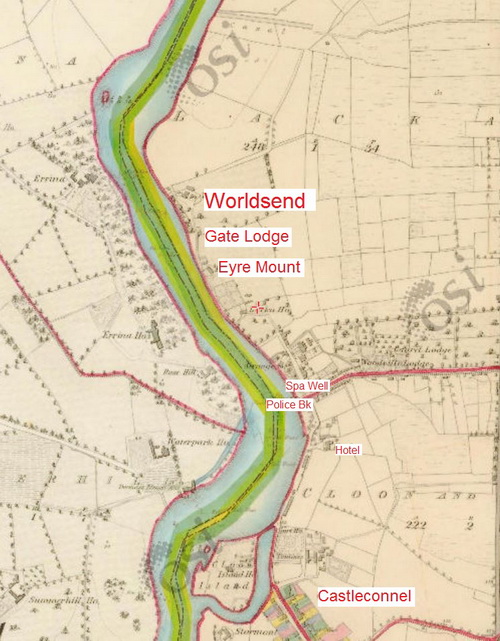
Castleconnell and Worldsend, Co Limerick (OSI 6" ~1840)

Castleconnell and Worldsend, Co Limerick (OSI 6″ ~1840)

The authors of a book called Village by Shannon, about Castleconnell, Co Limerick, say that the area of Worldsend, at the northern end of Castleconnell, derives its name from Worrall’s Inn, an establishment operated by a Mr Worrall in the early eighteenth century.

That may be so, but the book’s accounts of river-borne traffic — to a quay at the inn — do not seem to accord with what is known about the history of the Shannon navigation, and in particular of the Limerick Navigation between the city and Killaloe. Here are some of the problems.

My OSI logo and permit number for website

The purity of the ladies of Limerick

The City of Dublin Steam Packet Company have kindly given the use of the Dover Castle, steamer, to the Ladies of Limerick, for Friday next, when the ceremony of laying the foundation stone of the New Docks will be performed. A band will be on board the steamer.

Limerick and Clare Examiner 4 July 1849

Immediately alongside the spot where the stone was to be placed floated the Dover Castle steamer, filled principally with ladies. The excellent Band of the 74th Highlanders was also on board, and contributed much to the delight that animated many a countenance. Several boats and barges were also provided for the accommodation of ladies. Most of the spectators were invited by Cards issued from the Office of Public Works.

Limerick Reporter 6 July 1849

Loud cheering attested the joy that pervaded every bosom at the prospect of employment, which the ceremony held out. The Dover Castle, moored within a few yards of the large platform, was, as a matter of course, the most attractive appendage. It was occupied by the ladies of Limerick. They, too, evidenced by waving their white handkerchiefs (the symbol of their purity, their virtues and sympathy for the suffering poor) how sincerely they felt the importance of the occasion. A stream of music was then poured forth by the beautiful brass band of the 74th, which was quite in keeping with the general harmony.

The proceedings of the day were then brought to a pleasing and chearful close. The military filed off; the Artillery withdrew; the masts and pinnacles became deserted; the groups, about the ground, dissolved; the Corporate functionaries retired; the mace-bearer beat a modest retreat; the ladies were led off by their attendant squires; the people wended their way homewards, the boats disappeared, and the Dock works and ground were left to the sole possession of their ordinary occupants.

May we not hope — at all events, let us pray, that yesterday was an auspicious day for Limerick.

Limerick and Clare Examiner 7 July 1849

From the British Newspaper Archive run by Findmypast Newspaper Archive Limited, in partnership with the British Library.

Crime at Castleconnell

Charles Connors, of Castleconnell, cot builder, has been committed to Killaloe bridewell, for violating the person of a servant girl on Monday morning, at the Doonass side. He crossed the river in a boat, upon the pretence of ferrying her over, and then committed the offence.

Tipperary Vindicator 9 December 1859

From the British Newspaper Archive run by Findmypast Newspaper Archive Limited, in partnership with the British Library.

It hasn’t gone away, you know …

Yes, the Clones Sheugh, one of Sinn Féin’s favourite inland waterways, hasn’t gone away, although SF is now allowing FF to make the running. From the invaluable KildareStreet.com:

Brendan Smith [FF, Cavan-Monaghan]: To ask the Minister for Arts, Heritage and the Gaeltacht the stage of the proposal to restore the Ulster Canal; the funding provided in her Department estimates in 2016 for this project; when this project will proceed to the next stage; and if she will make a statement on the matter.

I suppose he could have read the Estimates himself, but maybe that would be too much to ask. Anyway, his constituency colleague [Heather Humphreys, FG, Cavan-Monaghan] replied:

Government approval to restore a 2.5km stretch of the Ulster Canal from the Shannon-Erne Waterway to the International Scout Centre at Castle Saunderson, Co. Cavan, was granted on 24 February 2015. The project, which comprises three work phases, is being undertaken by Waterways Ireland.

Phase 1, the site investigation work, has been completed. Phase 2, dredging of the River Finn, is in progress. I have been informed by Waterways Ireland that completion of this phase has been delayed as a result of contractual issues but that efforts to resolve these matters are ongoing. It is intended that Phase 3 of the restoration work, the construction of a new bridge and canal section, will proceed following completion of phase 2.

Waterways Ireland has an allocation of €2.7m in its 2016 budget for the Ulster Canal project. This is comprised of €1m from my Department’s capital allocation to Waterways Ireland of €2.689m for 2016, with the balance coming from the organisation’s own resources.

We are, it will be recalled, pretending that the River Finn is part of the Ulster Canal, and that Castle Saunderson, that shrine of Ulster Unionism, was on the canal’s route: we don’t want to upset the shinners, so say nothing to them.

Quite why folk are expected to want to visit the scouting establishment now on site I do not know; boating does not seem to be amongst the activities offered.

Castle-Connell

The celebrated Chalybeate Spa of Castle-Connell will be open to the visitors this season gratis, by order of Sir Richard de Bourgho, Bart, the youthful proprietor of that beautiful resort.

Clare Journal, and Ennis Advertiser
14 May 1840

From the British Newspaper Archive run by Findmypast Newspaper Archive Limited, in partnership with the British Library.

Kilkee Bathing

The Fashionable Lounge and Temple of Fancy

Mr J Ely has now open for inspection at Russell’s Lodge (next the Post-office) a splendid Fancy Bazaar, consisting of Parisian, Geneva, Vienna, and Berlin

fancy goods,

which for taste and fashion may safely challenge comparison with the assortment of Paris and London. The splendid Stock of elegant Articles is such as cannot fail to gratify the taste of the most curious; but puffing not being the custom of the Proprietor, he will feel obliged by an early visit — occular demonstration being the best proof.

This elegant Stock comprises Musical Clocks, with Fountains; Alabaster Clocks, Musical Boxes, playing from two to twelve tunes each; Accordians of all sizes; a magnificent collection of Dresden China, with Flemish Paintings; a large assortment of newly invented Dresden Mat Glass; American Glasses; a fashionable assortment of Bracelets, Snaps, and Crosslets; a truly splendid assortment of the very best manufactured London Jewellery, best Sheffield Plate, finest Persian Perfumery, and a great number of other Articles too numerous to mention; also a large quantity of German Silver Plate, which the Proprietor pledges himself are of the very best description, imported by him from the Continent.

NB — The Proprietor begs to state the terms on which he disposes of his Goods will be found to be most inducing and advantageous to the public.

(2p)                                                                                  Kilkee, August 15

The Clare Journal, and Ennis Advertiser
20 August 1838

From the British Newspaper Archive run by Findmypast Newspaper Archive Limited, in partnership with the British Library.

Baffled

According to a story in the dead-tree version of today’s Sunday Business Post [and regarded as Premium Content, and thus gated, in the online version],

A €22 million bridge is needed to allow for the construction of 2000 homes on the derelict Irish Glass Bottle site [in Ringsend, Dublin]. […] The necessary bridge over the River Dodder needed to make the site viable will have a lifting mechanism to enable ship traffic into the Grand Canal basin and the Liffey.

The Department of the Environment etc thinks €22 million is too much and would make the houses too dear; Green Party leader Eamon Ryan TD thinks the state should pay for it, presumably to facilitate all the motorists who might want to live on the site.

The site is here. There’s an aerial photo here. Here’s the Google version.

I can’t see why a lifting bridge over the Dodder is needed, unless the plan is to run traffic along a new route from Britain Quay to York Road, which would simply jam up the city centre. Can anyone explain what this is about?